November 6, 2026
Jones Hall
Houston, Texas – USA
Houston Symphony, Emmanuel Tjeknavorian, conductor; Yoonshin Song, violin.
Aram KHACHATURIAN: Selections from Gayane (1939)
Sergei PROKOFIEV: Violin Concerto No. 2 in G minor, Op. 63 (1935)
Dmitri SHOSTAKOVICH: Symphony No. 9 in E-flat major, Op. 70 (1945)
Aleksandr BORODIN / Nicolai RIMSKY-KORSAKOV and Aleksandr GLAZUNOV: Polovtsian Dances from Prince Igor (1890)
Lawrence Wheeler | 9 NOV 2026
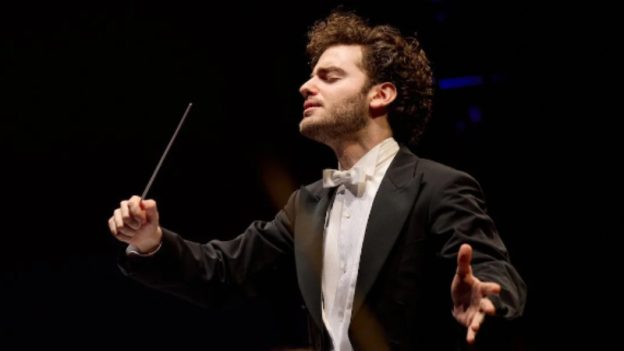
Friday evening, guest conductor Emmanuel Tjeknavorian made his Houston Symphony debut with a program featuring the music of Russia and the former Soviet Union. Houston Symphony concertmaster Yoonshin Song performed Sergei Prokofiev’s Second Violin Concerto. This was a high school night, with several area high schools busing students to Jones Hall. Dressed in their best concert attire, this experience may provide incentive to make symphony concerts a regular occurrence.
It is all too common for politics to enter any discussion of Russian music. Even today, some orchestras and conductors refuse to perform works by Russian composers or engage Russian musicians due to the war in Ukraine. Three works on this program reflect widely differing political perspectives on Russia. Their respective political climates influenced Borodin, Khachaturian, and Shostakovich. Prokofiev, while considered a revolutionary in music, felt music was separate from politics. When Soviet authorities interrogated him about one of his early ballets, he replied, “That concerns politics, not music, and therefore I won’t answer.” Even so, he agreed to write “music that was national in character.”
The program began with selections from Khachaturian’s ballet Gayane. The story centers on Gayane, a patriotic young woman whose husband betrays the Soviet regime and nearly kills her and their daughter. She is rescued by a Red Army border patrol commander. The themes reflect the era’s emphasis on proletarian patriotism and cultural integration within the USSR. In 1941, it was reworked to align with evolving wartime contexts that centered on a young Armenian woman’s internal conflict between personal loyalty and patriotic duty. In 1942, it was again reworked, incorporating Armenian folk motifs with Soviet patriotic elements such as collective farm life, which infused the work with themes of resilience and collective defense. It emphasized ideological motifs of Soviet-Armenian unity against fascism, aligning with state propaganda efforts to boost morale. Revisions continued postwar, making this a score adaptable for political adoption.
Tjeknavorian elected to perform the ever-famous “Sabre Dance” first, even though it is the finale of the ballet. Intended to make an immediate splash, it hinted at questions that surfaced during the course of the concert. Conducting sans score, Tjeknavorian led a dynamic, super-charged rendition. With xylophone doubling the melody, percussion had a workout. It was great fun watching Leonardo Soto’s well-choreographed timpani playing. The cellos joined Ben Freimuth on alto saxophone for an expertly played lyrical melody. (While the symphony program said this was a Houston Symphony premiere, the “Sabre Dance” was recorded 40 years ago with Sergiu Comissiona.)
For the “Dance of the Rose Maidens,” Tjeknavorian found the perfect balance between stately and snappy. The “Mountaineer’s Dance” had punch and drive, with Tjeknavorian maintaining cohesion in the cross-rhythm figure. “Ayesha’s Awakening” opened with a lovely piccolo solo answered by bass clarinet. The following waltz-like dance had lilting violin melodies and harp glissandos. The concluding selection, “Lezghinka,” is a frolicking compound-meter dance featuring an ostinato snare drum with unison flutes and oboes, punctuated by high horns and brass. Tjeknavorian’s brisk tempo, as with the entire suite, is modeled after his own father’s recording of Gayane with the Armenian Philharmonic Orchestra—easily the benchmark.

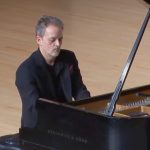
Yoonshin Song.(houstonsymphony.org)
Concertmaster Yoonshin Song’s tenure with the Houston Symphony has contributed to the growth of the violin sections, and by extension the string section as a whole. Her solo appearance this evening was truly impressive—hardly distinguishable from any violin soloist appearing with the Houston Symphony. In the soloist spot, her violin was facing out, revealing a nuanced and tonally gorgeous sound. (It makes one wish she would turn out more in her incidental solos.) Her intonation was impeccable—large shifts and high passages were infallible. She played expressively, with a richly warm vibrato. Her articulations were scrupulously clean—she was always in the right part of the bow. Yoonshin appeared to keep her eyes closed most of the time, using a sideways glance to keep in touch with the conductor in key transitions. Typically sparing with smiles, Yoonshin had a glow about her that invited the listener into her artistic world.
An accomplished violin soloist himself, Tjeknavorian is intimately familiar with the solo repertoire. His fluid hand motions and single-handed conducting style are assets in providing excellent accompaniment. While he maintained fine ensemble, Prokofiev’s rich orchestration was sometimes a bit too much for Yoonshin’s unforced sound. Use of a cautionary left hand would have helped.
(On a personal note, the Houston Symphony premiere of this concerto was given in 1956 by my colleague Fredell Lack, with Leopold Stokowski conducting.)
Shostakovich’s Ninth Symphony is the composer’s inside joke. Reaching a ninth symphony is a big deal for composers. While the most famous is Beethoven’s, there are also those of Schubert, Bruckner, and Mahler.Written in 1945, Shostakovich’s Ninth was promised as a celebration of the USSR’s victory in World War II and a glorification of Stalin’s regime. Instead, it tacitly made fun of the cultural apparatchiks and state pomposity. He did so within a classical form framework, with stepwise progressions contrasting with leaps in melodies. The steps are the unifying motive throughout the five movements.
The violins begin the symphony with a sprightly melody answered by flute and oboe. A trombone interrupts with a pompous two-note figure followed by piccolo. The trombone makes six more interruptions, all at the wrong time. For greater effect, these could have been more incisive. Guest concertmaster David Chan played an energetic solo with the requisite bite. For fun, French horns added a couple of razzes.
The second movement begins with a meandering clarinet solo, tenderly played by Mark Nuccio. Clarinet is joined by a second clarinet and the rest of the woodwinds before dying away. The strings move stepwise in tandem with increasing intensity, followed by flute and piccolo. The piccolo’s long final note was slightly below pitch, but Tjeknavorian did not appear to signal any correction.
The third movement is a Presto in compound meter with compound technical difficulties. It began brilliantly with solo clarinet and three flutes, moving to a trumpet solo played with fanfare by Mark Hughes. With rhythm hanging on each eighth note, there were brief moments of blurred ensemble. A change from a fluid beat to a clear ictus would have offered quick remedy, but that didn’t happen.
The fourth movement brass fanfare was clearly indicated and cohesive. This alternates with two extended bassoon cadenzas that cover the instrument’s full range of pitches and dynamics. Rian Craypo gave a solo that beautifully expressed isolation and resignation. This morphed into the final movement, which begins with a clownish theme. The bassoon serves as an ersatz Pagliaccio—Shostakovich’s alter ego. The music grows and gains speed before a mock march with circus undertones. The coda is a quicker version of the opening tune, now resembling Looney Tunes. Tjeknavorian took it to a brisk finish.
Borodin’s unfinished opera, Prince Igor, was completed by Rimsky-Korsakov and Glazunov. It tells the story of the Prince’s campaign against the invading Polovtsian tribes in 1185. In the opera, he sings: “Let’s march into battle, against the enemies of Russia! For Russia’s glory, I would break my lance in the distant Polovtsian steppes!” The opera has been criticized for aligning with imperialist dogmas. Certainly, they were keenly aware of the presence of the Tsar at the Mariinsky Theater.
The music for Prince Igor was given brilliant orchestration by Rimsky-Korsakov, one of the greatest orchestrators. It is otherwise familiar through the 1953 musical Kismet. You can also hear where Khachaturian got some ideas for Gayane. The “Dance of the Polovtsian Maidens” begins with a woodwind introduction, followed by the appropriated melody “Stranger in Paradise.” This was given tender expression by oboist Ann Leek and Adam Dinitz, English horn. Tjeknavorian took the Polovtsian Dances a notch faster than the score indicated tempo. Remarkably, the woodwinds were able to keep up. While intended to be exciting, it was nearly lost in transition. When all the notes are heard clearly, music sounds faster. Fortunately, the Houston Symphony is a virtuoso orchestra.
Tjeknavorian is unquestionably a talented conductor with a promising future. He has all the requisite musical and technical talent to succeed. It may be that he tries to be liked more than respected. Ideally, a conductor is more collegial than autocratic, but that relationship should never become cozy. Musical corrections need to be made on the fly, without fear or favor. Skilled musicians are accustomed to criticism, which can be both positive and negative. This was an impressive debut. I look forward to next time. ■
The program was repeated Saturday evening and Sunday afternoon.
EXTERNAL LINKS:
- Houston Symphony: houstonsymphony.org
- Emmanuel Tjeknavorian: emmanueltjeknavorian.com
- Yoonshin Song: houstonsymphony.org/musicians/yoonshin-song/

Read more by Lawrence Wheeler.