November 22, 2026
Peachtree Christian Church
Atlanta, Georgia – USA
Todd Skitch, flute; Amy Schwartz Moretti and Helen Hwaya Kim, violins; Catherine Lynn, viola; Charae Krueger, cello; Elizabeth Pridgen, piano.
Max REGER: Serenade No. 2 in G major, Op. 141a, for Flute, Violin, and Viola
Clara SCHUMANN: Three Romances, Op. 22
Johannes BRAHMS: Piano Quintet in F minor, Op. 34
Mark Gresham | 27 NOV 2026
The Atlanta Chamber Players brought together three distinct musical voices in a program that moved from the refined intimacy of Max Reger’s chamber writing to the expansive Romantic expression of Johannes Brahms’ Piano Quintet in F minor. Presented November 22 at Peachtree Christian Church, the concert also included Clara Schumann’s Three Romances, highlighting the considerable gifts of a composer whose achievements were long overshadowed by her reputation as a pianist and by the prominence of her husband, Robert.
The program opened with Max Reger’s Serenade No. 2 in G major, Op. 141a, performed by flutist Todd Skitch, violinist Helen Hwaya Kim, and violist Catherine Lynn. Composed in 1915, near the end of Reger’s life, the work belongs to a comparatively untroubled period of his creative output. After moving to Jena, in the German state of Thuringia, that year, the composer found a degree of personal and professional freedom that encouraged a new emphasis on clarity and transparency.
The instrumentation follows the precedent of Beethoven’s Serenade in D major, Op. 25, written for the same combination of flute, violin and viola. Reger had explored it once before in his Serenade in D major, Op. 77a (1904). Here, the three instruments engage in an unusually delicate conversation, without the grounding presence of a cello or piano. The resulting texture is light but not insubstantial, combining Classical proportions and melodic directness with Reger’s characteristically rich harmonic language.
Its three-movement design follows the traditional fast-slow-fast pattern: a buoyant “Vivace,” a more introspective “Larghetto” and an agile “Presto.” Reger described the music as clear and straightforward, written in the spirit of Mozart — a revealing departure from the denser contrapuntal writing for which he is better known.
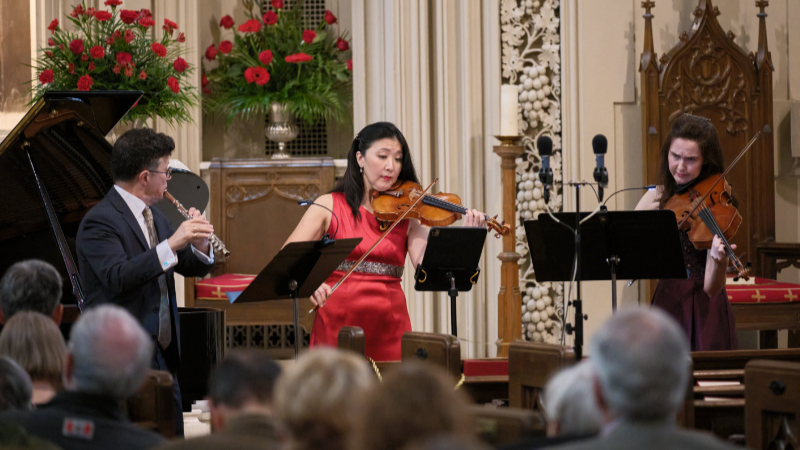
Atlanta Chamber Players perform Max Reger’s ‘Serenade No. 2 in G major, Op. 141a.’ L–R: flutist Todd Skitch, violinist Helen Hwaya Kim, and violist Catherine Lynn. (courtesy of ACP)
The three musicians brought an appealing lightness to Reger’s writing, allowing the instrumental lines to converse without one voice consistently claiming precedence. Skitch’s flute had room to carry the principal melodic material, while Kim’s violin and Lynn’s viola supplied a responsive counterpoint rather than merely accompanying it. The opening movement’s buoyancy came through without sacrificing rhythmic definition. The “Larghetto” provided a welcome change of atmosphere, its more reflective character allowing the players to draw out the music’s lyrical side. In the final “Presto,” they brought the serenade to a nimble close, maintaining clarity even as the musical exchanges became more animated.
Clara Schumann’s Three Romances, Op. 22, shifted the focus to violin and piano, with violinist Amy Schwartz Moretti joined by pianist Elizabeth Pridgen. Composed in July 1853, the three pieces date from a particularly productive period for Schumann, after several years when family responsibilities and her concert career had limited her time for composition.
That year also brought a significant musical friendship with the young Hungarian violinist Joseph Joachim, whose playing inspired the Three Romances. Schumann dedicated the published work to him, and the two subsequently performed the pieces together. The timing carries additional poignancy: Robert Schumann’s mental health would deteriorate seriously the following year, leaving Clara with increasing family responsibilities and little opportunity to pursue composition.
The music itself, however, is not overtly tragic. Rather, the three character pieces trace a progression from the lyrical, somewhat wistful opening “Andante molto,” through the more restless “Allegretto,” to the impassioned energy of the concluding “Leidenschaftlich schnell.” Their writing gives violin and piano equal expressive standing, with the keyboard serving as a genuine melodic partner rather than simply an accompanist.
Moretti and Pridgen approached the three romances as a genuine partnership, with the piano contributing considerably more than harmonic support. Moretti’s violin carried the music’s lyrical thread, but Pridgen gave the piano part sufficient presence to make its independent melodic contributions felt. The opening romance established an intimate, reflective mood; the middle piece introduced a more unsettled character, while the finale brought greater urgency and emotional intensity. The players were attentive to these shifts in temperament, shaping their phrases with evident sensitivity to one another. The result brought out the individuality of the three pieces without losing the sense of a connected sequence.
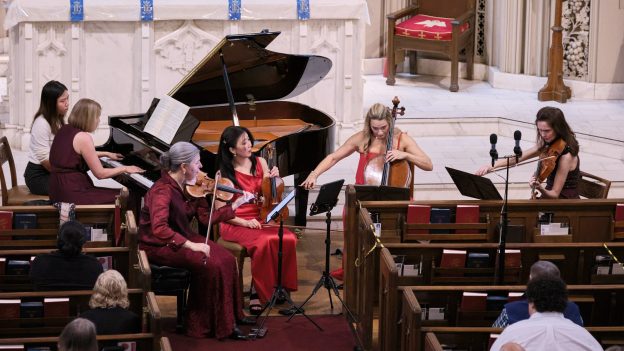
Following intermission, the full ensemble assembled for Johannes Brahms’ Piano Quintet in F minor, Op. 34, with Moretti and Kim on violins, Lynn on viola, Charae Krueger on cello, and Pridgen at the piano. The work brought all five musicians together for the program’s most substantial undertaking, in both scale and expressive ambition.
The quintet had an unusually complicated compositional history. Brahms initially conceived it in 1862 as a string quintet with two cellos, but his friend and violinist Joseph Joachim questioned whether the string ensemble could adequately convey the music’s considerable weight and dramatic force. Brahms subsequently recast it as a sonata for two pianos, which he performed with pianist Carl Tausig in 1864. Clara Schumann, however, felt that this version lost too much of the music’s essential character. She encouraged him to restore the strings, leading to the final combination of piano and string quartet, completed that same year. Her involvement creates an especially interesting historical connection with the preceding work on the program: Clara was not only a distinguished composer in her own right but also an influential musical confidante whose judgment Brahms valued.
The resulting quintet is among the great achievements of 19th-century chamber music, combining the dramatic breadth of symphonic writing with the intricate interplay of five individual instrumental voices. Its four movements range from the turbulent, forceful opening “Allegro non troppo” through the expansive lyricism of the “Andante, un poco adagio,” and the driving energy of the “Scherzo” to a finale that builds from a somber introduction toward an increasingly urgent and emphatic conclusion. The piano often assumes an almost orchestral breadth, yet Brahms continually distributes thematic material among the strings, creating a musical argument in which no instrument remains merely subordinate.
Brahms’ quintet placed greater demands on the ensemble, particularly in balancing the piano’s substantial role against the four string instruments. Pridgen gave the piano part the weight its writing requires without overwhelming the strings, keeping the musical argument distributed among all five players. The opening “Allegro non troppo” established the work’s dramatic character through exchanges that were forceful but generally well defined. The “Andante, un poco adagio” offered a more spacious contrast, giving the ensemble’s lyrical passages room to unfold. The “Scherzo” brought a welcome surge of energy, its rhythmic momentum sustained by a clear sense of collective purpose. In the finale, the musicians shaped the transition from the somber introduction toward the increasingly urgent closing passages with a convincing sense of direction. The movement’s emphatic conclusion provided a fitting culmination to the afternoon.
Taken together, the three works traced an engaging progression through different dimensions of 19th-century chamber music. Reger’s serenade offered a distinctive combination of Classical clarity and late-Romantic harmonic color, Clara Schumann’s romances brought a more intimate lyricism, and Brahms’ quintet extended the musical dialogue into a work of broader dramatic scope. ■
EXTERNAL LINKS:
- Atlanta Chamber Players: atlantachamberplayers.com

Read more by Mark Gresham.