

Mark Gresham | 5 NOV 2022
American composer and conductor Erich Wolfgang Korngold (1897–1957) was one of the most important and influential composers in the history of Hollywood.
Born in Brünn, Austria-Hungary (now Brno, Czech Republic), Korngold was a child prodigy. As an adolescent, he composed a ballet and two one-act operas. At age 23, his full-length opera, Die tote Stadt, premiered in Hamburg and Cologne to great success. He became a professor of music at the Vienna State Academy in 1931, but with the rise of the Nazi Third Reich, and at the request of Hollywood director Max Reinhardt, Korngold moved to Los Angeles, California in 1934 to write film scores, beginning with Reinhardt’s 1935 film A Midsummer Night’s Dream.
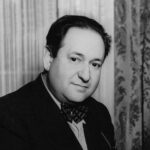
Composer Erich Korngold. (IMDB)
Korngold wrote scores for a total of 16 Hollywood films in all. His score for Anthony Adverse (1936) won an Oscar, but because he was part of the “studio system” it was Warner Brothers Pictures that claimed the prize for his work. Another Oscar came for the score of the 1938 film The Adventures of Robin Hood.
During that time, he refused to publish any of his concert music as long as the Nazi regime remained in power. Even though his Violin Concerto in D, Op. 35, was written during the 30s, he did not publish it until 1945, as soon as World War II was over. It was the first score that he published after the war. Like much of his concert music, it incorporated themes used in his music for motion pictures.
Renowned violinist Gil Shaham returns to Atlanta Symphony Hall next week as guest soloist in Erich Korngold’s Violin Concerto with the Atlanta Symphony Orchestra and guest conductor Hannu Lintu. EarRelevant’s publisher and principal writer Mark Gresham recently talked with Shaham by phone about the Violin Concerto. The Q&A below is drawn from that conversation and is edited for length and clarity.
Mark Gresham: I was listening earlier today to your recording of Korngold’s Violin Concerto that you made with André Previn and the London Symphony Orchestra almost 30 years ago. I know how pieces of music can evolve over time in a performer’s hands. Has your playing of this concerto changed much over the years?
Gil Shaham: I do think I play it very differently today from how I played it back then. At the time, there were very few recordings of the piece and maybe even fewer performances.
I learned of the piece through conductor Yuri Ahronovitch because he asked me to play it with the Jerusalem Symphony Orchestra. It was a concert that never took place. Yuri ended up canceling it. The orchestra and the conductor had never played Korngold before, and they changed the program. So, I never played it with them, but I always loved the Korngold Violin Concerto, so I was always looking for opportunities to play it.
I remember talking about it with André Previn at the time. I suggested it to André and told him how much I loved the piece, and he was all over it. He said, “Yes, we must play and record this music.” He was very excited to do it.
We recorded the Korngold and the Samuel Barber violin concertos. Both were not so well known at the time.
It was fascinating that before we made that recording, I had difficulty programming the Korngold Violin Concerto because people would say, “Oh, we don’t know it” or “We’re not sure there would be an interest in it.” Maybe ten years later, when I would try to get it programmed, people would say, “Oh, we can’t do it because we just had it last season,” so it’s a story of a composer who somehow made a well-deserved comeback.
MG: I’ve noticed many recordings of the Violin Concerto have been made since then, a long list of recordings.
GS: I think it’s true that the Violin Concerto is more often performed now than any of his other pieces.
MG: You say you now play it differently than when you recorded it with Previn. Can you talk about how that has evolved?
GS: You know, I think it has a little bit to do with me, but also the orchestras and conductors I play with. People know the music now. I arrive at the first rehearsal, and everybody already knows the tunes. I’d like to think that we’re doing the music more justice these days than we did back then.
I remember reading about Korngold speaking about the second movement. And he said that, in his mind, he wanted it to sound like a French chanson. Isn’t that beautiful? And somehow, that really stuck with me, but I was playing the piece for maybe 10 years before I heard that quote from him.
I also remember speaking with John Mauceri, and he was talking about the orchestration and how Korngold uses the harp and the vibraphone. It’s like a halo around the violin, so you have the melody with the violin, and it always has this glow, this shine.
The three movements are based on music from films. The first movement is from Another Dawn [1937], the second movement is from Anthony Adverse [1936], and then the third movement is from The Prince and the Pauper [1937]. I saw these movies many years ago, and they’re all wonderful. If anybody has time to see them, I highly recommend them all.
MG: What would you like the audience to take away from the performance?
GS: This concerto does what great music should. It takes a listener on a journey of about half an hour, and at the end, you’re transformed. You feel like you’ve read a great novel or seen a great movie.
I’m thrilled to be back with the Atlanta Symphony Orchestra again and to work with guest conductor Hannu Lintu for the first time. And I couldn’t be more excited to go on stage with one of the great scores by one of the great masters of music. ■
Gil Shaham performs Korngold’s Violin Concerto November 10 & 12 with The Atlanta Symphony Orchestra and guest conductor Hannu Lintu at Atlanta Symphony Hall on a program with The Oceanides by Jean Sibelius and Jennifer Higdon’s Concerto for Orchestra.
EXTERNAL LINKS:
- Gil Shaham: gilshaham.com
- Atlanta Symphony Orchestra: aso.org

Mark Gresham is publisher and principal writer of EarRelevant. He began writing as a music journalist over 30 years ago but has been a composer of music much longer than that. He was the winner of an ASCAP/Deems Taylor Award for music journalism in 2003.


.png)