

April, 2025
Spivey Hall
Morrow, Georgia – USA
Jonathan Biss, piano.
Franz SCHUBERT: Piano Sonata in C Minor, D. 958
Alvin SINGLETON: “Bed-Stuy” Sonata for Solo Piano
Franz SCHUBERT: Piano Sonata in B♭ Major, D. 960
Mark Gresham | 11 APR 2025
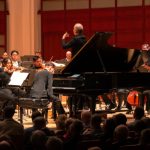
In a recital that bridged early romantic and contemporary expression, pianist Jonathan Biss delivered an evocative performance at Spivey Hall on April 5, 2025. The program featured Franz Schubert’s Piano Sonatas in C Minor (D. 958) and B♭ Major (D. 960) on either side of Alvin Singleton’s “Bed-Stuy” Sonata for Solo Piano (2024). Biss’s interpretations illuminated the intricate dialogues between these compositions, offering the audience a profound journey through time and emotion.
The pairing of Schubert’s Piano Sonatas in C Minor and B♭ Major offered an illuminating glimpse into the breadth and emotional terrain of the composer’s final year. Both written in September 1828—mere weeks before his death—these sonatas stand as pillars of the solo piano repertoire and reflect the duality that often characterizes Schubert’s late works: the tension between dramatic urgency and lyrical resignation, structural clarity and expansive wandering, the mortal and the eternal.
The C Minor Sonata, often described as the most “Beethovenian” of the three final sonatas, is tautly constructed and brooding. It evokes a sense of unease and compression, with motifs that gesture toward struggle, storm, and acceptance through endurance. Its minor key and rhetorical drive makes it a cousin to Schubert’s earlier C Minor works, such as the Impromptu D. 899/1, but here, the architecture is grander, the drama more panoramic.
By contrast, the B♭ Major Sonata is an introspective odyssey. With its otherworldly expansiveness and near-obsessive return to themes—particularly the famous low trill in the opening movement—it seems to exist slightly outside of time. Instead of conflict and resolution, it offers a kind of musical meditation where transitions unfold organically, and episodes linger longer than expected. Many performers and scholars view it not as a farewell, but as a work of transcendence.
To hear both in a single evening is to experience a journey through Schubert’s late imagination, where each sonata complements and deepens the other. It’s also a programming challenge that demands technical command and an interpretive perspective that can map the emotional and philosophical terrain of these deeply contrasting works.
Jonathan Biss has made Schubert a cornerstone of his repertoire, particularly in recent years. His online lecture-recital series Unquiet: Schubert’s Final Year and his recordings of the late sonatas and impromptus have affirmed his reputation as a Schubertian of uncommon insight. In interviews, Biss described Schubert’s late music as music that “can barely stand its own fragility,” and in performance, he gravitates toward its inner tensions rather than its surface beauty.
This sensibility informed his performances at Spivey Hall, with a narrative arc that moved from storm to stillness, compression to spaciousness, and deathward gaze to timeless reflection.
The distinguished American composer Alvin Singleton was born in 1940 in Brooklyn, New York. Based in Atlanta since the mid-1980s, Singleton has a rich and diverse musical background. He completed his studies at New York University and Yale University. As a Fulbright Scholar, he studied with Goffredo Petrassi at the Accademia Nazionale di Santa Cecilia in Rome, Italy. After spending fourteen years in Europe, Singleton returned to the United States, where he served as Composer-in-Residence with the Atlanta Symphony Orchestra from 1985 to 1988, after which he decided to remain in Atlanta. He also held residencies at Spelman College, the Detroit Symphony Orchestra, and the Ritz Chamber Players of Jacksonville, Florida.

Alvin Singleton (credit: Martin Popeláø)
Numerous orchestras and ensembles, including Kronos Quartet, the Boston Symphony Orchestra, and the Cleveland Orchestra, have performed Singleton’s compositions. Most recently, in late February, Emory University’s Department of Music hosted CompFest 2025, which featured Singleton’s chamber quartet In Our Own House, as well as some solo pieces from his Argoru series.
Singleton’s connection to the Bedford-Stuyvesant neighborhood of Brooklyn is deeply personal. Growing up in this close-knit community, he was surrounded by a vibrant musical environment. In an interview with the New York Amsterdam News, Singleton recalled, “Where I grew up, there were a lot of jazz musicians. I had friends in their families, so I used to go to their rehearsals.”
The title “Bed-Stuy” Sonata honors the neighborhood of his youth, although the piece is not programmatic. Singleton has repeatedly made it clear that his composition titles serve only as identifiers rather than descriptive guides to the music’s content and are not intended to depict or narrate. Instead, Singleton urges listeners to engage with the music on its own terms, independent of any implied imagery or storyline.
This concert at Spivey Hall marked the fifth time Biss has performed Singleton’s “Bed-Stuy” Sonata and the first time this reviewer has heard it, and I must say, it’s a “keeper.” At 84 years old, Singleton’s creative powers have not diminished, and this work is a fine example of the composer’s style, with its sophisticated, organic development of musical materials that sometimes surprises but ultimately delivers an expressive arc that holds the attention and is genuinely convincing.
Biss made his Spivey Hall debut in March 2007, and his association with Spivey Hall has been marked by a series of thoughtfully curated programs that resonate with the hall’s discerning audiences. The hall’s intimate setting, stellar choice of available pianos, and superb acoustics provided an ideal canvas for Biss’ artistry, allowing for a profound connection between performer and audience. By pairing the works of Schubert and Singleton in last Saturday’s concert, he offered a program that was both intellectually stimulating and emotionally compelling, reaffirming his stature as a pianist of exceptional insight and sensitivity. ■
EXTERNAL LINKS:
- Jonathan Biss: jonathanbiss.com
- Alvin Singleton: alvinsingleton.com
- Spivey Hall: spiveyhall.org

Read more by Mark Gresham.

.png)