
May 3, 2026
Hodgson Concert Hall, UGA Performing Arts Center
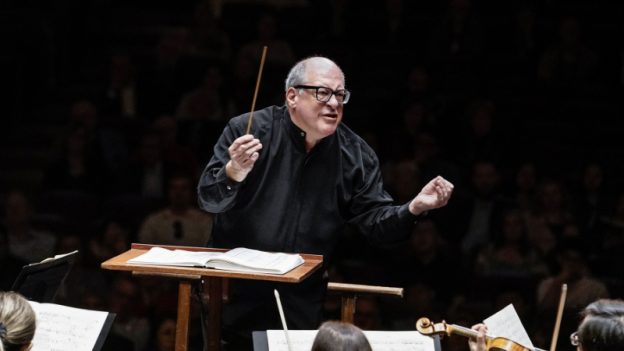
Atlanta Symphony Orchestra, Robert Spano, conductor; Stephen Hough, piano; Kelley O’Connor, mezzo-soprano.
Christopher THEOFANIDIS: On the Bridge of the Eternal
Leonard BERNSTEIN: Symphony No. 1, “Jeremiah”
Sergei RACHMANINOFF: Concerto No. 3 in D minor for Piano and Orchestra, Op. 30
Mark Gresham | 6 MAY 2026
Sunday’s visit to Hodgson Concert Hall in Athens, Georgia by the Atlanta Symphony Orchestra offered more than a touring repeat of its Atlanta subscription program. Under music director laureate Robert Spano, the performance reframed a triptych of works by Christopher Theofanidis, Leonard Bernstein, and Sergei Rachmaninoff as a meditation on time, faith, and identity—an arc that resonated with the University of Georgia Performing Arts Center’s 30th anniversary season and, more broadly, the approaching commemoration of the 250th anniversary of the American Declaration of Independence.
Spano has long been an advocate both of Bernstein’s rarely performed symphonies and the music of Theofanidis, a composer closely tied to the Atlanta Symphony over the years as an original member of Spano’s “Atlanta School of Composers.” That affinity showed in a program whose first half paired two works concerned, in strikingly different ways, with sacred text and existential inquiry.
Theofanidis’ On the Bridge of the Eternal opened the concert. Written during the pandemic, the work draws on a text from St. Augustine’s Confessions, reflecting on the nature of time as something both fleeting and eternally present. Spano shaped the piece less as a conventional overture than as a philosophical prelude, allowing its suspended harmonies and gradual accumulations of orchestral color to unfold with patience. The result was less declarative than questioning: a meditation rather than a statement.
That sense of metaphysical inquiry found a more urgent counterpart in Bernstein’s Symphony No. 1, “Jeremiah.” Composed during World War II, the symphony grapples with Jewish identity, faith, and catastrophe, culminating in a mezzo-soprano setting of the biblical Lamentations. If Theofanidis contemplates time as an abstract continuum, Bernstein confronts history as crisis—prophecy ignored, destruction realized, and grief voiced.
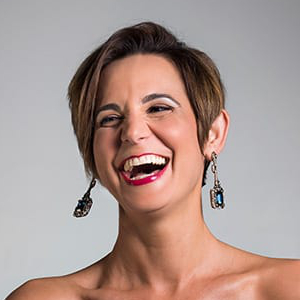
Kelley O’Connor (credit: Ben Dashwood)
Mezzo-soprano Kelley O’Connor delivered the vocal solo of the final movement with focused intensity, her clear tone heard cleanly through Bernstein’s accommodating orchestral texture without sacrificing emotional warmth. Spano resisted overt theatricality, instead emphasizing structural continuity across the three movements. The frenetic energy of “Profanation” emerged not as contrast but as consequence—an unraveling already implied in the opening “Prophecy.”
Heard together, Theofanidis and Bernstein formed a compelling diptych: Augustine’s timeless stillness set against Jeremiah’s historical anguish. Both works draw on sacred texts, yet their musical languages diverge—Theofanidis’ luminous, post-minimalist textures versus Bernstein’s hybrid idiom of neoclassicism, jazz inflection, and liturgical chant. What unites them is a shared preoccupation with how humanity situates itself within time—whether eternal or catastrophic.

Pianist Stephen Hough (credit: Sim Canetty Clarke)
The second half shifted registers with Rachmaninoff’s Piano Concerto No. 3, performed by the ever-reliable pianist Stephen Hough. One of the most formidable works in the repertoire, the concerto combines extreme technical demands with sweeping emotional architecture, unfolding in waves of tension and release around its deceptively simple opening theme.
Hough approached the work with clarity rather than excess, favoring structural transparency over sheer virtuoso display. His phrasing in the first movement emphasized long arcs, allowing the music’s cumulative power to emerge organically. The cadenza—often treated as a moment of bravura—felt here like an extension of the concerto’s core.
Spano and the orchestra provided a responsive framework, particularly in the second movement, where woodwind lines and string textures supported the piano’s rhapsodic unfolding without obscuring detail. The finale’s rhythmic drive was firm but never aggressive, maintaining coherence across the movement’s shifting thematic materials.
As an encore, Hough played an excerpt from his recent Mary Poppins Suite (arranged by Hough from the music from the Disney film) that included the Sherman Brothers’ tune “Feed the Birds.” The understated reading offered a gentle coda to the emotional sweep of Sergei Rachmaninoff’s concerto, trading virtuosity for inward reflection.
If the first half of the program examined spiritual and philosophical questions through American voices, the Rachmaninoff added a more complicated dimension to the evening’s implicit “America 250” framing. Though Russian-born, Rachmaninoff built a significant part of his career in the United States after emigrating following the Russian Revolution, eventually becoming an American citizen. His Third Concerto was premiered in New York in 1909. Although completed only two months before at his family estate in Russia, it could be argued to belong already, in part, to an American context.
That is, however, straining the “American” label to hyperbole to squeeze the concerto into an “America 250” program. It comes across as “American music” programmed by a European mind rather than by an American one, as does much of the ASO’s overall “America 250” programming, unfortunately. We see the usual suspects—Copland, Bernstein, and Gershwin—along with 21st-century composers (with an emphasis on DEI, plus a few pre-21st century contributions in that vein) but what has been missing is a lot of important historical American composers who shaped an what was once considered an “identifiably American sound” from an historical cultural perspective—comparable to Norman Rockwell, Grant Wood, Georgia O’Keeffe, or Edward Hopper representing visual art that is “identifiably American,” even though the individual styles of those artists are different.
The result: A yawning gap in how the “America 250” theme is celebrated and presented. Looping in Rachmaninoff, with a work of distinctively full-blooded Russian character, feels like a misplaced effort to fit the square peg into the round hole in a celebration of “American identity” on a critically historic anniversary in American history.
Nevertheless, despite the questions regarding dual identity, the concerto was a musically fitting, if less overtly programmatic, conclusion to the concert. Where Theofanidis and Bernstein grapple with belief and time through text, Rachmaninoff expresses a more personal, inward narrative—one of exile, virtuosity, and emotional breadth. The connection is not literal but atmospheric: a shift from collective lament to individual expression.
As a whole, the program did not present a seamless narrative arc so much as a set of resonant correspondences. The first half’s theological and historical concerns gave way to a Romantic concerto rooted in a different tradition, yet the underlying theme—how individuals and cultures locate themselves in time—remained.
Presented in Athens rather than Atlanta Symphony Hall, Sunday’s concert took on an added dimension as part of the University of Georgia Performing Arts Center’s anniversary season. In that context, Spano’s programming suggested a broader reflection: not only on American music and identity, but on the enduring questions—spiritual, historical, and personal—that continue to shape it. ■
EXTERNAL LINKS:
- Atlanta Symphony Orchestra: aso.org
- Robert Spano: robertspanomusic.com
- Stephen Hough: stephenhough.com
- Kelley O’Connor: kelleyoconnor.com

Read more by Mark Gresham.

.png)