
A K-pop audition introduced me to a young artist—and made my long-held belief about orchestras unavoidable
Henry Cheng | 23 MAR 2026
I met Giuliana Scaramazza through K-pop.
That sentence still makes me smile, because it captures something that orchestras are only beginning to fully understand: the future of our field won’t be built by protecting the perimeter. It will be built by expanding the pathways. When I was auditioning for the position of Music Director with the Johns Creek Symphony Orchestra, I crossed paths with Giuliana—a talented young violinist whose family had come to America seeking political asylum from Venezuela. She carried that rare combination you recognize immediately in a young artist: real ability, yes, but also that fierce kind of determination that comes from having already navigated far more than music.
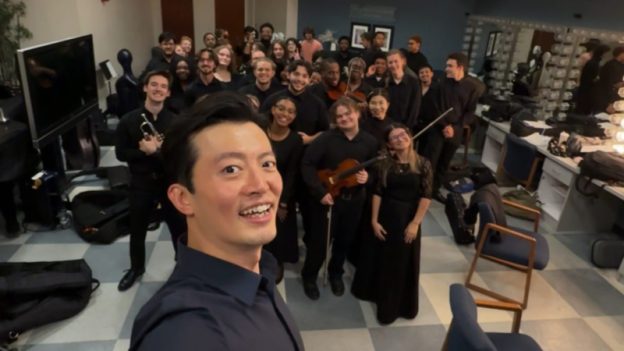
This season, JCSO launched a Young Artist in Residence program, and Giuliana became part of that first chapter. What made it meaningful wasn’t the label or the optics—it was the lived reality of watching a young musician move between worlds that were never designed to talk to each other. High school. University. Pre-professional expectations. The professional rehearsal room. Immigration, paperwork, finances, identity, belonging. She has played every concert with us at JCSO this season, and at the same time, she became a student at Georgia State University, where I recently concluded my tenure as the Conductor-in-Residence. Meanwhile, the very thread that first connected us—music that sat outside the traditional “orchestral” lane—became part of JCSO’s broader cross-cultural commissioning and education work with high schools.
Watching Giuliana blossom wasn’t only inspiring. It was clarifying. Because her story exposes the real issue hiding beneath so many of our conversations about audience development, relevance, education, and sustainability.
The question isn’t whether Giuliana has talent. The question is whether our institutions are designed to help talent survive the gaps between institutions—and to grow through those transitions rather than be fractured by them.
For much of the last century, orchestras were built like stand-alone institutions. A professional ensemble presents concerts, perhaps supported by an education department and a handful of outreach programs. A youth orchestra operates somewhere else in the city. Schools do what they can. Universities train musicians independently. Festivals ignite brilliance for a few weeks each summer and then disappear. Each of these institutions does important work. But too often they function like isolated islands—parallel efforts that rarely form a coherent pathway for the people moving through them.
When institutions operate in isolation, the symptoms are everywhere. Students encounter orchestral music occasionally rather than continuously. Young musicians move through disconnected stages of development—school, youth orchestra, university, and the professional world—without meaningful coordination across environments. Professional orchestras struggle to build long-term relationships with audiences because “community engagement” is treated as a separate activity instead of a central operating principle. Even innovation suffers: festivals experiment, universities research, youth programs nurture creativity, but discoveries remain siloed, trapped inside the institution that produced them.
So the system functions—yet it functions despite fragmentation, not because it was designed with connection in mind. And the people who pay the price are not the institutions. It’s the young artist trying to navigate them.
There is another way to think about orchestral culture, and it’s the way nature works: ecosystems thrive through interdependence. Different organisms perform different functions, but the health of the whole depends on the relationships between them. Musical life follows the same logic. Orchestral culture is strongest when the institutions that sustain it—schools, youth ensembles, universities, festivals, and professional orchestras—operate not as separate brands, but as connected layers of one living system.
In a true musical ecosystem, students meet orchestral music repeatedly over time rather than through one-off experiences. Young musicians move through a continuous developmental pathway rather than a maze of disconnected ladders. Professional orchestras become anchors for a broader cultural network rather than simply presenters of concerts. Innovation circulates across institutions instead of being trapped in one corner of the field. The orchestra becomes a center of gravity, not because it is the “biggest” organization in the region, but because it is the connector that allows the whole system to cohere.
Most thriving ecosystems include five layers. Schools are the first point of access and a sense of belonging. Youth orchestras deepen skill, discipline, and identity. Universities and conservatories prepare musicians for professional life while contributing experimentation and artistic dialogue. Festivals create intensive environments where artists and students collide, collaborate, and accelerate. Professional orchestras serve as the public-facing anchor—setting standards of excellence while connecting the entire ecosystem to civic life. When these layers are connected, musical culture becomes continuous rather than episodic, and continuity is what builds not just musicians, but audiences, families, and long-term community investment.
Here’s the part that matters for the future: it may be regional orchestras, not the largest metropolitan institutions, that are uniquely positioned to build these ecosystems. In major cities, scale and specialization can make coordination more difficult; institutions are large, bounded, and mission-separated. Regional orchestras live closer to the ground. Their musicians teach in local schools and universities. Their audiences overlap with families and students in youth programs. Civic leaders sit in the same rooms where cultural decisions are made. The orchestra isn’t distant—it’s embedded. That proximity is leverage. It makes regional orchestras natural connectors, capable of linking the layers of musical life into one coherent pathway and transforming the orchestra from a single institution into cultural infrastructure.
I’m living this in real time across multiple layers: JCSO as the professional anchor, MYSO as a youth pipeline, Georgia State as an education bridge, Atlanta Festival Academy as a creative laboratory, Ozarks Music Festival as a pre-professional performance environment, and local schools as the first touchpoint of belonging. Individually, each role matters. What changes everything is what happens when they connect—when the work isn’t a collection of separate programs, but a system designed to carry people forward over the years. Giuliana’s season is a microcosm of what becomes possible when an institution is built for flexibility, connection, and continuity: a young artist isn’t forced to “start over” at every transition. She’s supported by a pathway.
In a previous essay, I argued that education shouldn’t be treated as outreach. It’s infrastructure.
The ecosystem model extends that idea further. If education is infrastructure, then orchestras must stop operating like islands. Schools, youth orchestras, universities, festivals, and professional ensembles all create value, but the full value only emerges when those contributions are aligned. When the layers connect, the impact of each institution multiplies; when they remain disconnected, the entire system works harder for less return.
And this is why I believe the future is inevitable: the orchestra of the future isn’t a bigger stage. It’s stronger connective tissue.
When I think about Giuliana’s season—moving from school to university to the professional rehearsal room, not as a series of disconnected leaps but as a connected journey—I can’t unsee what’s possible. Orchestras are being asked to prove relevance and impact, but relevance isn’t a marketing campaign; it’s a design problem. When the layers connect, the return compounds: talent development strengthens, education becomes continuous, audiences deepen, and the orchestra stops behaving like an event and starts functioning like civic infrastructure. That’s why I believe this future is inevitable. The orchestra of the future isn’t a bigger stage. It’s stronger connective tissue—and once you see orchestral life as an ecosystem, it’s hard to go back to building islands. ■
Editor’s Note: Giuliana Scaramazza’s story is shared mere with her permission.
Henry Cheng will lead The Johns Creek Symphony Orchestra in its “IMAGINE: It’s Magic!” program on Saturday, March 28 at 7:30 p.m. at Mount Pisgah Church in Johns Creek. More information: johnscreeksymphony.org
EXTERNAL LINKS:
- Henry Cheng: johnscreeksymphony.org/henry-cheng.
.png)