
March 21, 2026
Spivey Hall
Morrow, GA – USA
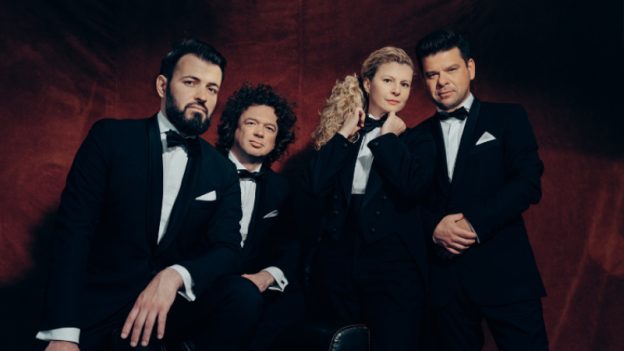
Pavel Haas Quartet (Veronika Jarůšková, first violin; Marek Zwiebel, second violin; Šimon Truszka, viola; Peter Jarůšek, cello).
Franz SCHUBERT: Quartettsatz in C Minor, D. 703
Ludwig van BEETHOVEN: String Quartet No. 16 in F Major, Op. 135
Franz SCHUBERT: String Quartet No. 14 in D Minor, D. 810, “Death and the Maiden”
Mark Gresham | 26 MAR 2026
The Pavel Haas Quartet came to Spivey Hall on March 21 with a program that traced a striking arc. Drawn from the music of Franz Schubert and Ludwig van Beethoven, the concert balanced formal clarity with emotional extremity and was performed with uncommon focus and expressive depth.
The afternoon opened with Schubert’s Quartettsatz in C minor, D. 703, a single-movement fragment that nonetheless feels complete in its dramatic scope. The Pavel Haas players leaned into its volatility, shaping the surging unisons and abrupt silences with a taut, almost orchestral sense of scale.
Beethoven’s String Quartet No. 16 in F major, Op. 135, brought a change of tone but not of intensity. Here, the quartet emphasized transparency and wit, allowing Beethoven’s late style, by turns playful and questioning, to emerge with conversational ease. The famous final movement, with its insistent “Muss es sein?” motif, unfolded as a philosophical dialogue rather than a rhetorical statement. The ensemble’s control of dynamics and articulation gave the music a sense of inevitability, even as it hovered between humor and existential inquiry.
After intermission, Schubert’s String Quartet No. 14 in D minor, D. 810, “Death and the Maiden,” the program’s emotional and structural centerpiece, followed. The Pavel Haas Quartet approached the work not as a display piece but as a narrative journey, drawing clear connections to the earlier Schubert fragment while expanding its expressive world. The first movement’s driving rhythms were delivered with fierce precision, yet never at the expense of tonal richness. In the theme and variations second movement, the players sustained a long arc of tension, the famous song-derived theme unfolding with a stark, almost vocal inevitability.
The “Scherzo” crackled with energy, its “Trio” offering only the briefest respite before the tarantella-like “Finale” surged forward. Here, the quartet’s technical command was matched by a visceral sense of risk, each phrase propelled toward an inexorable conclusion. Throughout, the ensemble maintained a remarkable balance: individual voices emerged with clarity, yet the overall sound remained unified and cohesive.
Taken together, the program suggested a through-line from Beethoven’s late introspection to Schubert’s more overtly dramatic engagement with mortality — the fragmentary Quartettsatz serving as a mediator between the two. The Pavel Haas Quartet illuminated these connections with intelligence and conviction, making the concert feel less like a sequence of works than a single, evolving statement.
It was, in the end, a performance that combined intellectual rigor with emotional immediacy — a searing, edge-of-the-seat account that turned familiar masterworks into something urgent and newly alive. ■
EXTERNAL LINKS:
- Pavel Haas Quartet: https://www.pavelhaasquartet.com
- Spivey Hall: spiveyhall.org

Read more by Mark Gresham.

.png)