
Mark Gresham | 6 APR 2026
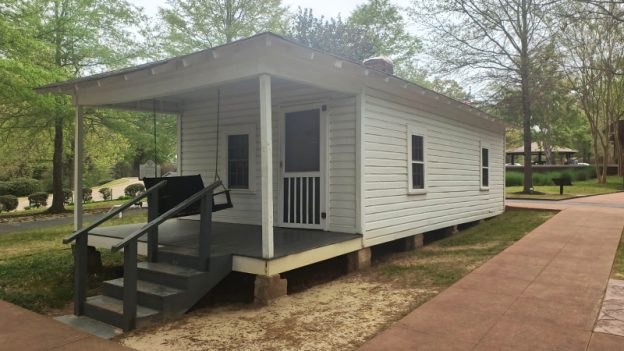
On Saturday morning, April 5, I stood in front of a modest two-room shotgun house in Tupelo and experienced something profoundly human: the birthplace of a legend reduced to its simplest origins.
That tiny frame structure, built for $180 during the Great Depression, is where Elvis Presley was born on January 8, 1935. Standing there, it stripped away the glamour of Graceland, the sequined jumpsuits, and the global icon status, revealing instead a story of poverty, gospel music in a humble church, and the raw spark of talent that would reshape popular culture.
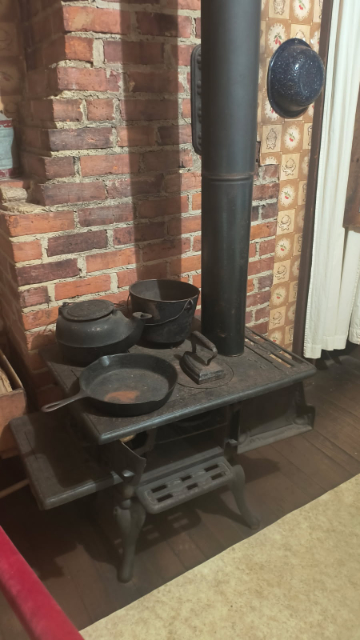
Although most of the furnishings inside the Presley home are only representative, some are original: this stove, the coal-burning fireplace (which faces the other room), and the flooring seen here are original, as is the overall structure. (credit: Mark Gresham, April 4, 2026)
Birthplaces of historical figures carry a unique power precisely because they ground the extraordinary in the ordinary. They remind us that greatness doesn’t descend fully formed—it emerges from specific times, places, and circumstances, often against long odds. These sites invite reflection on how environment, family, hardship, and early influences shape a person’s path. They turn abstract history into something tangible: you can stand in the same small space, imagine the sounds and struggles, and feel the continuity between then and now.
Just days earlier, on March 31, I had a similar experience at the birthplace of Abraham Lincoln in rural Hodgenville, Kentucky.
There, the one-room log cabin on the frontier—of which the original no longer exists, but a representative version is enshrined within a neoclassical memorial building—underscores themes of self-made resilience and moral growth. Lincoln’s early years in poverty and manual labor on Kentucky farms helped forge the character that would guide the nation through its greatest crisis. Like Tupelo, the site is humbling. It humanizes a towering figure and highlights how humble roots can cultivate empathy and determination. The memorial, with its symbolic cabin, echoes the idea that leadership arises not from privilege but from lived experience.
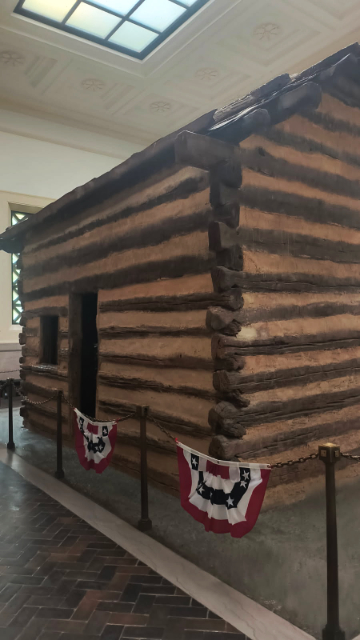
A reconstructed one-room log cabin representing Abraham Lincoln’s birthplace sits within the neoclassical memorial at the site. (credit: Mark Gresham, March 31, 2026)
Seen in close succession, the two sites began to speak to each other. The distances between them—geographic, historical, cultural—collapse into a shared narrative of origin. A frontier cabin. A Depression-era shotgun house. Both modest. Both improbably generative.
When it comes to musicians, birthplaces take on an even more intimate dimension. Music is deeply personal and sensory; standing where a performer first drew breath—or first heard music—creates a direct emotional bridge. In Tupelo, that connection feels especially immediate. It was here, in East Tupelo’s modest surroundings and the nearby Assembly of God church, that Elvis absorbed gospel, blues influences from the Shake Rag community, and country sounds from the radio. His family’s financial struggles forced them to move to Memphis when he was still young, yet those early years planted the seeds for rock ’n’ roll. The simplicity of the setting only amplifies the scale of what followed, showing how transformative art often springs from unassuming soil.
That same dynamic extends, in a different way, to European musical heritage. Ludwig van Beethoven’s birthplace in Bonn, now the Beethoven-Haus, is not preserved exactly as it once was but carefully restored and arranged to evoke his early life. Visitors encounter manuscripts, portraits, and even the ear trumpets he used as his hearing declined, all set within rooms that invite imagination as much as observation. The space reflects not just his childhood, but the continuing effort to connect his turbulent beginnings in Bonn—and later life in Vienna—to the music he would create.
In Salzburg, Wolfgang Amadeus Mozart’s birthplace operates much the same way. The Mozart Geburtshaus presents a restored version of the environment in which a prodigy emerged, shaped by a musically supportive household and an 18th-century cultural world. What visitors encounter is not an untouched past, but a thoughtful reconstruction that makes that past feel present.
To say that Beethoven’s symphonies trace back to early struggles in Bonn is, in that sense, less a literal claim than a meaningful one. The Bonn home we encounter today is partly reconstructed, yet it still anchors the idea that even the most expansive artistic achievements can grow from modest and carefully remembered beginnings.
What unites all these places—Lincoln’s cabin, Elvis’s shotgun house, Beethoven’s Bonn home, Mozart’s Salzburg residence—is the invitation to reflect on human potential. They show that world-changing contributions frequently begin in unremarkable settings: a frontier farm, a Southern town in the grip of the Great Depression, a modest European apartment. Hardship, community, faith, and raw talent intersect there.
Walking the Tupelo grounds, I was struck less by nostalgia than by continuity. Elvis’s voice started in that small room; Beethoven’s symphonies trace back to early struggles in Bonn; Lincoln’s resolve grew from rural Kentucky soil. Visiting connects you personally to that chain.
The experience lingers, not as spectacle, but as something quieter and more reflective. In both places, the message is the same: ordinary beginnings can lead to extraordinary legacies, and inspiration often hides in the everyday. ■
EXTERNAL LINKS:
- Elvis Presley Birthplace: elvispresleybirthplace.com.
- Abraham Lincoln Birthplace National Historical Park: nps.gov/abli.

Read more by Mark Gresham.



.png)