
April 10 & 11, 2026
Meymandi Concert Hall
Raleigh, North Carolina — USA
North Carolina Symphony; Carlos Miguel Prieto, conductor; Amanda Forsythe, soprano; Erica Petrocelli, soprano; Issachah Savage, tenor; Harold Wilson, bass; North Carolina Master Chorale, Dr. Alfred E. Sturgis, music director
Einojuhani RAUTAVAARA: Symphony No. 7, “Angel of Light” (1994)
Wolfgang Amadeus MOZART: Great Mass in C Minor, K. 427/417a (1783)
Christopher Hill | 14 APR 2026
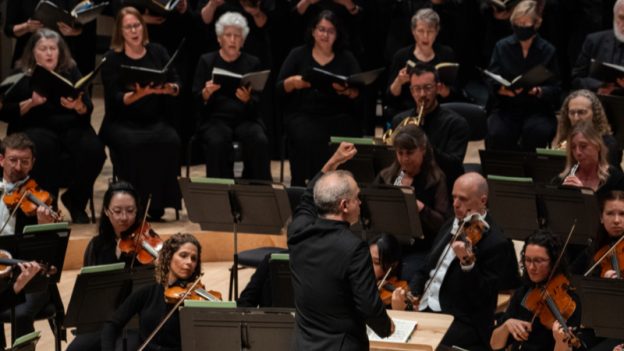
The imaginative program heard in Raleigh the weekend of April 10–11 paired two works of deep emotion and high ambition. In a pre-concert chat, Carlos Miguel Prieto talked about Rautavaara’s early religious environment, a mix of Lutheran, Catholic, and Orthodox traditions. In Mozart’s case, the early religious environment was also the composer’s early place of employment, the Archdiocese of Salzburg. Prieto remarked that he has long been interested in music’s ability to express ineffable spiritual experience, and that, for him, both pieces on the program succeed in doing so. Thus, the pairing.
Prieto also touched on the complex meaning of “angel” in the symphony’s subtitle, a meaning partly shaped by Rilke’s Duino Elegies, which, from its first poem, portrays angels as terrifying beings detached from human suffering. The maestro added that for himself, Rautavaara sounds as if he’s perpetually striving, but never quite succeeding, to ascend to an angelic realm. In performance with the North Carolina Symphony, Prieto made this reading palpable and most poignant.
If you are not familiar with Rautavaara, he is the Finnish Hovhaness. If you’re not familiar with Hovhaness — well, there’s really no other composer Rautavaara resembles so much. In an obituary, the New York Times described Rautavaara’s music as “lush.” But he’s eclectic: there are also borrowings from composers not usually described as “lush,” composers such as Sibelius, Shostakovich, and Copland. For all that, by the time of Symphony No. 7 the composer had fully assimilated these and other influences and was able to craft a work both masterful in technique and highly personal in its authentic voice and its musical narrative.
The orchestra played beautifully, apart from an unfortunate flub in the horn solo that lays one movement to rest. Newly strengthened, the North Carolina Symphony’s lower strings provided the sound field with a rich floor of long pedal tones and slow ostinatos, found throughout the symphony. In several movements, percussionists Richard Motylinski and Rajesh Prasad brought great precision to their difficult and crucial roles on xylophone and vibraphone (your reviewer thought the volume on the vibes was set a bit too loud); on untuned instruments, passages of apocalyptic cacophony couldn’t have been better executed. Concertmaster Justin Bruns captured the purity and sensitivity of a quite extended solo in the third movement. Trumpeters Paul Randall and Benjamin Hauser were sometimes cast as angelic taunters, and they brought real bite to their playing. Flutes right out of Sibelius’s Sixth Symphony had an appropriately cool fluidity (angelic, perhaps) as played by Megan Torti and Mary E. Boone. Also estimable were the ensemble and balance of the woodwinds, generally in complex mixed figurations that functioned like wallpaper patterns behind soloists or sections in the musical foreground. These and other soloists were asked to stand during the appreciative applause that followed the symphony’s close.
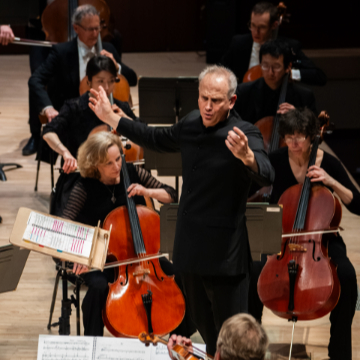
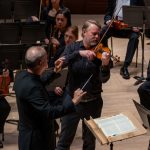
Carlos Miguel Prieto leads the NC Symphony, NC Master Chorale, and soloists in Rautavaara’s “Symphony No. 7, “Angel of Light.” (Courtesy of MCS)
Mozart was fired from his position as court and cathedral organist by the Archbishopric of Salzburg in June 1781. His feelings were strong enough to spark a number of short contrapuntal works on crude texts about a**-lickers. Mozart subsequently licked his wounds in Vienna, then second perhaps only to Prague or Paris in its musical sophistication. Mozart’s father was crestfallen by his son’s loss of a secure lifetime position, and when Mozart returned to Salzburg in 1783, the son had something to prove. At the beginning of his Vienna sojourn, Mozart chose to capitalize on his reputation as a pianist. Accordingly, he wrote three new piano sonatas and three new piano concertos to establish a performing presence in the city. When he returned to Salzburg, he brought those three sonatas with him to play.
But his visit was actually inspired by two other things. One was his brand-new wife, Constanze neé Weber, who happened to be an excellent coloratura soprano. The second was part of a missa solemnis in C minor, to be performed at a Salzburg church with guest artist Constanze substituting for the usual alto soloist. As it happened, this was Mozart’s second missa solemnis in C minor. The first, as Wolfgang’s father well knew, had also been Mozart’s first full-length mass (not a missa brevis) years before. In the new, unfinished mass, Mozart took pains to show how he was creating sacred music of unprecedented sophistication in Vienna. For this was a mass unlike any he had written while in his father’s Salzburg orbit, kind of a mash-up of a Bach choral work, a Classical mass, and an opera, the sort of thing that could only be written when one left Salzburg and hob-nobbed with the best musicians in Vienna. Oh, by the way, Dad, in Vienna even one’s wife can be a cultivated artist.
The Raleigh performance used the 1956 edition by H. C. Robbins-Landon, best known for his work on Haydn. Unlike some editions, the Robbins-Landon does not complete the mass with movements that Mozart either did not write or did not intend for this work. This edition ends with the Benedictus. On stage, the strings were reduced in strength — the sort of 1950s-style “authentic” performance practice Robbins-Landon had in mind. The chorus was disposed antiphonally, rather like orchestral strings were before Stokowski. The balance between the Symphony Orchestra and the North Carolina Master Chorale was excellent. Special mention must be made of the chorus’s music director, Alfred E. Sturgis, whose rehearsals resulted in subito pianos and subito fortes of exceptional power, not to mention both angelic and virile singing in appropriate passages and contrapuntal clarity.
The four soloists brought professional flair to their parts. Rising soprano Erica Petrocelli did credit to a difficult part, Mozart having given her solo much chugging (and unforgiving) sixteenth-note passagework that are a cliché of Classical-period liturgical music. Why did Mozart do this? Perhaps to contrast with (and set off) Constanze’s appealingly lyrical and also coloratura (operatic) part. In any event, Petrocelli took on this ungrateful role “on short notice” when the scheduled artist suddenly became unavailable. In the duets, the trio, and the quartet, she brought a lovely tone and fine projection to the ensembles.
Tenor Issachah Savage had a somewhat rounder, richer tone but less projection; he was heard less often in ensembles than your reviewer thinks Mozart intended. Basso cantante (something more like a lyric bass-baritone than a basso profundo) Harold Wilson brought both rich tone and excellent projection to his part. It’s easy to see (or hear) why he has been active at major opera houses in the U.S. and Europe. Your reviewer was especially impressed by soprano Amanda Forsythe. Her career has centered on performances of Baroque and Rococo music, with special emphasis placed on lesser-known works. Taking the hard path has, happily, not led to obscurity; recently, she won a Grammy for her recording of Telemann arias. Perhaps partly as a result of her immersion in this highly ornamented repertoire, her voice has a developed, focused, yet liquid quality that makes even chugging sixteenth notes bloom. It is, however, in the nuanced shaping of Mozart’s lyrical phrases that she came into her own in the Raleigh performance. As she sings them, these phrases sound so musically intelligent — so truly spoken, as it were — that immediately one recognizes the power of music itself to make speech more than it could otherwise be. Your reviewer would love to hear and see her in one of Alessandro Scarlatti’s rarely mounted but musically moving operas, but even more so as a Mozart heroine — Susanna (especially) or Countess Almaviva, Donna Elvira, Fiordiligi, or Pamina. Based on her singing in Raleigh, she could easily ace the Queen of the Night, too. In addition, Forsythe has genuine presence on stage, a presence that goes well beyond the mannerisms every soprano practices.
Prieto’s reading of Mozart’s Great Mass in C Minor emphasized the vigor, confidence, and ambition the composer brought to the work. His setting of the mass may resonate spiritually, but it is undoubtedly a young man’s music, energetic; a newly married young man’s music as well, frisky. It is also, in many movements, soul-searching. The audience responded with enthusiasm, constrained in expression perhaps by the knowledge that this is liturgical music, but nonetheless sincere. ■
EXTERNAL LINKS:
- North Carolina Symphony: ncsymphony.org
- Carlos Miguel Prieto: carlosmiguelprieto.com
- Amanda Forsythe: amandaforsythe.com
- Erica Petrocelli: imgartists.com/roster/erica-petrocelli
- Issachah Savage: issachahsavage.com
- Harold Wilson: haroldwilson.net
- North Carolina Master Chorale: ncmasterchorale.org

Read more by Christopher Hill.

.png)