
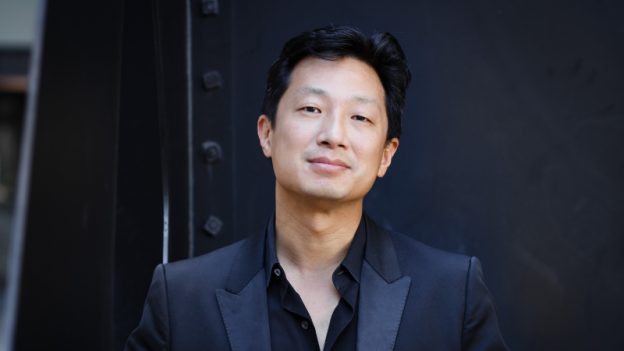
April 9–11, 2026
Atlanta Symphony Hall
Atlanta, Georgia – USA
Atlanta Symphony Orchestra, Jerry Hou, conductor; Jennifer Koh, violin.
Nicky SOHN: A Tale of the Bunny and the Turtle
Phlip GLASS: Violin Concerto No. 1
Sergei RACHMANINOFF: Symphony No. 1 in D minor, Op. 13
Mark Gresham | 13 APR 2026
Taiwanese-American conductor Jerry Hou returned to the podium of the Atlanta Symphony Orchestra Thursday night with a program that moved fluently between narrative immediacy and symphonic ambition, pairing a lively contemporary premiere with the tensile lyricism of Philip Glass and the brooding architecture of Sergei Rachmaninoff.
Hou, the orchestra’s former Resident Conductor (2020–23), now music director of the Wyoming Symphony Orchestra and a faculty member at Rice University’s Shepherd School of Music, led with a combination of clarity and kinetic energy that has become his hallmark. His baton technique is economical but never inert, and throughout the evening he demonstrated a particular sensitivity to rhythmic articulation — a quality that served all three works despite their stylistic distance.
The concert opened with the world premiere of Nicky Sohn’s A Tale of the Bunny and the Turtle (2025), a commission that was one of the prizes from her win of the 2024 Rapido! Take Seven competition. Drawing on a well-known Korean folktale, Sohn’s score unfolds for the listener less as a literal narrative than as a sequence of vividly characterized musical episodes.
What registered most strongly was Sohn’s ear for color and propulsion. The orchestration favors bright, cleanly etched timbres — darting woodwind figures, brassy interjections, and a rhythmic profile that often leans toward jazz-inflected syncopation without ever settling into pastiche. Hou allowed the piece’s contrasts to read clearly, and the orchestra responded with alert, rhythmically buoyant playing.
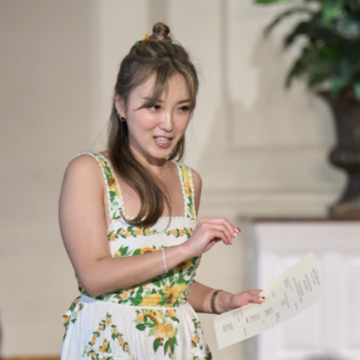
Composer Kicky Sohn. (credit: Chris Helton)
A Tale of the Bunny and the Turtle is not a “heavyweight work,” and need not be: it is attractive music, both consistently accessible and vibrant. What it does need next is choreography — whether ballet or modern dance. Sohn recently earned her Doctor of Musical Arts from Rice’s Shepherd School of Music, in Houston, where Hou is Assistant Professor of Conducting. It would seem a natural place for a project that presents the music with dance or pantomime.
Violinist Jennifer Koh followed with Philip Glass’s Violin Concerto No. 1, a work that has, over time, emerged as one of the composer’s most durable orchestral statements. Where earlier minimalist works often foreground process, this concerto depends on sustained line and cumulative tension — a challenge that lies as much in phrasing as in endurance.
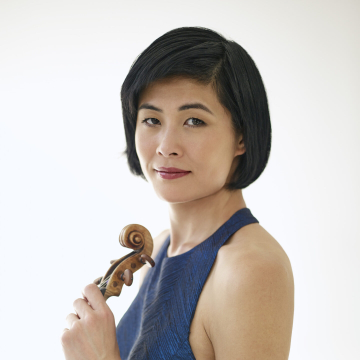
Jennifer Koh (credit: Juergen Frank)
Koh approached the solo part with a combination of tensile focus and tonal poise. Her sound, lean but never brittle, most;y found its points of balance above the orchestra’s pulsating textures. In the opening movement, she shaped the long arcs with a sense of inevitability rather than insistence, avoiding the mechanical neutrality that can flatten Glass’s idiom. The central movement, often the emotional core, unfolded with particular sensitivity: subtle inflections of timing and color gave the repeating patterns an almost breathing quality. Hou’s accompaniment was notably attentive, maintaining forward motion while resisting the temptation to overdrive the pulse. The result was a performance that emphasized the concerto’s lyricism without sacrificing its structural discipline.
After intermission came Rachmaninoff’s Symphony No. 1 in D minor, a work whose reputation has long been colored by the disastrous circumstances of its 1897 premiere. Heard now, freed from that history, it reveals a composer already in command of a distinctive harmonic language and a penchant for large-scale cohesion, although it is admittedly not on par with his Second Symphony.
Hou’s reading leaned into the symphony’s volatility without overstating its rhetoric. The opening movement emerged with a sense of unease rather than sheer weight, its motivic fragments carefully balanced to preserve clarity within the dense orchestral fabric. Particularly effective was his handling of transitions — often the work’s weakest points — which here felt more purposeful than episodic.
In the slow movement the strings producing a warm, blended sonority that avoided excess sentimentality. In the scherzo, Hou emphasized rhythmic precision over raw speed, allowing inner voices to register with unusual clarity. The finale, notoriously difficult to pace, built convincingly toward its conclusion, the recurring Dies Irae-inflected material lending a cumulative sense of fatalism rather than bombast.
Throughout, the orchestra played with commitment and polish. Brass entries were firm without overpowering, and ensemble coordination — particularly in the more rhythmically intricate passages — remained tight.
If the program suggested a unifying idea, it lay in its exploration of musical narrative: Sohn’s folkloric vignettes, Glass’s evolving patterns, and Rachmaninoff’s cyclical motifs each offered a different way of sustaining continuity over time. Hou proved an effective guide across these terrains, shaping each work according to its own logic while maintaining an overarching sense of forward momentum. ■
The program was repeated on Friday evening at Atlanta Symphony Hall.
EXTERNAL LINKS:
- Atlanta Symphony Orchestra: aso.org
- Jerry Hou: jerryhou.com
- Jennifer Koh: jenniferkoh.com
- Nicky Sohn: nickysohn.com

Read more by Mark Gresham.
RECENT POSTS
 Houston Symphony pairs Stravinsky’s austerity with Mozart’s grandeur, Mackey’s inventiveness • 20 Oct 2026
 Raven Chacon’s “Voiceless Mass” anchors an immersive evening with ensemble vim and Bent Frequency • 19 Oct 2026

.png)