
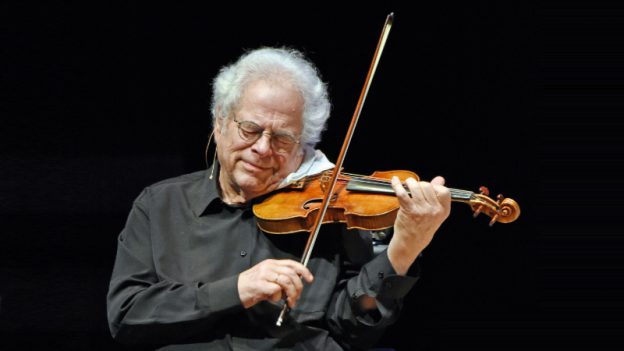
March 26, 2026
Schwartz Center for Performing Arts, Emerson Concert Hall
Atlanta, GA – USA
“An Evening with Itzhak Perlman,” a multimedia presentation blending personal narrative, archival video, and live musical performance, with Itzhak Perlman, violin; Rohan De Silva, piano.
Selected works and excerpts by Kreisler, Bach, Schubert, and others; including John Williams’ Theme from Schindler’s List.
Mark Gresham | 10 APR 2026
On March 26 , the Schwartz Center for Performing Arts offered something rarer than a recital: a self-portrait shaped in words, images, and music. Billed as “An Evening with Itzhak Perlman,” the program unfolded as a live biographical narrative—part documentary, part theater, part chamber performance—its structure carefully sequenced yet delivered with conversational ease. The format, first introduced at its 2019 Kansas City premiere, has since been shaped over successive tours into a seamless interplay of narrative, image, and sound.
The expectation of multimedia format and environment was established before the legendary violinist Itzhak Perlman made his entrance, after which the evening quickly moved into childhood. Fritz Kreisler’s Tempo di Minuetto served as an opening musical touchstone, less a display than a point of origin. From there, Perlman traced his parents’ immigration from Poland to Tel Aviv, the family barbershop, and a household animated by “food and music,” his delivery marked by dry humor and an instinct for timing that never lingered too long on sentiment.
The production relied on an episodic interplay of spoken recollection, projected images, and brief musical excerpts. Photographs and home videos, along with clips from the documentary Itzhak, functioned not as embellishment but as memory cues, giving visual contour to stories that might otherwise risk familiarity. Each return to the violin carried the resonance of what had just been told.
When Perlman spoke of hearing Jascha Heifetz on the radio, the anecdote opened naturally into music; when he described his early training, a Bach gavotte or student repertoire followed with disarming directness. This pattern—story giving rise to sound—defined the evening’s pacing. Joined by longtime collaborator Rohan De Silva as pianist, Perlman played with an intimacy that favored expression over projection, De Silva’s accompaniment adaptive to the flexible, narrative-driven flow.
The account of childhood polio marked a shift in tone. Presented plainly, without rhetorical weight, it was accompanied by images that underscored both limitation and resilience. Schubert’s Serenade, placed here, did not so much console as continue the thread: adversity absorbed into the larger continuity of a life in music. Humor remained close at hand, often arriving just as the narrative approached gravity.
The program’s central arc traced the transition from local prodigy to international figure. Perlman’s recollection of auditioning for The Ed Sullivan Show—and the subsequent appearance at age 13—was paired with archival footage, including a youthful “Flight of the Bumblebee.” The juxtaposition was quietly striking: the same musical voice, refracted across decades, its essential character intact.
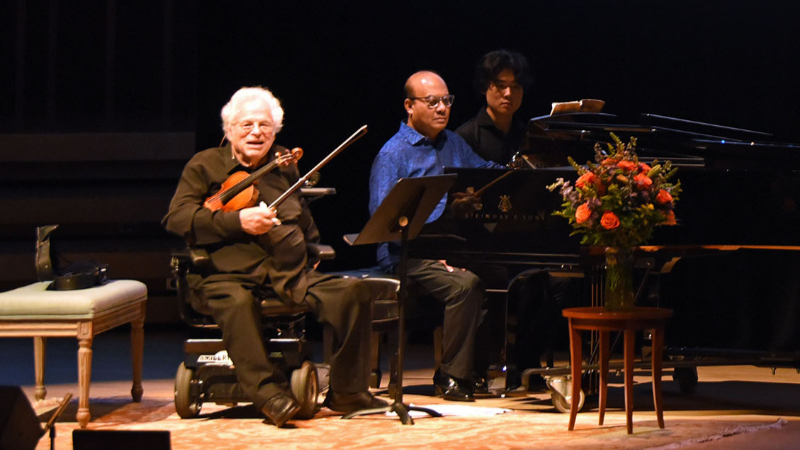
Octogenarian violinist Itzhak Perlman and collaborative pianist Rohan De Silva perform at Emerson Hall at Emory University’s Schwartz Center for Performing Arts in Atlanta, Georgia, March 26, 2026. (credit: Derek Storm)
From there, the narrative broadened to include Juilliard studies, early touring, and the practicalities of building a career. Anecdotes—searching for kosher food on the road, early concerts with little notice, summer study—were delivered with a light touch that kept the tone conversational even as the scope widened. Musical excerpts, including Kreisler’s Tambourin chinois, marked stages of development without interrupting the flow.
Later segments moved more freely across time, interweaving professional milestones with personal life: marriage, family, collaborations, and appearances beyond the concert hall. Video clips—from Sesame Street to concert collaborations—expanded the portrait without overstating it. A recurring thread addressed accessibility, with a candid sequence on the physical logistics of performance that underscored Perlman’s long-articulated emphasis on ability over limitation.
The closing sequence gathered these strands into sharper focus. A glimpse of his educational work, including the Perlman Music Program, led to the evening’s final performance: the theme from Schindler’s List by John Williams. Here, the integration of narrative and music reached its most direct expression. The piece functioned less as a showcase than as a summation, its lyric intensity carrying the weight of the story that preceded it. An encore by Brahms followed, offered simply.
What emerged over 90 uninterrupted minutes was not a catalog of achievements but a shaping of perspective. The program’s sequence—childhood, adversity, study, recognition, reflection—was familiar in outline, yet its presentation resisted grandiosity. Perlman’s presence, by turns wry, candid, and quietly reflective, kept the focus on lived experience rather than legend.
As part of Emory’s Candler Concert Series, the evening aligned with a broader celebration of established artistry while gently redefining its terms. If a traditional recital invites attention to interpretation, this format invited attention to context: to the experiences that inform the sound, and to the humanity that sustains it. By the close, the ovation that filled Emerson Concert Hall felt directed not only at the playing, but at the portrait itself—an acknowledgment of a life in music, rendered with clarity, warmth, and uncommon immediacy. ■
EXTERNAL LINKS:
- Itzhak Perlman: itzhakperlman.com
- Schwartz Center for Performing Arts: schwartz.emory.edu

Read more by Mark Gresham.
RECENT POSTS
 Houston Symphony pairs Stravinsky’s austerity with Mozart’s grandeur, Mackey’s inventiveness • 20 Oct 2026
 Raven Chacon’s “Voiceless Mass” anchors an immersive evening with ensemble vim and Bent Frequency • 19 Oct 2026


.png)