

February 6 & 7, 2026
Meymandi Concert Hall
Raleigh, North Carolina — USA
North Carolina Symphony; Carlos Miguel Prieto, conductor; Timothy McAllister, alto saxophone.
Leonard BERNSTEIN: Three Dance Episodes from On the Town (1945)
John ADAMS,:Saxophone Concerto (2013)
George GERSHWIN: Porgy and Bess: A Symphonic Picture, arr. Robert Russell Bennett (1942)
James P. JOHNSON: Victory Stride, arr. uncredited (1944)
Christopher Hill | 12 FEB 2026
This past weekend’s program of American music was not one compiled by the numbers. Instead of the oft-programmed dances from West Side Story (which Bernstein did not trouble to orchestrate himself), the North Carolina Symphony performed Three Dance Episodes from ‘On the Town’, which Bernstein himself arranged. Instead of Gershwin’s own suite, Catfish Row, the orchestra is performing Robert Russell Bennett’s Porgy and Bess: A Symphonic Picture. Instead of one of Gershwin’s, Copland’s, or John Williams’s concerted works, the NCS presented the John Adams Saxophone Concerto, performed by the artist who premiered it. Finally, instead of including nothing at all from the actual creators of jazz — a state of affairs entirely normal in concerts of American music — the orchestra is performing James P. Johnson’s Victory Stride.This brief work functions in effect as the program’s encore. In sum, if you’re looking for a carefully vetted entree into some of the most accessible and enjoyable middlebrow American music of the last century (especially the 1940s), come and get it.
Now to the music. By the time Leonard Bernstein wrote the ballet Fancy Free in 1944, his legendary career was in full swing. He was already known in classical musical circles as a triple threat. First, Bernstein was known to be a splendid pianist, as is shown by his later recording of Ravel’s G-major concerto. As an assistant conductor to Bruno Walter at the New York Philharmonic, in November 1943, Bernstein landed on the front page of the New York Times when, at literally a moment’s notice, he substituted for Walter in a subscription concert of Schumann, Tchaikovsky, Strauss, and Wagner. Perhaps most importantly to him personally, his 1942 Symphony No. 1 “Jeremiah” had established his credibility as a serious composer with a voice of his own; moreover, a composer who, like his mentors Aaron Copland and Marc Blitzstein, did not hide his identification with Jewish ethnicity. Where Fancy Free fits into all this is that, before that ballet, Bernstein had not yet publicly revealed his fourth and perhaps biggest asset, a Gershwin-sized talent for mashing up pop-culture music and art music.
The subject matter and music of Fancy Free were those of young adults in the wartime United States. Copland and Martha Graham had been offering the public cowboy ballets; Bernstein and Jerome Robbins offered a fresh alternative, urban swing ballet. Fancy Free proved such a success that the two creators immediately turned its plot premise into a full Broadway musical, On the Town, which premiered a mere nine months after the ballet. The following year, 1945, with the war still raging, Bernstein took ten minutes of his new On the Town music and turned it into what the North Carolina Symphony played in this concert.
The Three Dance Episodes are fast – slow – fast. The slow one features a solitary trumpet solo, rather similar both in mood and sound to Copland’s Quiet City, but also reminiscent of the central movement in Gershwin’s Piano Concerto. The solo was sensitively played by first chair Paul Randall, who brought just the right amount of “lonely town” feeling to the trumpet’s coloration. The two fast movements reference various pop musical phenomena, such as Benny Goodman’s small-group swing recordings (kudos here to clarinetist Samuel Almaguer) and Mary Lou Williams’s refinements of boogie-woogie. The fast movements are enlivened by unexpected phrase extensions and key changes, rather like those familiar from West Side Story. Bernstein’s 1944–45 writing for orchestra is a pleasure to the ear. The North Carolina Symphony recreated his work with carefree finesse, and the Raleigh audience responded enthusiastically, even if this was clearly not the piece they had come to hear. (Translation: Applause was loud but ceased the first moment the conductor, Carlos Miguel Prieto, walked offstage.)
The centerpiece of this program was John Adams’ 2013 Saxophone Concerto. The soloist was the man for whom the work was originally written, Timothy McAllister. The concerto has since been played by a number of other saxophonists; in fact, a few years back, Branford Marsalis performed it with the Winston-Salem Symphony. The concerto is difficult to perform for both orchestral musicians and the soloist. In a pre-concert chat, Prieto mentioned that he and McAllister have played this concerto together on four previous occasions. “The ‘fear factor’ is gone,” he joked. And joke or not, that history partially explains the extreme refinement of this weekend’s presentation. In their expert hands, the concerto comes across almost like a different piece from what can be heard, say, on YouTube. Adams has not abandoned minimalism, but he has sublimated it within a work of long, expressive melodic lines. In uncertain performances, you quickly hear the minimalist figurations in the foreground; as played by the North Carolina Symphony under Prieto, those figurations provide a source of energy that helps propel the music forward, yet at the same time they merge into the longer musical lines that Adams intends as foreground. In long moderato and slow sections of the first movement, Adams uses delicate high tone clusters (in a manner best known from Hovhaness) , and he closes the movement with a long, low, foggy intersection of tone clusters that likely comprises all twelve tones of the chromatic scale.
Over all this the alto saxophone plays both piercingly lyrical and astonishingly difficult passages. A few days before the concert, I had a chance to ask Timothy McAllister what it’s like to work with composers when they are writing you a concerto. His answer is worth quoting.
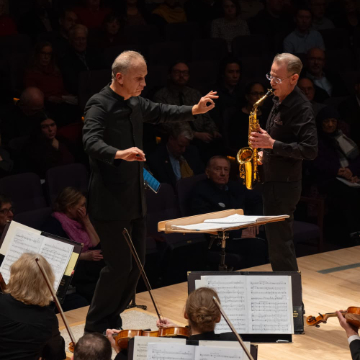
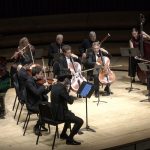
Carlos Miguel Prieto, conductor; Timothy McAllister, alto saxophone, with the North Carolina Symphony. (Courtesy of NCS)
For John Adams, the alto saxophone represented that iconic early bebop sound associated with Charlie Parker’s alto playing, in particular, or with early film noir soundtracks, which often feature a crooning alto solo. The alto range … has a close relationship to the clarinet, which was John’s instrument growing up. Further, he wanted to expand upon the lineage of alto saxophone concertos we associate with the classical repertoire, such as pieces by Glazunov, Ibert, Debussy, Cowell, Dahl, and others, while also fusing the two worlds.
Since Adams was once a clarinettist himself, before starting the concerto, he likely remembered something about idiomatic fingerings. He also got feedback and input from his upcoming soloist. In addition, Adams wrote music that benefits from being played without a growl.
Connected with this is Prieto’s own view of Adams’s solo part. In a comment before the concert, he noted that it reminded him of Stan Getz’s playing. To this end, Prieto furnished excerpts from Getz recordings. Your reviewer’s takeaway was that, in those excerpts, Getz played with unwavering tone and focused tone color, regardless of whether he was playing lyrically or aggressively. That manner comes closer to the original French school of saxophone pedagogy than, say, the mouthpieces, embouchure, articulation, and even instrument material (e.g., plastic) favored by a jazz musician like Ornette Coleman. McAllister happens to be a master of the French manner as well as an extender of it through curated admixtures of New World discoveries.
So difficult is Adams’s solo part that one can easily imagine playing it well just once for a concert audience would be enough work for an entire weekend. This, of course, is not how subscription series work. But perhaps this is why Prieto, before first lifting his baton, turned to the audience and said, “This guy is on fire tonight!” Whatever McAllister’s actual physical state, he lived up to that billing. The word ‘chops’ was invented for guys like him (of whom I imagine there are few). Sometimes his fingers looked like a troupe of spiders racing over his instrument, top to bottom, all at once, searching for perfect fingerings to play explosive music with expressive purity of tone.
The second half of the program began with Porgy and Bess: A Symphonic Picture, the first and shorter of two concert works Robert Russell Bennett made from Gershwin’s opera, which Gershwin, in turn, made from Porgy, a drama by DuBose Heyward. Porgy made a strong impression when it premiered on Broadway, October 10, 1927. Just how strong can be seen from another Broadway show, Blackbirds of 1928, which opened May 9, 1928, and went on to become the hit of the season in 1930 Paris. Amidst Blackbird’s string of hits (“I Can’t Give You Anything but Love,” for instance), written by Dorothy Fields and Jimmy McHugh in the usual AABA song format, was an ambitious, more extended song in the format AABACDEFA. That song is “Porgy,” a precursor to Gershwin’s “I Loves You, Porgy.” From the start, then, there was something about Porgy that people felt required stretching the norms and the vocabulary of pop culture. This was right down Gershwin’s alley, of course. Gershwin also stretched the norms of art culture, and though charmed, it resisted him for several decades after his death. You’d never catch Schnabel (unlike Trifonov today) playing Gershwin’s Piano Concerto — no, there were specialist virtuosos like Oscar Levant and Jesus Maria Sanroma for that. And when Gershwin was performed by orchestras, it was not as part of a normal subscription concert but in a more relaxed context, say, at a bandshell or at the Proms. When RCA released their well-received discs of Earl Wild playing Gershwin, he was accompanied not by the Boston Symphony under Munch but by the Boston Pops under Fiedler.
Such was the state of affairs in 1942, when the music director of the Pittsburgh Symphony, Fritz Reiner, decided that concert-goers should have a chance to hear Gershwin at his peak. So Reiner concocted a medley of Porgy and Bess extracts that emphasizes not only Gershwin’s gift for melody but his ear for sophisticated harmony and rhythm. (Example: For the opening, Reiner chose a quartal passage that is first cousin to the opening of Arnold Schoenberg’s Chamber Symphony 1.) To turn Reiner’s medley into a symphonic work, the conductor enlisted Robert Russell Bennett. Russell Bennett was himself a prolific classical composer, but by 1942, he had been putting food on the table for over two decades by orchestrating other people’s Broadway shows. Russell Bennett began performing this service for Gershwin in the mid-1920s, shortly after Ferde Grofé orchestrated Rhapsody in Blue. Reiner couldn’t have made a better choice.
Russell Bennett had his work cut out for him, though. He wanted to use as much of Gershwin’s own sound as possible. But when you assign a vocal line to an instrument, that instrument is no longer available to accompany the vocal line. So changes are inevitable. In addition, when Gershwin wrote Porgy and Bess, he understood the importance of church choirs and gospel in Black communities of his day. Accordingly, the chorus in Porgy and Bess is just as important as the pit orchestra in accompanying the singers, and Russell Bennett had to figure out how to transfer every note of their music to orchestral instruments. The result was predictably superb. And even though today we have a scholarly edition of Gershwin’s own Catfish Row, the sweeping drama of the opera is better conveyed by Reiner and Russell Bennett, whose work is as effective in its way as Loren Maazel’s Ring without Words, which the NCS performed last season.
After its taut, precise, and (dare I say?) sexy performance of Adams’ challenging asymmetries, the orchestra had no problem kicking off its shoes and sounding jazzy in a natural way, a way that didn’t “play down” to the music. About five minutes in, a long parlando passage with an oboe solo would have been more effective had the conductor allowed his soloists more rubato. Later, a banjo player suddenly emerged from the wings for a solo in “I Got Plenty of Nothing,” and in a couple of early bars there were ensemble imprecisions between him and accompanying woodwinds — noticeable but not major, and over in a second or three. Aside from these passages, it would be hard to imagine a more colloquial and finished performance. Your reviewer has commented before on Prieto’s ability to evoke sustained, hushed pianissimos from his ensemble. This approach made the music of “Summertime” not merely lovely, but truly magical. As it happens, your reviewer attended a performance of Porgy and Bess at the Metropolitan Opera in New York just a few weeks back. Their orchestra is justly famous, and their production was superb, but in terms of instrumental sonic wizardry, the Raleigh performance was the one you wouldn’t want to miss, thanks to Russell Bennett’s orchestrations, Prieto’s emotional engagement and mature craft (which includes adjustments for individual halls), and the players’ own virtuosity. Audience response suggested this is the piece they had come to hear, and many chose to let their full-throated cheers make up for any missing chorus.
Now to the encore. People like labels, and James P. Johnson is usually praised as perhaps the most important of Stride piano’s creators, even though the term ‘Stride’ didn’t come into general usage until ten or even fifteen years after the music it labels. More accurately, one might call Johnson “the Black Gershwin,” for besides his influential stylistic innovations as a jazz pianist, Johnson composed concertos, symphonic works, and operas. But branding power is branding power, and Johnson knew it. So in 1944, when he composed a high-spirited piece to lift wartime spirits, he named it Victory Stride. Marin Alsop, bless her, brought an orchestration of Victory Stride to the New Orleans Symphony and its then music director, Carlos Miguel Prieto. For the remainder of his tenure in New Orleans, Prieto performed the piece almost annually. However well the New Orleans folks played it, they couldn’t have swung with more pizzazz than the North Carolina Symphony did on Saturday evening. ■
EXTERNAL LINKS:
- North Carolina Symphony: ncsymphony.org
- Carlos Miguel Prieto: carlosmiguelprieto.com
- Timothy McAlister: timothymcallister.com

Read more by Christopher Hill.

.png)