
February 20 & 21, 2026
Meymandi Concert Hall
Raleigh, North Carolina — USA
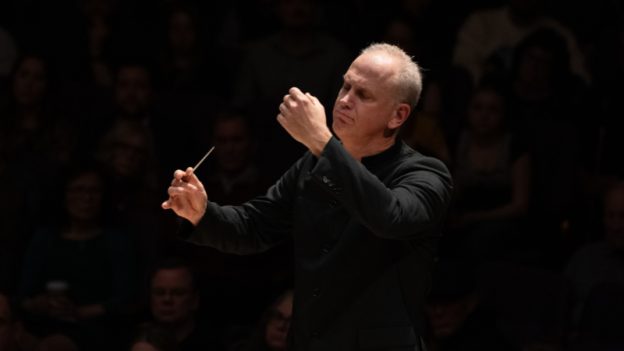
North Carolina Symphony; Carlos Miguel Prieto, conductor; Vadim Gluzman, violin.
Pyotr TCHAIKOVSKY: The Year 1812, Festival Overture, Op. 49 (1880)
Pyotr TCHAIKOVSKY: Violin Concerto, Op 35 (1878)
Maurice RAVEL: Daphnis et Chloé (1909–12)
Christopher Hill | 24 FEB 2026
The North Carolina Symphony’s second February program was notable for its sensitivity and thoughtful touches during the first portion and for its world-class performance during the second.
The program began with The Year 1812, an overture more often heard outdoors than indoors. It opens with liturgical chant. In a pre-concert chat, music director Carlos Miguel Prieto recalled the impression this opening made on him some years back when he performed it with a male chorus. In this weekend’s concerts, Prieto continued, you’ll hear the lower strings trying to replicate (as well as instruments can) that quality of humble devotion so characteristic of monastic chant.
That opening section of the overture functions as a prelude to the kind of introduction to a sonata form Haydn made popular. There follows the agitated beginning of the sonata form itself, music in some places not unlike that found in dramatic bits of Tchaikovsky’s Romeo and Juliet overture, and at its best not unlike that of the Pathétique Symphony’s first movement. Indeed, the whole torso of The Year 1812 is well wrought, its craftsmanship (in your reviewer’s humble opinion) somewhat superior to that of the Violin Concerto’s first movement. And the torso’s coda begins brilliantly, with an unexpected recasting of the prelude’s liturgical theme. But the coda then devolves into, as Tchaikovsky knew, empty rhetoric and bombast, created not by bells, cannons, or any instrumentation but by the sheer paucity of its musical argument.
Despite any regrets Tchaikovsky later had, the composer knew exactly what he was doing communicatively in this coda, and who can argue with the consistency of ecstatic audience response to it over the last 144 years? Not this reviewer. After the final blaring trombone fell silent, the Raleigh audience jumped to its feet and cheered with such unrestrained energy as to suggest that the Fourth of July falls in February. Indeed, the audience was so stirred that when the first movement of the Violin Concerto ended, members again leapt to their feet and cheered wildly. It was only after they sat down a second time and discovered the concerto wasn’t over that the coughing started. Well, the hell with decorum, I say. But it would also be nice to hear music without nervous coughing.
For Tchaikovsky’s beloved Violin Concerto, music director Prieto invited, not for the first time, a long-time musical colleague, Vadim Gluzman, to solo with his ensemble. The concerto was not a work Tchaikovsky had planned to write, but a confluence of circumstances conspired to produce this masterwork. Early in March 1878, the composer decamped at his new patroness’s Swiss estate, still recovering from a failed marriage and subsequent suicide attempt. At her estate, he was joined by a kindly and sexually omnivorous violin virtuoso and composer, Iosef Kotek, who introduced him to Eduard Lalo’s 1874 Symphonie espagnole. Lalo’s work impressed Tchaikovsky greatly by its originality, seriousness, and passion. A flood of his own musical ideas followed, perhaps fueled in part by a crush on Kopek. With the latter’s expert help, the concerto was completed by month’s end, at which time Tchaikovsky was able to write of Kotek, “How lovingly he busies himself with my concerto! It goes without saying that I would have been able to do nothing without him.”
Back in Moscow, Tchaikovsky asked the great violin pedagogue Leopold Auer to give the work its premiere. Auer declined. Your reviewer’s guess is that Auer smelled someone else’s pedagogy in the violin’s idiomatic figurations and technical challenges. Auer went so far as to declare the deftly written violin part “unplayable.” You know, when those big nineteenth-century egos felt slighted, they didn’t pull any punches, did they? Later, after the concerto had proven to be a hit worldwide, Auer started playing it, but not without snipping out trivial bits of the violin’s passagework, no doubt to make it playable. Fortunately, the overall result was something like pulling a teabag out of a big mug ten seconds earlier. “Fortunately” because Auer’s snipped version is the one used by Gluzman this weekend.
In his youth, Ukraine-born and Chicago-based Gluzman was a protegé of Isaac Stern. Gluzman plays a 1690 Stradivarius, the “Ex-Leopold Auer,” indicating that his is the very instrument used for the premiere of Auer’s snipped version of Tchaikovsky’s concerto — a dubious distinction, perhaps. The instrument resonates with the rich, throaty low tessitura and satisfyingly complex high tessitura for which Strads are renowned. These days, many instruments like this one are owned by corporations or billionaires. Access to them is usually competitive, and when a violinist has one to use, it indicates a high level of technical and artistic proficiency. Gluzman clearly qualifies, and he makes the instrument sound gorgeous.
At the same time, not every night is a performer’s best night. On Saturday night, your reviewer got the strong impression that Gluzman mastered this concerto many years ago and has since performed it so often that he could play it beautifully in his sleep — and was doing exactly that in Meymani Hall. Such, at least, was my impression before the first movement cadenza, which comes not near the end of the movement (as in Beethoven and Brahms) but at the end of the development (as in Mendelssohn). In the cadenza, one started hearing a quite different violinist, one deeply engaged with the music, not just handy with the notes. The new Gluzman played the rest of the Tchaikovsky concerto personally, with inwardness as well as flair. He took the fast portions of the last movement so fast that Heifetz, by comparison, sounds somewhat turtlelike. At the same time, Gluzman also invested the last movement’s several slow passages with genuine soulfulness. Overall, his turned out to be an impressive performance.
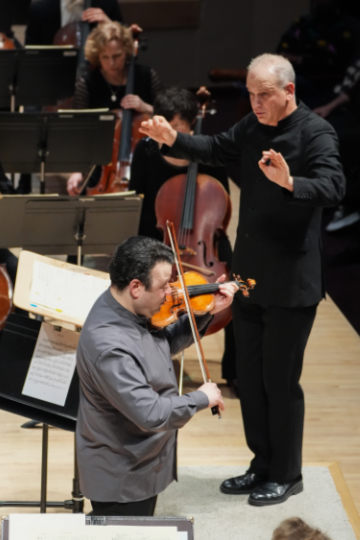
Vadim Gluzman solos in Tchaikovsky’s ‘Violin Concerto’ with Carlos Miguel Prieto and the North Carolina Symphpy. (courtesy of NCS)
Gluzman’s unusual choice of encore provided one of the thoughtful touches mentioned at the opening of this review. The concert had, as noted, opened with Tchaikovsky’s sextet of solo violas and cellos; now the first portion concluded with a sextet of violins performing a ravishing and utterly unsentimental arrangement of Percy Grainger’s “Irish Tune from County Derry” made by Atlanta-based violinist-composer Alice Hong, who has been praised before on this website. Imagine how one might put into sound a spacious landscape of varying greens, across which move with solemn dignity cloud shadows cast from the gentle blue sky above. Hong has achieved something like this and, at the same time, has extended Grainger’s own compositional voice, which tended more and more to use tone clusters as he aged. ’Twas a long, rapt moment thanks to County Derry, Percy Grainger, Alice Hong, Vadim Gluzman, and his five North Carolina colleagues, Justin Bruns (concertmaster), Anna Black (acting associate concertmaster), Karen Galvin (assistant concertmaster), Jacqueline Wolborsky (principal 2nd violin), and Tiffany Kang (associate principal 2nd violin).
Now to the program’s second part. In 1906, Sergei Diaghilev presented an art exhibition in Paris titled “Two Centuries of Russian Art and Sculpture,” featuring avant-garde work by Leon Bakst. The show’s success emboldened Diaghilev to return the following year with a program of avant-garde orchestral and vocal music by Rimsky-Korsakov, Rachmaninoff, and Scriabin. The conductor was Koussevitsky. The soloists were Félia Litvinne and Feodor Chaliapin. To put this in perspective, 1907 was also the year in which Maurice Ravel was creating the first of his famous orchestral works, the Rhapsodie espagnole. The success of the Russian concert emboldened Diaghilev to return to Paris the next year with a lavish production of Mussorgsky’s opera Boris Gudinov featuring Feodor Chaliapin. Afterward, with three big successes notched now in his belt, Diaghilev decided to throw caution to the winds and create his own Parisian ballet company, the Ballets russes, to perform, starting in 1909, during the summer months, after the regular ballet season was over. For his first summer season, Diaghilev featured danced versions of modern Russian novelties like Rimsky-Korsakov’s Scheherezade; but he also ventured into non-Russian territory with a performance of Les sylphides, a ballet comprising orchestrations of piano music by Chopin. For some of those orchestrations, he used Rimsky-Korsakov’s student, Igor Stravinsky.
Diaghilev played it safe, musically speaking, in his 1909 season, but he already had bold plans for his second season, and to that end, in early 1909, he commissioned two ballets, the first to music by the prestigious Ravel, the second to music by the little-known Stravinsky (after Liadov declined). Stravinsky’s Firebird proved a sensation during the 1910 season, but Ravel’s Daphnis et Chloé was not ready yet for production. For the 1911 season, Stravinsky provided a second sensation, Petrushka, but Ravel’s Daphnis et Chloé was still not ready. Finally, at the opening of the 1912 season, Daphnis et Chloé was ready. What took so long?
Well, some composers write fast, like Mozart, Schoenberg, and Stravinsky, and some write slowly, like Beethoven, Brahms, and Ravel. But that can’t be the whole story, for a frustrated Ravel turned some of his Daphnis music into an orchestral suite that was performed and published in 1911. Another, more interesting reason the ballet took so long to complete was the way it developed — namely, through conflict between Russian and French expectations.
We Americans, who tend to parse our lives through consumer behaviors, know well that “sex sells.” For the Russians in 1909, this was true, too, but the emphasis during the first decade of the twentieth century was more that sex liberates. The Russian composer Scriabin was especially influential in this regard, and from the very first season of the Ballets russes Diaghilev’s choreographer and scenic director, Michel Fokine and Leon Bakst, respectively, began liberating Parisians by flaunting on stage suggestive movements performed in filmy, see-through pantaloons (in 1909 on women, in 1910 even on men) as well as through other calculated sartorial deficits.
For Daphnis et Chloé Bakst had taken a simple story from ancient times — a love triangle with a shepherd, a shepherdess, and a cowherd at its vertices — and developed it into what was intended to be the boldest foray yet into the liberation of Parisians from nineteenth-century convention. Meanwhile, Maurice Ravel was taking Daphnis in quite a different direction. As the composer once explained, in Daphnis: “I was [concerned] with fidelity to the Greece of my dreams, which identifies willingly with that imagined and depicted by French painters at the end of the 18th century.” Here, Ravel alludes especially to canvases of Jacques-Louis David and, especially, Hubert Robert, in which exaggeratedly monumental Greco-Roman ruins are painted as seductive landscapes into which viewers can project themselves and let their imaginations run riot. In Robert’s canvases people, when they do appear, are so dwarfed by the immensity of the ruins that they become mere smudges of paint amidst a highly articulated memorialized environment.
In theory, Fokine and Bakst’s sexually permissive world could have nestled comfortably among Robert’s fantastic ruins. But painting in the Age of Napoleon (in certain respects a moralizing age) was not painting in the era of Louis Quinze. Ravel understood this well, and when his imagination ran riot amongst the ruins, it turned out there was little room for licentiousness within these dream landscapes.
In short, fights ensued between Ravel on the French side and Fokine/Bakst on the Russian side. The latter changed their scenario and dance on occasion to fit Ravel’s music. The former, on occasion, rewrote his music or substituted new music to fit Bakst’s scenario and Fokine’s evocative undulations. These compromises happened not once, not twice, but several times over. The result ended up taking three years, and to judge from what happened next, the end result may have been frustrating in the extreme for the choreographer and set/costume designer.
What happened next? Your reviewer vividly remembers hearing Stravinsky in the early 1960s relate, in regards to Diaghilev’s next original ballet, The Rite of Spring, how the famous riot on its opening night was due not to Stravinsky’s own adventurous music but to the unbridled sexuality of the ballet’s choreography, in which, as I recall Stravinsky putting it, “a troupe of Lolitas” — that is, female tweener sexual predators (a male fantasy, to be sure) — behaved very naughtily on stage.
That was 1913. The previous year, no social riots attended the Daphnis et Chloé premiere. Imaginative riots, however, abound in the musical score, perhaps Ravel’s most complex and perfectly finished. Stravinsky later called it “not only Ravel’s best work, but also one of the most beautiful products of all French music.”
In his pre-concert chat, Prieto said that he has known and loved Daphnis most of his life, that he first became acquainted with it through his French grandmother. Ravel extracted two orchestral suites of music from the ballet, of which the second suite is the one more often played. The suite from Daphnis heard in Raleigh this weekend, however, was one of Prieto’s own devising. It includes about forty minutes of the ballet, considerably more than either of Ravel’s suites, which, even when played together, last only around 29 minutes.
Anyone exposed to Hollywood soundtracks from the late 1940s will feel familiar with the sophisticated harmonic and melodic style of Ravel’s Daphnis et Chloé. The work has clearly been a touchstone for umpteen composers, and for the best of reasons. The orchestra is large, and the scoring frequently asks all sections to play at once. Yet thanks to Ravel’s sensitivity in mixing tone colors, the score also sounds transparent, with instruments easy to identify and follow. Further, instruments almost always play within their most sonorous range, not at Mahlerian extremities. The result is a uniquely warm, burnished, and sensuous sound.
The description just given should not be taken to mean that Daphnis et Chloé is easy to play. It is not. The above phrase “thanks to Ravel’s sensitivity …” should be amended. What greeted your reviewer’s ears on Saturday evening were not sounds entirely determined on paper or even on vinyl but actual sounds in real time played by actual people led by an actual musical, disciplined, and canny music director, for all of whom realized this music sounded to your reviewer like a labor of love. I heard nothing but euphony, incisive energy, and exquisite balances.
Aware that, in reviews of the NCS, I tend to praise the ensemble and its conductor more often than not, your reviewer kept closing his eyes and imagining himself in the halls of other (big-name) orchestras familiar to him. He kept trying to hear something that would have disappointed had the name of the orchestra making those sounds been, say, Berliner Philharmoniker. For example, all the best orchestras have principals with unique personal styles of considerable subtlety. Each ensemble has its own distinctive tone and voice, without which the musical world would be poorer. On Saturday evening, playing Ravel, the North Carolina Symphony under Prieto sounded its unique voice in a way your reviewer had not heard before. Maybe if one made an A-B comparison of the NCS and different orchestras, across a wide range of repertoires, one could quickly identify that this or that other orchestra was superior. But not when Ravel’s Daphnis et Chloé was the piece being played. Yes, on Saturday night, the North Carolina Symphony under Prieto rose to a level not heard by your reviewer before. It was unarguably world-class. ■
EXTERNAL LINKS:
- North Carolina Symphony: ncsymphony.org
- Carlos Miguel Prieto: carlosmiguelprieto.com
- Vadim Gluzman: hvadimgluzman.com

Read more by Christopher Hill.


.png)