
April 11, 2026
Mt. Pisgah Church – The Underground
Johns Creek, Georgia – USA
Imagine: What We Carry
Johns Creek Symphony Orchestra; Henry Cheng, conductor; Sarah Kapps, cello; Adelaide Federici, violin.
John CAGE: 4’33”
J.S. BACH: “Sarabande” from Cello Suite No. 2 in D minor
Arvo PÄRT: Fratres for string orchestra
Dmitri SHOSTAKOVICH: Chamber Symphony, Op. 110a
J.S. BACH: “Andante” from Violin Sonata No. 2 in A minor
Ralph VAUGHAN WILLIAMS: Fantasia on a Theme by Thomas Tallis
Howard Wershil | 16 APR 2026
How often, for a symphony concert, do you enter a dark, cozy, atmospheric space that fills you with such wonder and curiosity that you can’t imagine what the evening will present? How often does that space feel not just like a space to hear, but a space to be, to go deep inside yourself, as well? How often does your concert’s program include an eye mask, allowing you to fade into your own personal world and experience the concert sensation with a heightened sense of listening? And how fortuitous is it that such a space should be called “The Underground?”
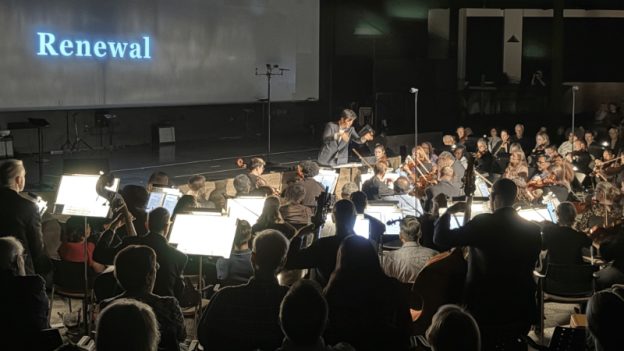
While most of the concerts presented by the Johns Creek Symphony Orchestra occur in the main sanctuary of Mt. Pisgah Church, this particular concert, consisting only of its string section and percussion, was instead scheduled in the church’s basement-to-the-side, a gathering area with several meeting rooms and a presentation area with black and grey surfaces and warm, muted acoustics — an area presumably more intended for social gatherings and youth activities than for church services and major symphonic expressiveness.
It was an inspired choice. The venue exuded its own particular, peculiar, and necessary sense of calm for the events about to occur. And why not? The concert presented this evening by the Johns Creek Symphony Orchestra was personally conceived by Music Director Henry Cheng, on topics and emotions close to his heart. In theme and content, this was like no other concert I’ve ever encountered, even including a panel discussion about music and healing after the concert, extending the fulfillment we all experienced.
Henry Cheng himself, in an insert to the program notes, offers his vision clearly: “Some music is loud. Tonight’s isn’t. This concert is about listening – to silence, to grief, to breath, to beauty. It’s a reminder that what we carry isn’t always visible… but it’s felt. Let this hour be a space where we don’t rush to move on. Instead, we stay, and feel, and remember: we’re still here.”
Seating for this concert was unique in itself: The orchestra, placed on the lowest point of the floor, faced a stage, with the audience seating placed behind the orchestra. Interspersed among the last two rows of the orchestra were several duets of chairs, providing those lucky occupants an opportunity for orchestral immersion rarely afforded to mere attendees. Being one of those individuals who values a sense of privacy while enjoying a musical event, I chose to be seated close behind the orchestra, rather than within, but still close enough to the performers to feel a kindred connection, and close enough to the music to feel significant wonder and awe.
The selections offered on this concert were divided into four sections, each with its own significance to the theme of “What We Carry.” In introducing the initial offering, director Henry Cheng shared an honest moment from his life, a moment of challenge and doubt, a moment such as many of us can, and do, and will experience, thus setting the stage for an audience experience of music that can yield truth, and hope, and vulnerability, and an appreciation for the powerfulness and expansiveness of human condition… if you listen with an open heart.
Invocation
4’33” by John Cage is not a piece you would expect to hear from a symphony orchestra… yet, in its nature, it can be performed by any musical entity. Composed in 1952, the composition consists of 4 minutes and 33 seconds of silence. But in that span of silence, we come to know more of the world immediately around us, the environmental sounds, breathing, our own heartbeats, whatever natural music enters our auditory experience. Being familiar with the piece, I had wondered whether it would be introduced or simply performed without audience preparation, with my own sense of impish evil much preferring the latter. Instead, Cheng made the wise decision to properly introduce the piece, giving the audience a chance to fully appreciate its significance from the outset. I found the experience one eliciting a sense of reverence. Perhaps, as we humans may revere life even more after a gentle, mindful slumber, we may also revere music even more after such a candid, well-conceived, zen-like escape.
The JCSO’s performance of 4’33” was truly sublime.
J.S. Bach’s “Sarabande” from Cello Suite No. 2 in D minor, beautifully and sensitively performed by cello soloist Sarah Kapps, gave us a marvelous introduction to the sonic components yet to come in the evening’s unfolding journey. This is a wonderful, poignant piece of music, well suited as a key to unlock whatever chambers that may be hiding our most solemn and intimate feelings.
Fratres for string orchestra by Arvo Part is a true marvel, speaking emotional volumes in its simplicity, gentleness, and strength. In its performance of this masterpiece, the Johns Creek Symphony Orchestra shone so brightly, offering us every degree of nuance necessary to exert this composition’s power over us, allowing it to effortlessly cast its spell. While “awe” and “reverence” are words that can become trite in their overuse, they still seem appropriate, in this instance, to express the resulting effect of such an astounding composition.
It’s not often that a concert presentation brings me close to tears. Did someone this evening not suggest that part of healing is letting out your emotions? Do not the efforts of composers and performers encourage just that? Thank you, thank you, JCSO. I’m sure the audience thanks you as well.
Memory
Memory — it’s always with us. We may experience it in its entirety, or in fragments at times, sometimes transformed from its initial reality to a biased recollection, or even to a destructive but persuasive fallacy. Memory, by nature, can be forgotten or lost, but we carry its influences with us… truly, always, persistently, regardless of description or status or state.
The choice of Dmitri Shostakovich’s Chamber Symphony Opus 110a to express this phenomenon proved to be a brilliant one. While it’s certainly not unusual for pre-20th-century composers, within a composition, to play with themes in a referential, transformational, memory-like fashion — and, given the political limitations to which Shostakovich was subject, we can question whether or not to consider him a 20th-century composer — Shostakovich takes this practice, in his Chamber Symphony, in astounding and unique directions.
The length of the composition (and this was, in fact, the longest work on the evening’s program) affords the composer more than ample room to play with, transform, twist, raise, lower, hide, resurrect, neglect, overstate, shout, whisper, blast, and mute every one of the many themes presented. Shostakovich does so in the most surprising and compelling ways.
The piece progresses thematically and dramatically in what might be considered a conventional fashion, with expected highs and lows, loud passages and softer, gentler passages, but all with the sense that something’s different, something’s out of place, something’s wrong — but maybe it’s not. The sense of unease created within a context of assurance is truly remarkable and eerily effective. The music builds to a most unusual climax: just a few instruments softly and disjointedly performing several of the themes that occur in the piece, if not all of them, before returning to the progress of the work at large. This moment — this climax, this unexpected interruption — somehow solidified, in my mind, the entire concept of memory, its complete embodiment, with all its power, consequences, inconsistencies, and unreliability.
And then, when you might expect, conventionally, for the piece to begin to wind down — it doesn’t. In fact, it continues for quite a while beyond an expected point of conclusion, without disappointment, boredom, or impatience, perhaps demonstrating that the memories explored in this piece, through thematic development and transformation, will always be available to confound and amuse us.
This was the first time I had heard this composition, and I appreciate the JCSO bringing it to the audience’s attention. Their rendition of this piece was dynamic, vigorous, and highly enthusiastic, bringing Shostakovich’s vision clearly to light. While I do have to admit that I heard odd moments of struggle in the more rapid, frenetic passages, it was hardly enough variation from excellence to detract from the decisive power of their wonderful performance.
Stillness
If stillness is the point at which we finally gather our thoughts for future progress, then J.S. Bach’s “Andante” from Violin Sonata No. 2 in A minor must have been selected to provide us with a timely sense of balance and calm. Violinist Adelaide Federici’s sensitive performance accomplished the goal admirably. This piece didn’t have the poignancy of the previous Bach offering, and in the context of the theme and progress of the evening, we can be grateful for that. Given that this concert features two compositions by the master, referencing two very different emotional states, I find myself reconsidering his importance. Maybe in its elegance and structural perfection, the music of J.S. Bach is still the best projector from which we can absorb the widest variety of our most simple and profound emotional experiences.
Perhaps.
Renewal
I have a confession to make; one a reviewer would not normally share. But after such an emotionally satisfying concert as this, with such profound and valuable themes, with such resonances with vulnerability and the human condition, how can I not be honest? With my readers. With the audience. With myself.
And so, to be honest: I did not read the entire program fully before the concert began. In fact, I thought the concert ended with the last Bach performance. But behold, so much unexpected delight to come! When Ralph Vaughan Williams’ Fantasia on a Theme by Thomas Tallis began, I was transported to Heaven. How could this happen? Who would think to add a piece to the concert that wasn’t on the program? And what could an audience think of such a profound gesture? Never mind that this happens to be one of my favorite compositions, always filling me with a sense of freedom, and wonder, and imagination, and hope. How fortunate could I be to be imbued with such a sense of… renewal!
Of course, I know better now. But happy accidents do happen, even rather strange ones. And aren’t we fortunate for that!
Fantasia on a Theme by Thomas Tallis is one of those rare compositions that I believe will always stand the test of time. As a fantasia containing few themes, it grows and develops, shifts and pauses, and progresses with a sense of freedom that invokes joy and hopefulness if not absolute jubilation. The performers of the Johns Creek Symphony Orchestra brought this majesty to our perception magnificently. I’ve heard this piece on recording many times, but I’ve not heard it performed live. Being seated so close to the orchestra — close physically, close musically, close emotionally — I heard elements and contrasts, details and nuances, that I had never heard in a recording, and I feel so very fortunate to have had that opportunity.
Concerts such as this — concerts that focus on the emotional power of music and its relation to the human condition in profound and imaginative ways, and theme it accordingly — are indeed rare. While a part of me would like to see so many more concerts like this, I do wonder if the power of such a concert might not be due to its inevitable infrequency. More than other concerts I’ve attended, I felt included in this one, drawn in, intentionally satisfied, and I dearly believe the audience felt the same. Even if a concert such as this should not happen again, we have it in our memory. We have it in our hearts. We have silence and stillness and renewal to value, as long as we can appreciate the strength of its allure.
The power of music is available to us all. ■
EXTERNAL LINKS:
- Johns Creek Symphony Orchestra: johnscreeksymphony.org
- Henry Cheng: henrycheng.com

Read more by Howard Wershil.
RECENT POSTS
 Houston Symphony pairs Stravinsky’s austerity with Mozart’s grandeur, Mackey’s inventiveness • 20 Oct 2026
 Raven Chacon’s “Voiceless Mass” anchors an immersive evening with ensemble vim and Bent Frequency • 19 Oct 2026

.png)