
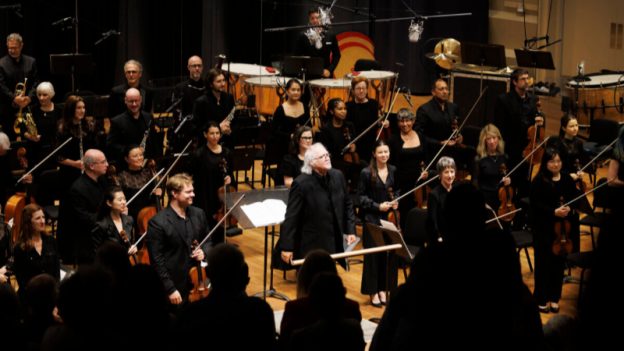
Grand Teton Music Festival Orchestra, Sir Donald Runnicles, conductor.
Gustav MAHLER: Symphony No. 5
Reference Recordings FR-763SACD
Formats: Hybrid SACD, digital
Release Date: March 13, 2026
Total Duration: 72:57
Giorgio Koukl | 16 APR 2026
Released by Reference Recordings, a new rendering of Gustav Mahler’s Symphony No. 5 has been made by the Grand Teton Music Festival Orchestra, conducted by Sir Donald Runnicles. Recorded live in July 2024 at Walk Festival Hall, it features soloists like Thomas Hooten (trumpet) and Gail Williams (horn).
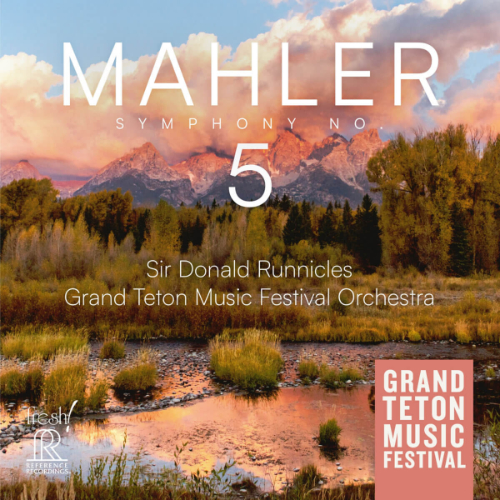
FR-763SACD (click to enlarge)
In fact, what is striking immediately is the incredible quality of the entire brass section, something quite unheard of here in Europe, maybe with the exception of a few Eastern European orchestras.
This recording enters into direct competition with rather massive precedent renderings by names like Bernstein, Barbirolli, or Kubelik. Let us briefly examine the main differences of some of them:
- One of the first known recordings, despite its obvious technical limits, is still at the top of the list: it was conducted by Bruno Walter with the New York Philharmonic in 1947. It is an essential historical document as Walter was Mahler’s protégé. Known for swifter tempos, which were never used in later recordings.
- Leonard Bernstein and the Vienna Philharmonic recorded a version in 1987, which is perhaps the most well-known. Highly emotional and visceral, it captures well the journey from darkness to light.
- Claudio Abbado and the Berlin Philharmonic. Praised for its structural clarity, transparency, and technical perfection, but sometimes too dry sonics.
Well, in this dense and high-quality world, Sir Runnicles and the GTMF Orchestra enter with ease and often obtain far better results. The technical part certainly plays a great role. Recorded in High Definition (24-bit / 192 kHz), it features Dolby Atmos and Hybrid SACD formats. The very exhaustive booklet describes in great detail the exact recording and technical means used, a rarely known but important piece of information.
Mahler’s Symphony No. 5 (1901–1902) is considered a monumental work marking a turning point in his career, moving away from the folk themes of “Des Knaben Wunderhorn” toward a purely instrumental, contrapuntal language.
It is structured in five movements.
- First movement (“Trauermarsch”): Begins with a famous, haunting trumpet fanfare in triplets, the “fate” motive. It alternates between elegiac resignation and outbursts of wild despair. Sir Runnicles has chosen quite slow tempi, which serve him very well indeed. It is a real explosion of the brass section and a great showcase for the orchestra.
- Second movement (“Stürmisch bewegt”): A violent response to the march, characterized by “demonic” energy. A brief D-major chorale appears as a glimpse of hope but collapses by the end.
- Third movement (“Scherzo”): The longest movement and the heart of the symphony. Based on typically Viennese Ländler and waltz rhythms, it features an “obbligato” solo horn.
- Fourth movement (“Adagietto”): Scored for strings and harp only, it is often interpreted as a musical love letter to his wife, Alma. It is an oasis of ecstatic lyricism.
- Fifth movement (”Rondo-Finale”): A masterpiece of counterpoint and fugues that transforms the ”Adagietto” themes into a joyful, triumphant conclusion.
The world premiere in Cologne (October 18, 1904) was a critical disaster. Mahler famously said, “No one understood it. I wish I could conduct the premiere fifty years after my death.”
Critics found the orchestration (especially the brass) aggressive and chaotic.
Critic Rudolf Louis wrote: ”If music could smell, Mahler’s Fifth would emanate the odor of putrid exhalations.”
Even his wife, Alma, hated the “Finale,” calling it a “boring academic exercise in counterpoint.” In a letter Mahler wrote to her the morning after the premiere, calling the Fifth a “cursed work” and admitting he felt like a “beginner” who had forgotten how to orchestrate, leading him to revise the score until his death in 1911.
Probably the brilliant but thick orchestration was the main cause for such a disastrous result. Even regarding Bruckner or Brahms, who were certainly considered the standard for a “German” symphonic model, such a violent reaction today is quite incomprehensible. In fact, this work now holds its place firmly among the standard symphonic repertoire.
This release, with its high quality, will surely contribute to a better understanding of this score and, as such, is an easy recommendation. ■
EXTERNAL LINKS:
- Grand Teton Music Festival: gtmf.org
- Donald Runnicles: donaldrunnicles.org

Read more by Giorgio Koukl.


.png)