
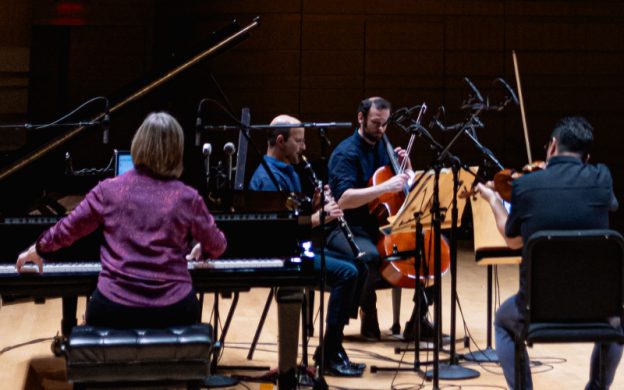
Orli Shaham, piano; members of Pacific Symphony (Richard Cassarino, bass; Meredith Crawford, viola; Tony Ellis, trumpet; Warren Hagerty, cello; Dennis Kim, violin; Joshua Ranz, clarinet; Benjamin Smolen, flute).
Viet CUONG: Wax and Wire
Reena ESMAIL: Saans
Peter DAYTON: Fantasy
Aver DORMAN: Sextet
Sarah Kirkland SNIDER: The Currents
Ari Barack FISHER: Romance for Cello and Piano
Jessie MONTGOMERY: Peace
Margaret BROUWER: Parallel Isolations
Pacific Symphony PDR01
Formats: CD, digital
Release Date: February 13, 2026
Total Duration: 72:48
Giorgio Koukl | 27 APR 2026
American Tapestry seems to be a very clever and descriptive title chosen for this all-American composers CD. Indeed, it represents a wide array of personalities and composing techniques, and even without being specifically designed to cover the entire panorama, nonetheless it is very impressive in showing the immense variety of talents that America today can offer.
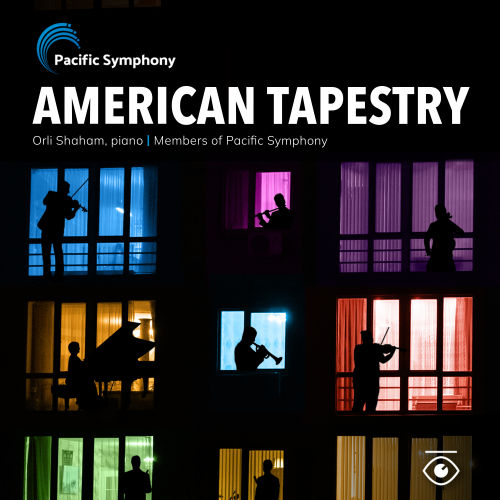
American Tapestry (PDR01) cover art (click to enlarge)
The eight names chosen are mostly unknown here in Europe, but would certainly deserve more attention from the concert planners. They are: Margaret Brouwer, Jessie Montgomery, Sarah Kirkland Snider, Aver Dorman, Viet Cuong, Reena Esmail, Peter Dayton, and Ari Barack Fisher.
Two of the scores have been written on request of the central force of this project: the pianist Orli Shaham, together with musicians of the Pacific Symphony, and are here recorded in world premiere. This is the Sextet of Aver Dorman, with its four movements the longest work on this installment, and Parallel Isolations of Margaret Brouwer.
But let us start with the first track, which is probably the best one on the whole CD.
The Vietnamese-American composer Viet Cuong calls his seven-minute-long work Wax and Wire. It is a real explosion of ideas, rapid and brilliant passages, and infinite inventive capacity. Written for clarinet, violin, cello, and piano, it is magnificently played by Joshua Ranz, Dennis Kim, Warren Hagerty, and Orli Shaham. One can only silently admire the precision of interplay of these gifted musicians. Listening to the recording for the first time, there seems to be far more than four musicians, as the density and dynamic array suggest a much larger ensemble.
Reena Esmail, with her trio Saans, has a completely different approach to making music. It is introspective, has a certain calm, and a very nice balance between the instruments. She uses moments of silence wisely and is lucky to have these musicians to play her score. They are certainly able to build the necessary agogical tension in a way that never trespasses the tiny border of being too bland, a danger which, in the hands of less gifted musicians, certainly would be present.
Peter Dayton’s Fantasy for viola and piano, magnificently played by Meredith Crawford and Orli Shaham, is an introspective, finely woven five-minute piece. Given the general lack of valid pieces for viola, it will certainly be more than welcome by violists.
It is extremely well written for the instrument, a not-so-easy task, as composers generally tend to consider the viola simply a “bigger brother” of the violin and so miss many of the possibilities this beautiful instrument offers.
The longest score of this CD follows: Aver Dorman has his Sextet conceived in four movements: “Allegro,” “Andante,” “Hocket,” and “Scherzo.”
The composer, in the short but exhaustive booklet, explains his idea of contrast, taking examples from Schumann and his two alter egos, Florestan and Eusebius, which is certainly a nice way to recuperate some roots from the past and use them today.
Here, the musicians are joined by a fabulous trumpeter, Tony Ellis, and equally valid bassist Richard Cassarino. Once again, they play with an ensemble capacity which has no equal, certainly a fruit of long hours of rehearsing.
Sarah Kirkland Snider has written a short piano solo piece called The Currents, in which she makes extensive use of musical cells that develop into a web of interchanging ideas, something the minimalists have done before but treated in a less dogmatic way. Orli Shaham plays this music with dedication and precision. Maybe some more agogical freedom would have added a hint of more intensity.
The Romance for cello and piano by Ari Barack Fisher is exactly what the title suggests: a neo-romantic slow piece with a lot of sweet melodies. Despite its somewhat more dramatic climax, this score offers little beyond the usual.
The short work by Jessie Montgomery for violin and piano, called Peace, is, in a certain way, similar to the precedent. Maybe the more interesting use of dissonance offers the listener a greater intellectual challenge.
The last track, written by Margaret Brouwer during the pandemic, is titled Parallel Isolations. We can appreciate here the contribution of the flutist Benjamin Smolen, certainly another very credible instrumentalist. The sudden changes of mood reflect well this dark moment of solitude. The piano solos are hellishly difficult and played with great energy by Ms. Shaham.
This is certainly a nice way for anyone to take a glimpse into today’s American compositional scene, which seems pretty lively and variegated. ■
EXTERNAL LINKS:
- Orli Shaham: orlishaham.com
- Pacific Symphony: pacificsymphony.org

Read more by Giorgio Koukl.





.png)