
May 23, 2026
Mt. Pisgah Church
Johns Creek, Georgia – USA
“Passing The Baton”
Johns Creek Symphony Orchestra; Henry Cheng, music director; David Coucheron, violin; Julie Coucheron, piano.
Felix MENDELSSOHN: Scherzo from A Midsummer Night’s Dream, Op. 21
Felix MENDELSSOHN: Concerto for Violin, Piano and Orchestra in D minor
Felix MENDELSSOHN: Symphony No. 4 in A major, Op. 90 “Italian”
Howard Wershil | 4 JUN 2026
I have to admit it. I really enjoy attending concerts. All kinds. For those of you who have read more than one of my reviews, you already know that these concerts can be orchestras, ensembles, music with dance and visual art… all kinds of concerts. We encounter musical events in a variety of venues and a broad spectrum of locations, each with its own atmosphere and appeal. And each musical performance group I’ve had the pleasure of experiencing offers unique strengths and qualities that shine a light on the peculiar sound phenomenon we call music.
The Johns Creek Symphony Orchestra is certainly no exception to this collection of sonic illuminators. For the final performance of their 2025 – 2026 concert season, under the heading of “Passing The Baton,” the Johns Creek Symphony Orchestra offered us a bright, optimistic program of music featuring, exclusively, the accomplishments of composer Felix Mendelssohn, and the exceptional performance talents of violinist David Coucheron and his sister, pianist Julie Coucheron. It was a wonderful concert, filled with light and color. But why, one could ask, would you feature only Mendelssohn? And why, one might also ask, would you title a concert “Passing The Baton?”
According to the ever-present Google AI Overview, “The phrase ‘passing the baton’ is a powerful idiom adapted from relay races, representing the smooth and intentional transfer of leadership, responsibility, or a legacy from one person or generation to the next. It emphasizes collaboration and continuous momentum toward a shared goal.”
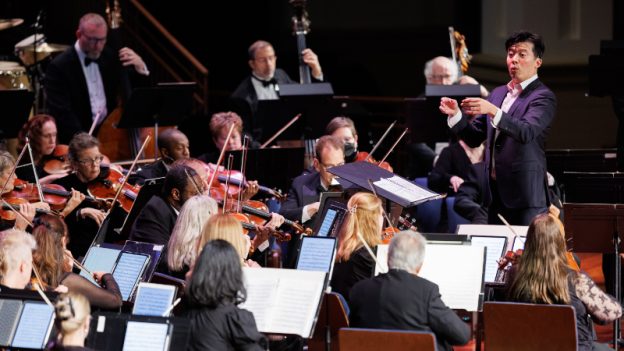
Tonight’s event was, among other things, a celebration of maestro Henry Cheng’s acquisition of his role as music director, and his subsequent accomplishments in that role. The concert began with a video highlighting the year’s musical activities, immediately followed by a performance of the first selection on the concert, Mendelssohn’s ”Scherzo” from A Midsummer Night’s Dream, Op. 21. The piece was performed with magnificent spirit, showing off the orchestra’s fine capacity to express effective dynamic range and subtle detailing. It was a marvelous rendition, and extremely enjoyable to hear.
After that, Cheng addressed the accomplishments and forward strides of the JCSO during its 2025–2026 season. The expansion of the orchestra and its outreach is impressive, including a) expanding their education program from serving hundreds in the community to serving thousands; b) developing more partnerships, not only with local organizations, but with international organizations as well; c) mounting their first international tour, to Vietnam, as a representative of the United States, thus encouraging a continuing partnership between the United States and Vietnam; d) creating new concert concepts, including that of inviting the audience to sit with, and within, the orchestral performers’ domain. Cheng emphasized that, as the theme of the year’s activities declares, it was all done within the context of “the simple act of imagining.” He continued to share, with very heartfelt sincerity, that he has found a community he loves, finding inspiration, support, and, of course, challenges in moving the orchestra forward to new heights and visibility.
An example of the JCSO’s new partnerships was highlighted by the performers featured on the next selection, violinist David Coucheron and his sister, pianist Julie Coucheron, both well-established, well-respected performers in and beyond Atlanta’s music community. Both are members of the Georgian Chamber Players, and David Coucheron is also concertmaster of The Atlanta Symphony Orchestra. Both of their performances in Mendelssohn’s Double Concerto for Violin, Piano, and Orchestra were exceptional, showing great sensitivity and confidence. Both of their performances were magnificently supported by the JCSO’s own polished skills. I might have said “were, surprisingly, magnificently supported,” in a prior year, or an alternate universe, but not here. I’ve heard, with my own ears, the strides this symphony has accomplished, especially during the past year. There is no “surprise” here on my part, only delight and appreciation. In the past year, the Johns Creek Symphony Orchestra has surely come into its own.
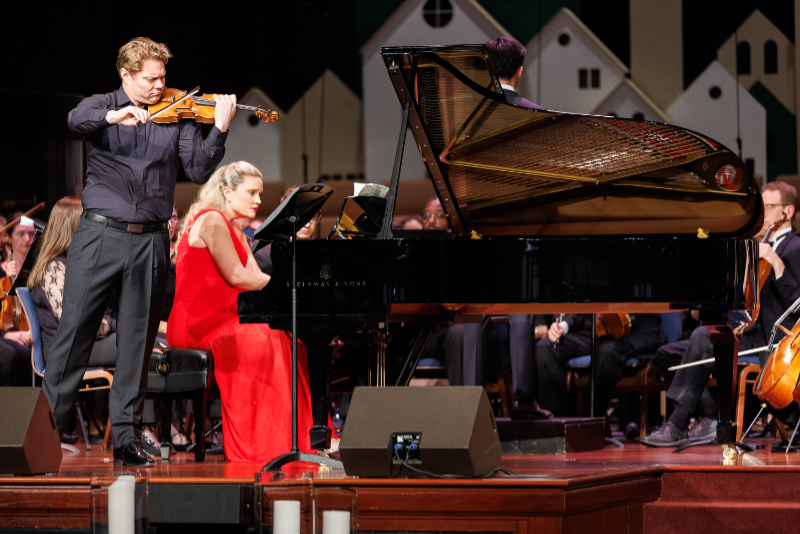
David and Julie Coucheron perform Mendelssohn’s “Double Concerto” with the JCSO under music director Henry Cheng. (credit: Ken Ortloff)
This exceptional piece, the Double Concerto for Violin, Piano, and Orchestra, was composed by Mendelssohn when he was only 14 years old. Considering the bravura and tenderness Mendelssohn is already capable of expressing at such a young age, we can only marvel at his subsequent accomplishments. Such genius is rare to find at any age, but at 14 years old? Extraordinary!
The piece has three movements: “Allegro” (D minor), “Adagio” (A major), and “Allegro molto” (D minor). Interestingly enough, these movements were not printed in the program, causing the audience to applaud after completion of the first movement. No major criticism here from me; mistakes do happen, in this case simply providing one of those rare, amusing moments of vague audience embarrassment that I’m certain passed quickly with the advent of the beauty and power of the following two movements. This is a quite accomplished piece of music, with the “Adagio” being particularly lovely. The talents of David and Julie Coucheron combined with those of the John’s Creek Symphony Orchestra gave the piece every ounce of nuance it deserved.
After a brief intermission, the JCSO returned with its final offering of the evening, Mendelssohn’s Symphony No. 4 in A major Op. 90, “Italian.” This piece consists of four movements: “Allegro vivace,” “Andante con moto,” “Con moto moderato,” and “Saltarello: Presto.” Indeed, this time, the movements were clearly printed in the body of the program. This is a piece of ebullient joy and humor, passion and melancholy, composed ten years after the previously performed work, presenting us with a somewhat more mature, perhaps somewhat more romantic Mendelssohn to consider.
Earlier, I asked why one might program a concert of Mendelssohn’s music exclusively. Music Director Henry Cheng, in his earlier address to the audience, did allude to this being a year of transition for the JCSO, and, in honor and reference to transition, composer Felix Mendelssohn does indeed serve as an applicable, appropriate icon of musical transition. Here again, I utilize our ever-present friend Google to shed some light:
While Mendelssohn’s work might indeed embrace a sense of change and transition, so did Cheng’s conducting and the JCSO’s performance of this impressive work, clearly demonstrating movement from their past to a promising future. The first movement, “Allegro vivace,” begins our stunning journey into light and fantasy, superbly supported by an invigorating performance. The “Andante con moto” followed… a slice of dark, mysterious daydreaming, whose wistful sensibility was captured admirably. “Con moto moderato” presented us with a lighter, waltz-tempo experience, at times delightful, at times somber, providing us with a welcome respite before our engagement in the final movement, “Saltarello: Presto,” which offered the then-unprecedented phenomenon of a symphonic work ending with variants on a traditional folk dance. Both movements were performed by the JCSO with extreme aplomb and fervor.
Once again, there was audience applause after the first movement of this work. But who am I to question such spontaneous enthusiasm? The audience was clearly enthralled with the performance. And the Johns Creek Symphony Orchestra deserved every bit of applause it received, including the standing ovation offered at the end of the evening’s concert.
It has been a season’s ending for many of Atlanta’s excellent music performance organizations, and so, too, for this spectacular 19th season of the Johns Creek Symphony Orchestra. I wonder what treasures and surprises are waiting for us in their next season of orchestral music?
I tell you, we can only IMAGINE! ■
EXTERNAL LINKS:
- Johns Creek Symphony Orchestra: johnscreeksymphony.org
- Henry Cheng: henrycheng.com
- David & Julie Coucheron: davidandjuliecoucheron.com

Read more by Howard Wershil.


.png)