
July 18, 2026
Severance Hall
Cleveland, Ohio – USA
The Cleveland Orchestra; Semyon Bychkov, guest conductor; Karen Gomyo, violin.
Dmitri SHOSTAKOVICH: Violin Concerto No. 1
Johannes BRAHMS: Symphony No. 4 in E minor, Op. 98
.
Pittsburgh Symphony Orchestra
July 19, 2026
Heinz Hall
Pittsburgh, Pennsylvania – USA
“The Music of Danny Elfman”
Pittsburgh Symphony Orchestra; Sarah Hicks, conductor; Sandy Cameron, electric violin; Danny Elfman, vocalist.
Danny ELFMAN: Music from Spider-Man
Danny ELFMAN: Music from Dracula
Danny ELFMAN: Music from Milk
Danny ELFMAN: Music from Pee-wee’s Big Adventure
Danny ELFMAN: Music from Beetlejuice
Danny ELFMAN: Music from The Nightmare Before Christmas
William Ford | 29 JUL 2026
The weekend began beneath an unexpected sky.
Driving north through Ohio, I found myself entering a landscape clouded by smoke drifting south from Canadian wildfires. By the time I reached Columbus, the skyline appeared muted behind a yellowish haze that turned the city’s skyscrapers into mere shadows.
After arriving, I opened an email from the Cleveland Orchestra announcing that the evening’s concert, originally scheduled for Blossom Music Center, had been moved indoors to Severance Hall because of the heat and air quality. It was a sensible decision, but one that created an obvious logistical challenge. Thousands of ticket holders who had expected reserved seats at Blossom would now be accommodated inside a hall with approximately 2,000 seats. Admission would be general seating, with doors opening an hour before the performance.
I decided to arrive early.
When I reached Severance Hall nearly an hour before the doors opened, I expected to find a modest line. Instead, the subterranean entrance plaza was already filled with patrons chatting quietly while waiting for admission. The atmosphere was patient and cheerful rather than anxious. My first thought was simple: Clevelanders really do love their orchestra.
It also struck me that the concert had already begun, at least in one sense. No music had yet been played, but the experience was underway. Friends greeted one another, visitors admired the building, and the anticipation was palpable. It was a reminder that a concert is rarely defined only by what happens after the conductor walks on stage—it’s the total experience that matters.
The Cleveland Orchestra staff handled the unexpected relocation with remarkable efficiency. Within minutes of the doors opening, patrons were moving smoothly through the lobby and into the hall. Despite the unusual circumstances, there was little sense of confusion. I found an excellent aisle seat in Row L and settled in for an evening that would prove memorable for reasons extending well beyond the program itself.
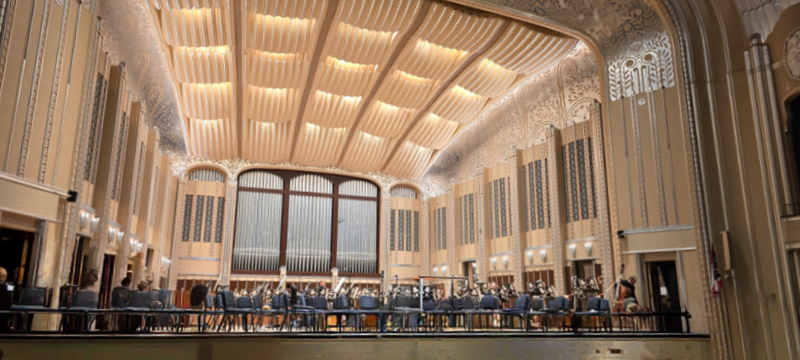
Severance Hall, Cleveland (credit: William Ford)
Built in 1931 as the permanent home of the Cleveland Orchestra, Severance Hall remains one of America’s architectural treasures. Designed in a refined blend of Art Deco and Egyptian Revival styles, the hall combines elegance with restraint. Sportswriters often describe legendary stadiums as cathedrals for baseball or football. The metaphor applies equally well here. Severance Hall is a cathedral for classical music, conceived from the beginning for one purpose: the performance of orchestral music at the highest level.
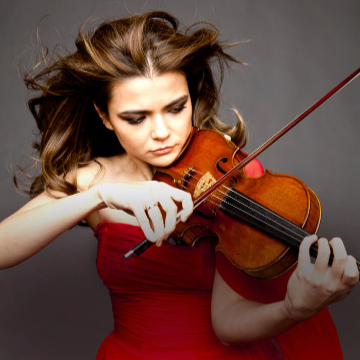
Karen Gomyo (karengomyo.com)
That visual aesthetic continued when violinist Karen Gomyo walked onto the stage. Against Severance Hall’s luminous Art Deco interior, her elegant silver gown blended almost seamlessly into the hall’s palette of gold and silver. At certain moments she seemed less like a soloist standing in front of the orchestra than one of Erté’s iconic Art Deco figures brought to life, an impression shared by more than one audience member seated nearby. Before a note had been played, the visual harmony between artist and hall had already become part of the afternoon’s experience.
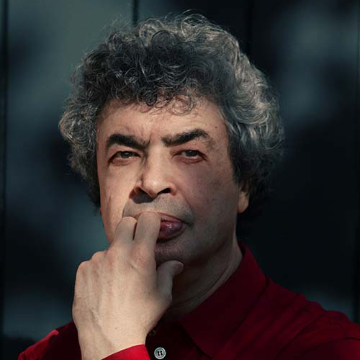
Semyon Bychkov (credit: Umberto Nicoletti)
Guest conductor Semyon Bychkov, esteemed music director of the Czech Philharmonic, opened the program with Dmitri Shostakovich’s Violin Concerto No. 1, one of the towering works of the twentieth-century repertoire. The concerto resists easy emotional categorization. It is by turns introspective, sarcastic, monumental, and fiercely virtuosic, demanding not only extraordinary technique from the soloist but also stamina throughout its nearly forty-minute length.
Karen Gomyo’s performance was extraordinary. Her bow control was impeccable, producing an unusually pure tone free from the incidental noises that often accompany even excellent violin playing. Her sound possessed both power and lyricism, and every technical challenge appeared effortless. There was no unnecessary theatricality, only complete command of the instrument in the service of Shostakovich’s deeply personal score.
Throughout the opening movement, I found myself thinking less of a conventional concerto than of a brooding orchestral work with violin obbligato. The solo violin part seemed almost to be searching for something just beyond its reach, questioning rather than proclaiming. There were moments of extraordinary beauty, but little sense of final resolution. That searching quality remained one of the performance’s most compelling characteristics.
The sardonic Scherzo provided a dramatic contrast, while the great Passacaglia unfolded with remarkable patience under Bychkov’s direction. Rather than emphasizing individual episodes, he shaped the movement as a continuous architectural span leading naturally into the monumental cadenza. By the time Gomyo launched into the whirlwind Burlesque, virtuosity had become the inevitable consequence of everything that had preceded it rather than an end in itself.
Bychkov and the Cleveland Orchestra matched her at every turn. The orchestra’s transparency allowed every line to speak naturally while maintaining remarkable unity of purpose. The lower strings produced an exceptionally blended foundation, the woodwinds contributed playing of uncommon refinement, and the bassoons, in particular, were consistently superb. The string section displayed an almost uncanny ability to function as a single instrument, particularly among the lower strings, whose blended sonority gave the orchestra enormous depth without sacrificing clarity. The bassoons were exceptional throughout the afternoon, contributing warmth and character to countless passages that often pass unnoticed.
After intermission came Brahms’ Symphony No. 4, a work that represents one of the supreme achievements of the late Romantic symphonic tradition. Brahms writes on an expansive scale, yet never permits the music to spill into excess. The opening movement grows organically from its gentle opening phrase into music of increasing weight. The second movement offers noble lyricism and warmth, while the third provides energetic contrast with its muscular rhythms and exuberant brass writing. The celebrated finale, constructed as a passacaglia built upon thirty variations, stands among the most remarkable achievements in nineteenth-century orchestral literature, combining rigorous architecture with overwhelming expressive power.
Bychkov approached the symphony on a grand scale without allowing it to become inflated. The performance was expansive yet disciplined, revealing Brahms’ architectural mastery while never sacrificing forward momentum. The Cleveland strings displayed astonishing ensemble, and the orchestra’s celebrated precision was always evident. The bassoons distinguished themselves, while even the modest triangle part in the finale emerged with unusual clarity. If there was a minor reservation, it was that the horns occasionally projected with more force than the surrounding texture required.
Part of what made the evening so memorable was the partnership between orchestra and hall. Severance Hall possesses an extraordinary combination of warmth and clarity. Every orchestral section retained its individual character while blending seamlessly into the whole. The acoustics rewarded attentive listening; clarity never came at the expense of warmth, and warmth never obscured detail. It is easy to understand why musicians speak so affectionately about performing in this hall.
When the audience finally emerged from Severance Hall, the skies had changed. The smoke that had hung over Ohio earlier in the day had largely disappeared, being replaced with a slight breeze.
The road west now led toward Pittsburgh, where the smoke that had obscured much of Ohio the previous day had largely disappeared, replaced by clear skies and welcome sunshine. As I crossed into western Pennsylvania, the landscape became increasingly rugged, the highways winding through hills that hinted at the industrial history that helped shape the region.
Downtown Pittsburgh was alive with the annual Picklesburgh festival, which had transformed several city blocks into a celebration attracting thousands of visitors. Against that lively backdrop stood Heinz Hall, home of the Pittsburgh Symphony Orchestra.
Originally opened in 1927 as the Loew’s Penn Theatre, Heinz Hall is one of America’s great examples of adaptive reuse. Saved from demolition and meticulously reinvented and remodeled during the 1970s, it now serves as the permanent home of the Pittsburgh Symphony Orchestra. While Severance Hall was conceived from the beginning as a concert hall, Heinz Hall followed a very different path, one that preserved an architectural landmark while giving it an entirely new life.
Stepping through its doors, one immediately understands why so many first-time visitors stop to take photographs. The soaring lobby, crystal chandeliers, marble columns, sweeping staircases, and rich red and gold detailing create an atmosphere of unmistakable grandeur. Breche Opal and Levanto marble, polished brass, plush carpeting, and carefully restored decorative plasterwork combine to produce a space that feels both elegant and welcoming.
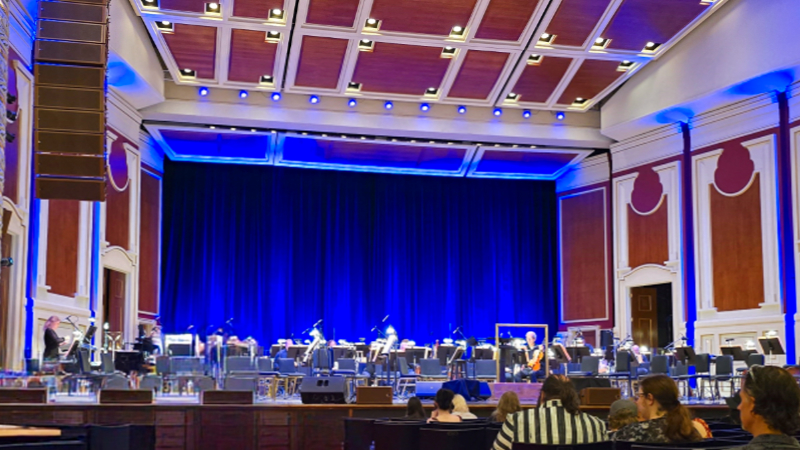
Heinz Hall, Pittsburgh (credit: William Ford)
Equally striking is the way the building encourages people simply to remain there. Spacious foyers provide room for conversation before the performance and during intermission. Multiple bars are thoughtfully positioned throughout the building, while the outdoor plaza and waterfall extend the experience beyond the auditorium itself. Unlike many modern performing arts centers, Heinz Hall seems designed not only to house performances but also to invite patrons to interact.
Long before the orchestra appeared, the building itself had become part of the evening.
The program could hardly have contrasted more sharply with the previous afternoon’s Brahms and Shostakovich. Rather than a traditional symphonic concert, the Pittsburgh Symphony presented The Music of Danny Elfman, a survey of music drawn from the composer’s long and remarkably successful career in film.

Sarah Hicks (sarahhicksconductor.con)
The Pittsburgh Symphony Orchestra was led by Sarah Hicks, principal conductor of Live at Orchestra Hall with the Minnesota Orchestra and one of today’s most experienced conductors of crossover and multimedia performances. Her easy rapport with the audience and confident podium presence helped establish a welcoming atmosphere from the outset. Hicks proved an ideal guide for the evening. Her relaxed manner immediately established a connection with the audience, and her brief introductions provided just enough context without interrupting the flow of the program. Conducting film music presents challenges quite different from leading the standard orchestral repertoire. These scores often demand extraordinary rhythmic precision and rapid shifts of color while placing less emphasis on the long architectural arcs that characterize symphonic literature. Hicks understood those demands completely, directing the performances with confidence, clarity, and an obvious affection for the music.
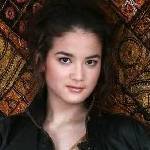
Sandy Cameron (sandycameron.com)
Guest violinist Sandy Cameron, a frequent collaborator with Danny Elfman and the dedicatee of his Violin Concerto Eleven Eleven, appeared as featured soloist in a program devoted entirely to Elfman’s music. Her amplified electric violin naturally invited comparisons with performers such as Lindsey Stirling, yet she never allowed visual style to overshadow musical substance. Her playing fit comfortably within Elfman’s imaginative sound world, adding another layer of color to an already vibrant orchestral palette.
The program sampled music from across Elfman’s career, including selections from Spider-Man, Dracula, Milk, Pee-wee’s Big Adventure, Beetlejuice, and The Nightmare Before Christmas.
Elfman’s music resists conventional symphonic expectations. Rather than emphasizing extended thematic development, his scores rely upon brilliant orchestral color, rhythmic vitality, memorable motives, and vivid atmosphere. Judged by the standards of Brahms or Shostakovich, one might miss the point. These scores were written to support stories unfolding on screen. Removed from their cinematic narratives, they become a succession of brilliantly orchestrated musical scenes whose greatest strengths lie in color, energy, and imagination. That is not a weakness. It simply reflects the composer’s task. Elfman was writing to illuminate stories, deepen characters, and heighten emotion, not to construct autonomous symphonic forms.
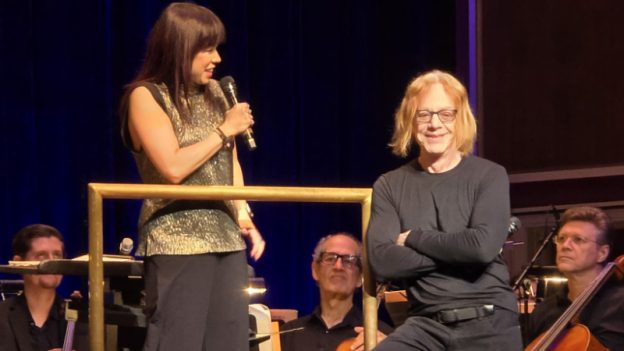
One of the evening’s highlights came when Danny Elfman himself appeared to perform songs from The Nightmare Before Christmas, reprising the role of Jack Skellington that he first brought to life more than three decades ago. The audience responded enthusiastically, many clearly reliving memories associated with the film. It served as another reminder that orchestral concerts today often succeed by connecting music with experiences audiences already cherish.
The Pittsburgh Symphony performed with breathtaking precision throughout. Every section played at an exceptionally high level, but the horn section was simply spectacular. Combining enormous power with impeccable intonation, rhythmic precision, and remarkable musicality, it was arguably the finest horn section I have ever heard in live performance.
The balance between orchestra and amplification also deserves mention. Film concerts often struggle to integrate electronic sound with acoustic instruments, yet throughout the evening the engineering remained remarkably natural. Danny Elfman’s vocals, Cameron’s electric violin, narration, and the orchestra all occupied their proper places within the overall sound without one overwhelming another.
Looking around Heinz Hall, I noticed something else.
Many patrons were photographing the lobby, the chandeliers, and the grand staircases before the concert and again during intermission. Some were almost certainly first-time visitors. Others were introducing friends or family members to the hall for the first time. They were not simply documenting a building. They were preserving memories of an evening out. It was apparent that the nearly at-capacity audience was made up of patrons who might not otherwise attend a symphony concert.
That observation brought me back to the crowded entrance at Severance Hall twenty-four hours earlier.
In Cleveland, patrons arrived early and patiently filled the plaza, eager simply to be inside one of America’s great concert halls. In Pittsburgh, visitors wandered through the foyers, paused to admire the architecture, gathered for drinks, and photographed the surroundings before returning to their seats. These were different experiences, shaped by different buildings and different programs, yet they shared something important. Neither audience appeared to view the concert as a transaction in which one purchased a ticket, listened to music, and went home. The event itself mattered. One other note—one cannot help but notice that both Severance Hall and Heinz Hall are immaculately maintained. Each reflects decades of careful stewardship and civic pride.
As orchestras continue searching for ways to attract new audiences, much of the discussion understandably centers on programming, marketing, ticket prices, and repertoire. Those conversations are important, but this weekend reminded me that another element deserves equal attention. This weekend reminded me that people often leave home for more than the performance itself. Architecture, hospitality, civic pride, anticipation, and the simple pleasure of sharing an afternoon or evening with others all become part of what we remember. The music remains at the center, but it is rarely the whole experience.
I traveled to Cleveland and Pittsburgh expecting to hear two excellent orchestras, and I did. What I had not fully anticipated was how much I would remember everything surrounding the performances. The drive through smoky skies, the unexpected change of venue, the first glimpse of Severance Hall, Karen Gomyo’s elegant silhouette against its Art Deco interior, the festival atmosphere of downtown Pittsburgh, the restored grandeur of Heinz Hall, and the unmistakable enthusiasm of audiences in both cities became inseparable from the music itself.
During the drive home, I found myself thinking less about individual performances than about the weekend as a whole. I had heard two outstanding orchestras in two remarkable halls presenting completely different kinds of music. Yet what stayed with me was not a comparison between Cleveland and Pittsburgh. It was the realization that both cities understand something fundamental: a concert begins long before the conductor walks on stage and continues long after the audience leaves the hall. ■
EXTERNAL LINKS:
- The Cleveland Orchestra: clevelandorchestra.com
- Pittsburgh Symphony Orchestra: pittsburghsymphony.org
- Semyon Bychkov: semyonbychkov.com
- Karen Gomyo: karengomyo.com
- Sarah Hicks: sarahhicksconductor.com
- Sandy Cameron: sandycameron.com
- Danny Elfman: dannyelfman.com

Read more by William Ford.




.png)