
October 2, 2026
Schwartz Center for Performing Arts, Emory University
Atlanta, Georgia – USA
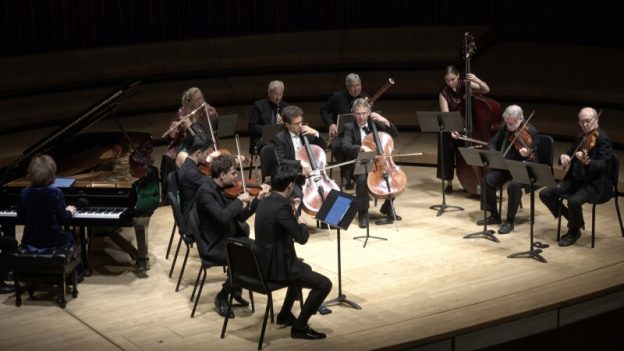
Anne-Marie McDermott, piano; Francisco Fullana, Kristin Lee, Lun Li and Richard Lin, violin; Paul Neubauer and Daniel Phillips, viola; Dmitri Atapine and Nicholas Canellakis, cello; Nina Bernat, double bass; Tara Helen O’Connor, flute; David Shifrin, clarinet; Marc Goldberg, bassoon.
William BOLCOM: Three Rags for String Quartet
Amy BEACH: Piano Quintet in F-sharp minor, Op. 67
Bernard HERRMANN: Psycho: A Narrative for String Ensemble
Aaron COPLAND: Appalachian Spring Suite for Ensemble
William Ford | 5 OCT 2026
The Chamber Music Society of Lincoln Center opened the 2026–27 Candler Concert Series at Emory University’s Schwartz Center for Performing Arts with American Soundscapes, a program ranging across more than a century of American music. William Bolcom, Amy Beach, Bernard Herrmann, and Aaron Copland hardly constitute a stylistic school. What emerged was less a definition of an American sound than four very different ways American composers absorbed and transformed the musical traditions they inherited.
Emerson Concert Hall was also the right size for this music. Chamber music benefits from proximity, and the hall allowed individual instrumental lines to remain distinct without sacrificing warmth.
The Chamber Music Society is not a permanent ensemble but a repertory company that assembles different combinations of musicians for each work. For this tour, the musicians were Anne-Marie McDermott, piano; Francisco Fullana, Kristin Lee, Lun Li and Richard Lin, violin; Paul Neubauer and Daniel Phillips, viola; Dmitri Atapine and Nicholas Canellakis, cello; Nina Bernat, double bass; Tara Helen O’Connor, flute; David Shifrin, clarinet; and Marc Goldberg, bassoon.
William Bolcom’s Three Rags for String Quartet opened the concert. Bolcom was among the composers caught up in the revival of interest in ragtime that began around 1970, when Joshua Rifkin’s recordings helped restore Scott Joplin to serious musical attention and, a few years later, The Sting brought Joplin’s music into popular culture.
Bolcom did something different with the form. Ragtime supplied him with a deliberately restrictive framework of regular phrases, characteristic syncopation, and an immediately recognizable rhythmic profile. He could then hang unexpected harmonic, rhythmic and textural ideas upon it, stretching the language without destroying the identity of the rag.
I understand the attraction of the exercise better than I enjoy its results. Some of Bolcom’s distortions create the curious effect of hearing a rag performed by amateur musicians struggling with intonation or rhythmic steadiness. That effect comes from the composition rather than the playing, but recognizing the device did not make it particularly interesting to me. The slide whistle similarly seemed calculated to produce a predictable laugh. It did, but I wondered what the laugh contributed beyond momentary novelty.
The limitation is inherent in the experiment. However inventive Bolcom becomes within the form, the underlying rag remains a rag. As a concert opener, Three Rags was lively and accessible. By its conclusion, however, I was quite content not to hear another rag for a while.
Amy Beach’s Piano Quintet in F-sharp minor, Op. 67, took us into an entirely different musical world. Written in 1907, it is an impressive piece of late-Romantic chamber music, superbly crafted and filled with thematic development. Brahms is an obvious ancestor, but I also heard something of César Franck in its chromatic intensity and continual accumulation and release of harmonic tension, with occasional flashes of color suggesting Debussy.
The Quintet left me with a question: where can music operating at this emotional temperature go next?
Beach is extraordinarily adept at creating instability. Harmonies strain toward resolution, textures thicken, dynamics rise, and phrases push toward arrival. The release eventually comes, sometimes with considerable beauty, but the process begins again almost immediately. Tension accumulates, intensifies, finds release, and then starts accumulating once more. The pattern becomes so persistent that tension and release can begin to seem less a means of expression than the subject of the music itself.
That does not make the Quintet poorly constructed. Quite the opposite. Themes develop and transform, and the writing for piano and strings is assured. My difficulty was that the music repeatedly seemed to arrive at essentially the same emotional destination.
It reminded me of the exhaustion I sometimes feel at the end of Schoenberg’s Verklärte Nacht. There comes a point at which late-Romantic chromaticism and emotional intensity seem to have consumed nearly all the available oxygen. Schoenberg eventually concluded that he could not continue in that direction and radically changed his musical language. Beach did not make anything approaching Schoenberg’s break with tonality, and her other music demonstrates that this hyper-intensity was not her only expressive voice. But the Quintet can sound like music written among the glowing embers of a Romantic tradition that had pushed expressive saturation remarkably far.
I like Beach’s music, and the Quintet increased my curiosity about where her music went afterward. Yet I was also happy when it ended. Admiration and exhaustion are not mutually exclusive.
Bernard Herrmann’s Psycho: A Narrative for String Ensemble raised an entirely different issue, and one that has interested me for years.
There is an enormous amount of film music that is colorful, atmospheric, memorable and beautifully orchestrated but that falls surprisingly flat when transferred directly to the concert hall. The reason is understandable. Film music was not originally required to provide its own complete dramatic structure. Editing, dialogue, characterization and action supplied much of that structure. Remove the movie, and a sequence that functioned perfectly on screen may suddenly seem not to develop at all.
Prokofiev understood the problem. In works such as Alexander Nevsky and Lieutenant Kijé, he demonstrated that music whose form was originally dictated by editing, dialogue, and dramatic action has to acquire a new form once those things disappear.
Herrmann apparently understood exactly the same thing.
The title Psycho: A Narrative is particularly revealing. Herrmann is not abandoning narrative when he removes Hitchcock’s images. He is transferring responsibility for the narrative from the film to the music itself. The material was reordered, altered, and connected so that the music could provide the architecture that the movie had originally supplied.
What is remarkable is how Herrmann accomplishes this. For roughly 15 minutes, the music sustains almost unrelenting tension. Unlike the Beach Quintet, with its repeated cycles of tension and release, Herrmann offers remarkably little release. The unease accumulates and remains unresolved. In another context, this might become oppressive or monotonous. Here it becomes the point. Herrmann manages to capture the psychological atmosphere of Psycho without requiring Hitchcock’s images to do it for him.
That is precisely what I have long wished more film composers would do. A collection of cues is not necessarily a concert work, no matter how attractive those cues may be. Herrmann treated the transformation into concert music as a second compositional problem.
Psycho is particularly well suited to the process because Herrmann’s original score was already conceived entirely for strings. Removed from Hitchcock, the familiar shrieking attacks and uneasy repetitions cease functioning merely as reminders of Janet Leigh and a shower curtain. They become elements in an exceptionally dark piece of twentieth-century string writing.
This was not simply music from Psycho. It was Herrmann reconsidering what that music had to become once Psycho was no longer there.
Aaron Copland’s Appalachian Spring Suite for Ensemble closed the program in a form quite different from the familiar orchestral version. Appalachian Spring began as a ballet for Martha Graham scored for only 13 musicians because of the restricted performing space at the Library of Congress. Copland subsequently created the familiar orchestral concert suite and later returned that concert version to 13-player chamber forces.
The smaller ensemble changes the music’s character more profoundly than the numbers might suggest. Without massed strings and the coloristic resources of a full orchestra, the music becomes leaner, sparer, and sometimes almost severe. Individual string lines remain exposed, the winds become distinct personalities, and the piano assumes unusual prominence.
At times the result is surprisingly abstract. Familiar piano runs acquire a hard, percussive clarity that occasionally brought Petrushka to mind. Without the warmth of a large string section, one also hears more readily the angularity beneath Copland’s pastoral language. This is still unmistakably Appalachian Spring, but with some of its familiar pastoral clothing removed. The chamber version more clearly reveals the modern composer beneath the Copland who eventually became virtually synonymous with musical images of the American landscape.
The two works also share an intriguing connection in the second half. Herrmann and Copland were both dealing with music originally joined to something visual. Herrmann had Hitchcock’s film; Copland had Graham’s choreography. Both produced music capable of carrying its argument without the visual element, although by very different means.
The Chamber Music Society musicians were an exceptionally accomplished group, but several contributions stood out.
Double bassist Nina Bernat was no shrinking violet. She played with substantial presence, providing a remarkably solid floor beneath the ensemble without disappearing into it. Pianist Anne-Marie McDermott impressed not merely through obvious technical command but through her judgment of scale. She seemed able to find precisely the volume and weight required by an individual phrase, particularly important in chamber music where the piano can so easily overwhelm its partners.
I also admired the precision of violists Paul Neubauer and Daniel Phillips when playing together. Their ensemble could be remarkably exact. On occasion, I wished the first violins had achieved quite the same unanimity.
Finally, it was striking to hear the 13 musicians negotiate Appalachian Spring without a conductor. Conductorless chamber orchestras do this routinely, of course, but it remains refreshing to be reminded just how much coordination accomplished chamber musicians can achieve simply by watching and listening to one another.
American Soundscapes ultimately made a stronger case for its title by refusing to suggest that there is any single American sound. Bolcom looked toward the American vernacular, Beach toward the European Romantic tradition, Herrmann toward Hollywood, and Copland toward a musical language that came to represent America to much of the world. Together they offered four very different answers to what an American composer might do with the musical materials at hand. ■
EXTERNAL LINKS:
- Chamber Music Society of Lincoln Center: chambermusicsociety.org
- Schwartz Center for Performing Arts at Emory: schwartz.emory.edu

Read more by William Ford.

.png)