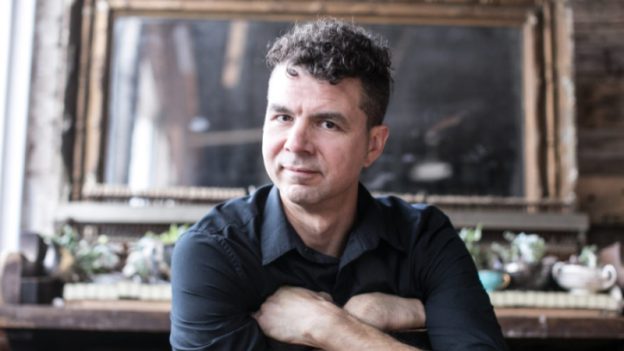
After 32 years with the Atlanta Symphony Orchestra, 54-year-old bassist and composer Michael Kurth confronts Parkinson’s disease and an uncertain professional future.
William Ford | 23 OCT 2026
For more than three decades, Michael Kurth has been a familiar presence in the bass section of the Atlanta Symphony Orchestra. He joined the orchestra in the fall of 1994, beginning a career that has combined orchestral performance with composition, teaching, and an unusually broad curiosity about musical instruments and traditions.
Today, at 54, Kurth is confronting the possibility that the current season may be his last with the ASO. Parkinson’s disease, diagnosed nearly two decades ago, has increasingly affected his ability to perform. Although recent changes in his treatment have improved his playing, he is beginning to consider a future without the full-time orchestral position that has anchored his professional life.
“I’m assuming, I’m guessing this will be my last season with ASO,” he told me during a recent interview. “And the question is, what’s next?”
“There’s Too Much of Me Left”
Kurth’s musical interests have always extended beyond the double bass. His collection includes some 200 to 300 instruments, among them guitars, mandolins, a cello, an oud, percussion instruments, and numerous unusual or handmade examples. He enjoys exploring their possibilities, although the bass remains the instrument on which he has built his performing career.
Composition has become an increasingly important part of his musical life. He recently wrote a violin concerto premiered by Helen Kim with the Georgia Philharmonic and is now working on a required piece for a violin competition organized by former ASO associate concertmaster William Pu. Other projects, including church orchestrations, are also in development.
Kurth describes himself as an old-fashioned composer who writes music for living performers. He values the interpretive collaboration that takes place when musicians bring a score to life, distinguishing that process from music created entirely through digital production.
He is equally emphatic about his need to compose, whether or not a commission is involved.
“I’m going to write anyway,” he explained. “If I’m not doing that, I’m doing something. I have to. I can’t not do anything. There’s too much of me left.”
Living With Parkinson’s
Kurth first noticed symptoms around 2005. His handwriting became smaller, a condition known as micrographia, and he began experiencing stiffness that interfered with ordinary activities such as using a computer mouse and brushing his teeth. After consultations with several physicians, he was diagnosed with young-onset Parkinson’s disease around 2008 or 2009 at Emory’s Movement Disorders Clinic.
His form of Parkinson’s does not produce the characteristic tremor commonly associated with the disease. Instead, he experiences stiffness, slowed movement, and periods of involuntary movement. At times, the sensation of internal physical tension makes sitting still extraordinarily difficult. Kurth recalls one particularly uncomfortable experience during an orchestral film presentation. A 48-minute interval between musical cues required him to remain seated with his bass, an ordeal he describes as torture. The physical sensation is difficult to communicate, although he once characterized it in a composition subtitle as something resembling machinery and barbed wire clanging inside his rib cage.
The disease has also affected his playing. Certain bowing techniques, particularly the rapid bouncing motion known as spiccato, have become less reliable. Kurth is candid about the resulting challenges and the professional standards he continues to impose upon himself.
“I don’t want my friends in my section to feel torn between trying to be loyal to a friend and helpful to a friend and needing their section to sound better,” he explained.
His concern reflects the complicated position of a musician whose experience and commitment remain intact even as his physical capabilities change.
Treatment has made an enormous difference. Kurth underwent surgery for deep brain stimulation in 2020 and now uses a portable pump that delivers Parkinson’s medication beneath the skin. The pump has helped overcome some of the difficulties he experienced with oral medication, particularly its inconsistent absorption.
The improvement has been significant.
“Right now I’m feeling really good. I’m playing better than I have in about a year,” he said. “I was worried I wouldn’t be able to start this season, but I’m feeling pretty good this season.”
Nevertheless, Kurth understands that the benefits of treatment may change as the disease progresses.
“The pump has given me sort of a new lease. But it’s only a lease. I don’t own it.”
The Uncertainty of What Comes Next
Perhaps the most affecting part of our conversation concerned Kurth’s efforts to prepare for the possibility of leaving the orchestra.
He recently attended a webinar about his union pension plan and has begun investigating Social Security, disability benefits available through the ASO contract, and the financial consequences of retirement. He is trying to determine how much income he might receive and whether his other musical activities could provide sufficient support.
The calculations are complicated by the rules governing disability benefits. Different programs impose different restrictions on employment and earnings, creating difficult choices for someone who wants to continue working.
“I’m researching all that now, trying to figure out what the best next step for me is,” he explained.
Kurth has already developed several sources of work outside the orchestra. He teaches at Emory University, where he coaches an ensemble organized to function without a traditional conductor. He plans to take on students in composition and orchestration and continues to accept church and other musical assignments.
But these activities raise questions about whether he can replace the financial security of his full-time ASO position and how continued employment might affect his eligibility for disability benefits.
When I asked whether he was frightened, his answer was immediate.
“I’m scared of not working.”
Kurth explained that he once imagined having another 10, 15, or even 20 years with the orchestra. His disease progressed slowly enough that he could continue to look ahead, but he now recognizes that his remaining time as a full-time orchestral musician may be much shorter.
“I’m scared of being a burden on my family. I’m scared of not being useful.”
For Kurth, work provides more than income. It is an essential part of how he understands himself and his place in the world.
“Being industrious and useful is one of the, sort of like my main, my setting,” he said. “When the switch is on, that’s what I’m doing. I’m being useful.”
His situation presents a difficult paradox. He is investigating financial protections intended to support people whose disabilities interfere with employment, while hoping to preserve as much of his working life as possible. The decisions he makes may determine both his financial security and the opportunities available to him.
Music Beyond the Orchestra
One of Kurth’s most satisfying recent activities has been performing at informal open-mic gatherings with acoustic musicians. He brings his bass and offers to accompany performers, often without knowing what they intend to play. He must identify keys and chord progressions, sometimes by watching a guitarist’s hands, and respond immediately to unfamiliar music.
The experience draws on decades of musicianship while presenting an entirely different kind of challenge from orchestral performance.
“To have the ability to jump in the deep end and not sink, it’s exhilarating, honestly,” he said.
When the collaboration succeeds and another musician acknowledges his contribution, Kurth experiences precisely the satisfaction he fears losing.
“It’s a great feeling. It’s useful.”
The contrast is revealing. In the orchestra, Kurth worries about meeting the demanding technical expectations of his section. In a less formal musical setting, his knowledge, experience, and ability to respond to other performers remain valuable. He continues to find opportunities to make music and contribute to the enjoyment of others.
“I Want to Know What’s Next”
Kurth has begun considering a variety of possible directions for his future. He wonders whether he might become a creative director, teach public school music, or develop programs for people with Parkinson’s disease.
He has thought about organizing a Parkinson’s choir or karaoke activities that might encourage people experiencing speech and vocal difficulties to use their voices more freely. These possibilities remain exploratory, but they reflect his determination to find meaningful work beyond the ASO.
They also help explain why he wanted to speak publicly about his circumstances.
“Part of why I’m going public with this is someone out there probably knows something I should do to be useful.”
Kurth hopes that someone familiar with his musical experience might recognize an opportunity he has yet to consider. His background encompasses orchestral performance, composition, arranging, teaching, and an unusually wide range of musical interests.
He is realistic about the progression of Parkinson’s and the uncertainties surrounding his health. He is equally aware that leaving the orchestra would require a significant adjustment, professionally, personally, and financially. Yet his creative ambitions remain very much alive.
Near the end of our conversation, Kurth returned to the question that now occupies so much of his attention.
“Is what’s next me becoming somebody’s creative director? Or me getting certified to teach public school music? Is there room for that somewhere?”
He has spent more than three decades building a career with the Atlanta Symphony Orchestra. Now he is searching for a way to carry that experience into another chapter of his professional life.
“There’s a lot more left of me,” he said. “I can’t not me.” ■
Michael Kurth is a bassist with the Atlanta Symphony Orchestra, a composer, and an educator at Emory University. His website can be found at kurthmusic.com
EXTERNAL LINKS:
- Michael Kurth: kurthmusic.com

Read more by William Ford.