EarRelevant Staff | 5 NOV 2026
GOTHENBURG, Sweden— Herbert Blomstedt, the Swedish-American conductor whose career spanned more than seven decades and whose musical authority brought him to the podiums of major orchestras well into his late 90s, died Nov. 4 at his home in Gothenburg, Sweden. He was 99.
His management company, KünstlerSekretariat am Gasteig, announced the death in a statement, saying Blomstedt died peacefully surrounded by his family.
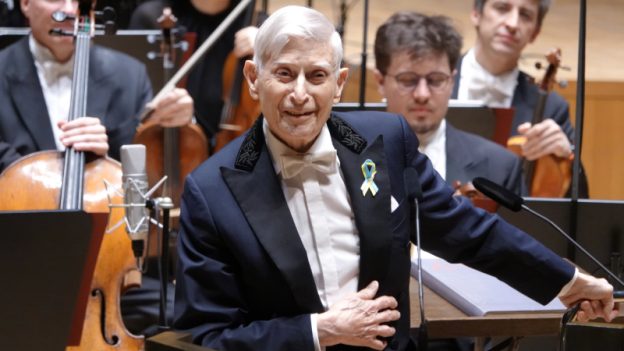
Blomstedt continued to appear with leading ensembles well into his 90s, maintaining a demanding schedule of guest engagements even after falls and other health setbacks. In his later years, he often conducted while seated, sometimes from a wheelchair. He spoke frequently of his desire to remain active on the podium until his 100th birthday and beyond. A succession of health challenges eventually forced him to cancel engagements in recent months, the agency said.
“His greatest motivation always was to serve the music,” the management company said. It described him as guided throughout his life by his Seventh-day Adventist faith and noted his unwavering commitment to composers’ intentions, profound knowledge of scores, musicianship, discipline and humility.
Lothar Schacke, honorary director of the agency and Blomstedt’s manager for nearly four decades, recalled that each encounter with the conductor “was a gift,” and that his kindness, knowledge, wisdom and gentle humor enriched those around him intellectually and emotionally.
Born July 11, 1927, in Springfield, Massachusetts, to Swedish parents, Blomstedt returned with his family to Scandinavia when he was two, growing up principally in Sweden and Finland. His father was a Seventh-day Adventist minister, and the faith became a lasting influence on his personal life and musical outlook.
Blomstedt studied at the Royal College of Music in Stockholm and Uppsala University before continuing his training at the Juilliard School in New York, where his teachers included Jean Morel. He subsequently studied with Leonard Bernstein at the Tanglewood Music Center in Massachusetts, winning the Koussevitzky Conducting Prize in 1953.
His professional conducting debut came in 1954 with the orchestra then known as the Stockholm Philharmonic, now the Royal Stockholm Philharmonic Orchestra. That year, he was appointed chief conductor of the Norrköping Symphony Orchestra, a position he held through 1962, beginning a sequence of leadership posts that established him among Scandinavia’s leading conductors.
His subsequent appointments included the Oslo Philharmonic (1962–68) and the Danish Radio Symphony Orchestra (1967–77), where he became the ensemble’s first chief conductor. He also led the Swedish Radio Symphony Orchestra from 1977 to 1982. These appointments established a substantial presence in Scandinavian musical life before his career expanded further into Germany and the United States.
From 1975 to 1985, Blomstedt served as chief conductor of the Staatskapelle Dresden, one of Germany’s oldest and most distinguished orchestras. His tenure there brought him international recognition through performances and recordings that demonstrated his command of the central German-Austrian repertoire.
From 1985 to 1995, Blomstedt served as music director of the San Francisco Symphony, a decade that proved pivotal for both the orchestra and his standing in the United States. Through ambitious programming, international tours and an extensive recording relationship with Decca, he helped raise the ensemble’s international profile and establish it among the country’s leading orchestras.
The orchestra’s recordings under Blomstedt included widely admired cycles of the symphonies of Carl Nielsen and Jean Sibelius, composers whose music he championed throughout his career. His work with the San Francisco Symphony also earned two Grammy Awards: for Carl Orff’s Carmina Burana in 1993 and Johannes Brahms’ Ein Deutsches Requiem in 1996.
After leaving San Francisco, Blomstedt remained active in Europe, serving as principal conductor of Hamburg’s NDR Symphony Orchestra from 1996 to 1998 and as music director of the Leipzig Gewandhaus Orchestra from 1998 to 2005. The Leipzig appointment placed him at the head of one of the world’s oldest orchestral institutions, continuing a relationship with the German musical tradition that had been central to his career in Dresden.
He subsequently maintained an unusually extensive guest-conducting schedule, appearing with the Berlin Philharmonic, Vienna Philharmonic, Royal Concertgebouw Orchestra and major American ensembles. Several orchestras he had led honored him with titles such as honorary conductor or conductor laureate, recognizing relationships that continued long after his formal appointments ended. He was also named an honorary member of the Vienna Philharmonic.
Blomstedt’s approach to conducting was distinctive for its lack of theatrical self-display. He was known for meticulous preparation, a thorough command of the score, and an insistence that the conductor’s role was to illuminate the music rather than impose a personality upon it. His interpretations combined intellectual rigor with expressive warmth, allowing musical structure and the composer’s intentions to shape the performance.
His repertoire was broad, but he was particularly admired for his interpretations of Beethoven and Anton Bruckner. He also became one of the foremost international advocates of Scandinavian music, bringing the works of Nielsen, Sibelius and Wilhelm Stenhammar to audiences beyond their home countries. His performances of these composers, particularly his recordings of the Nielsen and Sibelius symphonies, remain important parts of his recorded legacy.
His religious convictions were more than a private matter. Blomstedt regarded music-making as a form of service and believed that music could bring people closer to spiritual understanding. His Seventh-day Adventist observance meant that he avoided rehearsals on the Sabbath, from Friday evening through Saturday, although he would conduct public performances on those days. He saw no contradiction in the distinction, considering the sharing of music with an audience an expression of his calling.
His final concert appearance took place on May 15, 2026, with the San Francisco Symphony at Davies Symphony Hall. At 98, Blomstedt arrived onstage in a wheelchair to conduct Mahler’s Ninth Symphony. During the performance, his physical condition became increasingly difficult, and the music was interrupted for several minutes during the third movement while attendants helped him into a more supportive chair. He completed the performance but withdrew from the remaining two concerts on doctors’ advice. Conductor David Robertson replaced him.
The appearance brought a poignant close to a career that had begun more than 70 years earlier with the Stockholm Philharmonic. Blomstedt had additional engagements scheduled into 2027, including appearances with orchestras with which he had maintained longstanding relationships.
In September 2026, he was named the music laureate of Japan’s Praemium Imperiale, one of the international arts world’s major honors. He could not attend the October awards ceremony in Tokyo because of health concerns; Stefan Forsberg, president of the Royal Swedish Academy of Music, accepted the award on his behalf.
Blomstedt also received numerous other distinctions during his career, including honorary doctorates from several institutions and Germany’s Grand Cross of Merit with Star. He was elected to the Royal Swedish Academy of Music.
He is survived by four daughters and seven grandchildren. His wife, Waltraud, died in 2003. ■
EXTERNAL LINKS:
- Herbert Blomstedt, official management agency: ks-gasteig.de
- San Francisco Symphony: sfsymphony.org

Read more by EarRelevant Staff.