

January 5 & 7, 2024
Bass Performance Hall
Ft. Worth, TX – USA
Robert Spano, conductor; Dallas Black Dance Theatre.
W.A. MOZART: Overture to The Magic Flute
W.A. MOZART: Symphony No.41 (“Jupiter”)
Igor STRAVINSKY: Petrushka
Gregory Sullivan Isaacs | 10 JAN 2024
This past Friday evening, the Fort Worth Symphony Orchestra, under the baton of music director Robert Spano, presented a concert that featured a ballet. That is rather difficult to pull off in a concert hall because the orchestra takes up most of the available real estate, leaving only the stage’s apron for choreographic maneuvering. However, partnering with the Dallas Black Dance Theatre enabled Spano and the FWSO to pull it off as though this was the intended way to present Stravinsky’s ground-breaking ballet, Petrushka.
Petrushka was written in 1911 for Sergei Dighilev’s Ballets Russes, one of the leading ballet companies of that era. This followed the massive success of the first ballet collaboration between Stravinsky and Diaghilev: The Firebird.
First of all, Spano used the suite from the ballet that Stravinsky compiled in 1946. As with most suites drawn from larger works, this version was designed to enable concert performances. The advantage here was two-fold: the music is considerably shortened and (even better, considering the space problem) uses a somewhat smaller orchestra.
The plot comes down to us from the puppet theater of the 16th-century Italian commedia dell’arte. It has three main characters, maneuvered by the active intervention of the puppeteer. That is all you really need to set up endless variants of the romantic triangle plot. Stravisky’s version has four characters: Petruska, the Ballerina, the Moor, and the Puppeteer (here called the Magician).
The plot is rudimentary. The Magician brings his puppets to life to work out their differences. Petruska is in love with the Ballerina, but she only has eyes for the swarthy Moor. After much interaction, the Moor, crudely but effectively, solves the problem by killing his rival, Petruska, who comes back as a ghost to haunt them all.
In this version, choreographer Sean J. Smith keeps the spirit of Mikhail Fokine’s original staging, set at the Shrovetide celebration, roughly equivalent to our Mardi Gras. However, instead of a street festival, Smith moves the action to a chic cocktail celebration. The women are festooned in short spangly sequin dresses that show lots of leg, and the men are in fancy shirts, vests, and pants, also slit up the legs to imply tuxedos. Each has a martini glass, and their dancing implies that it was frequently emptied and refilled.
Fokine’s version starts off with the three puppets hung on a wall where they are usually stored. When the Magician brings them to life, they remain attached so that their initial dancing steps are thus off the ground and in the air. Cleverly, Smith preserves this opening gambit by seating the three principals on chairs so as to offer a tribute to Fokine’s off-ground steps.
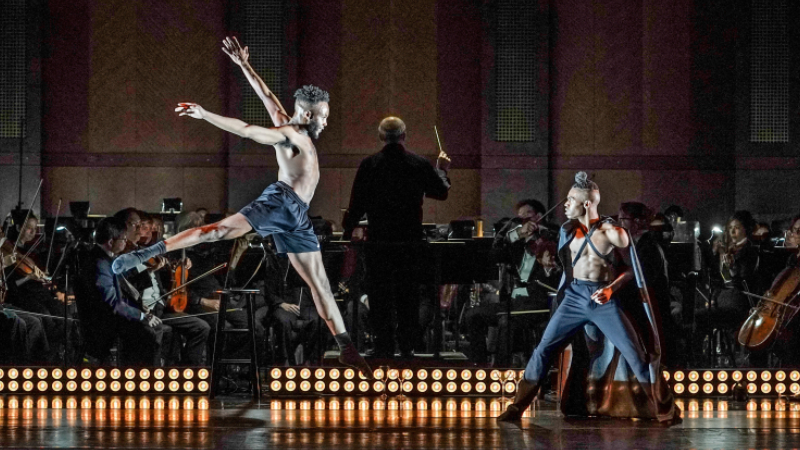
Foreground, l-r: Terrell Rogers, Jr. and Elijah W. Lancaster of the Dallas Black Dance Theatre performing Stravinsky’s “Petruska” with the Fort Worth Symphony Orchestra led by Robert Spano, January 5, 2024. (credit: Karen Almond)
However, one aspect of Fokine’s version was not observed. The Ballerina is supposed to dance en pointe throughout. But this is not a technique used by the modern dance-oriented DBDT, so it is understandable.
Toes or not, the dancers were uniformly superb and displayed a mastery of traditional ballet steps seasoned with modern dance moves imported from everything from jazz dance to hip-hop. Astonishingly, all of the dancers were able to spin pirouettes for as many as seven or eight rotations, deliver sky-high leaps, execute dramatic lifts, and keep everything clean and precisely together. The four leads, uncredited in the program, were superlative.
The program’s first half was not as impressive, even though it was Mozart. We heard the overture to the opera, The Magic Flute, and his Symphony No. 41, known as the “Jupiter,” his last, most fully realized, and longest of his symphonies, that is recognized universally as the pinnacle of the Classical Era.
The main problem with the Mozart selections was that Spano used the fully assembled string sections of the orchestra rather than paring it down to a more appropriate size. Even though Spano achieved a surprising degree of clarity from the overstuffed sections, the performances lacked the transparency that would have allowed Mozart’s sparkling orchestrations to shine out. That aside, Spano delivered a thoughtful but maybe a bit overserious performance. ■
EXTERNAL LINKS:
- Fort Worth Symphony Orchestra: fwsymphony.org
- Robert Spano: robertspanomusic.com
- Dallas Black Dance Theatre: dbdt.com

Read more by Gregory Sullivan Isaacs.


.png)