
May 15, 2026
Jones Hall
Houston, Texas – USA
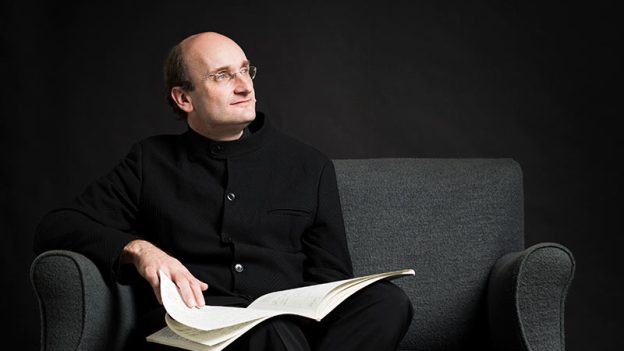
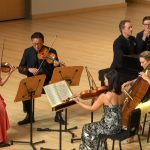
Houston Symphony, Andrew Manze, conductor; Augustin Hadelich, violin; Sopranos and Altos of the Houston Symphony Chorus, Anthony J. Maglione, director.
Jennifer HIGDON: blue cathedral (1999)
Pyotr Ilyich TCHAIKOVSKY: Violin Concerto in D major, Op. 35 (1878)
Gustav HOLST: The Planets (1917)
Lawrence Wheeler | 18 MAY 2026
Friday evening at Jones Hall marked the second program of the Houston Symphony’s Transfiguration Festival, including works by Jennifer Higdon, Pyotr Tchaikovsky, and Gustav Holst. Making his Houston Symphony debut was acclaimed British conductor Andrew Manze. Violin virtuoso Augustin Hadelich returned for a performance of Tchaikovsky’s popular Violin Concerto.
This program has several connections to last week’s concert. Joshua Bell performed a violin concerto he commissioned from five American composers called The Elements. Jennifer Higdon wrote the third movement, titled “Air.” The fifth movement is titled “Space.” This directly relates to The Planets by Gustav Holst, which served as a model for The Elements. It is fairly unusual for consecutive subscription concert programs to feature works by a contemporary composer. It is also a bit out of the ordinary to hear a new work performed in close proximity to its original inspiration.
It is not common, but certainly fortuitous, to have two world-class violinists perform on the same stage a week apart. While stylistic differences are identifiable, the superb level of execution is unmistakable. The conductors for both weeks achieved excellent results, but through markedly different means.
Jennifer Higdon is one of the most performed and recorded living American composers. Her compositions can be heard on more than four dozen CDs, and tonight’s work, blue cathedral, has been performed by more than 400 orchestras. A seminal work, it is a tone poem dedicated to the memory of her younger brother, Andrew Blue Higdon, who was lost to cancer. Neoromantic in style, it ponders the question of what makes a life by means of her “intuitive” compositional process. blue cathedral follows a wide range of emotions that loosely resemble an elegy expressed in a cinematic framework. Higdon played the flute and her brother the clarinet—both instruments are featured. Two violas and cellos play a tonally rich quartet at the opening. Extensive use of percussion adds to an energetic middle section, where rapid sixteenth notes in the brass are followed by a fanfare that dissolves into another flute and clarinet duo. The solo quartet returns, answered by English horn. The clarinet then plays alone, without the flute. The piece ends with pitched crystal glasses being played while several musicians shake Chinese health balls in their hands. This creates a soft, celestial wave of sound. Simultaneously, the piano plays a series of high-pitched fifths in groups of three, which sounds like a telephone that remains unanswered. Conductor Manze drew a plethora of colors from the musicians through enthusiastic and often symmetrical arm motions. In many sections, associate principals were performing with uniformly excellent results.
Tchaikovsky’s violin concerto was initially deemed unplayable, and its first performance was met with critical disdain. (Eduard Hanslich’s terrible review of the premiere is considered one of the worst in music history.) In spite of its initial reception, it has become a staple of the repertoire. The solo part has multiple technical difficulties along with countless musical decisions. Virtually every violinist of stature performs this concerto, and there are as many different interpretations.
From the very first notes, it was clear that Hadelich was going to take the contest out of the concerto. His was a classical approach, perhaps reflecting Tchaikovsky’s admiration of Wolfgang Amadeus Mozart. He also provided a lift in the main theme, reflective of Tchaikovsky’s love of ballet. Far from the traditional, somewhat aggressive playing often heard, lightness and elegance were his approach. Phrases were afforded seamless legato bow strokes, while double-stops and changes of position were played with stunning accuracy. The most difficult passages were tossed off effortlessly. While his left hand is a marvel of execution, his bow is always at the right place at the right time. Still, he played strongly when the character of the music required it, even breaking a bow hair in the brilliantly played cadenza, which he quickly removed between phrases. The end of the first movement was met with the customary applause, with several people standing—perhaps because they thought it was the end.
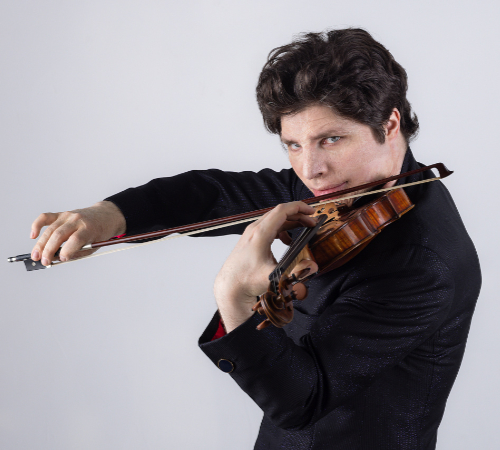
Augustine Hadelich (credit: Suxiao Yang)
The second movement, “Canzonetta,” played without mute, continued Hadelich’s tonally beautiful playing. There was freedom of expression, initially played simply and more emotionally involved on the repeat. Here, he reacted to the clarinet and violas by changing his tone.
The last movement was infused with a bit of gypsy fiddler character—and at times a folksy drinking song. Any toasts were made with champagne, with nary a whiff of “cheap vodka.” Hadelich took nothing to excess, unless you count excessive brilliance. Those favoring a more traditional interpretation were surely disappointed, but this was refreshing—and damn fine playing, to boot. The Jones Hall audience gave Hadelich an extended standing ovation. His encore was his own transcription of “Träumerei” from Scenes from Childhood by Robert Schumann. It was touchingly beautiful and fiendishly difficult, ending with double artificial harmonics.
Manze’s conducting in the concerto was uneven. An excellent violinist himself, his personal knowledge of the concerto did not always translate to his baton. The very beginning of the concerto was not unified in the first violins. While the string sections were reduced, six stands sat in a long row. Moving one or two stands into the wedge between violin sections would have helped ensemble cohesion, especially given the number of substitute players. There were many fine woodwind solos, notably from the clarinet and French horn.
Holst’s orchestral suite The Planets is one of the most famous classical music pieces. It describes seven planets, excluding Earth and Pluto, in astrological rather than astronomical terms. It is easy to hear similarities to John Williams’s Star Wars music. Understandably so, since producer George Lucas used The Planets as a temp track, and wanted to use “Mars” as the movie’s theme. Holst wrote an innovative, highly descriptive score that resonates with listeners and remains a favorite among orchestras. Being British, Manze was in his musical element, providing a thoughtful and idiomatic reading. Issues of ensemble remained, but the overall sweep and joy of music-making took precedence. Particularly beautiful was the Scottish-sounding theme in the middle of “Jupiter.” Manze held the dynamic at mezzo-forte until the written forte. The fortissimo culmination is one of the great moments in music, and it was inspiring to hear.
Fine playing ran throughout. In “Mars,” the massive brass section produced a wall of sound. “Venus” was highlighted by solo violin, solo French horn, and dual harps. “Mercury” was fleet of foot, but tripped on a few spiccato triplets. “Jupiter” was festive, with six French horns joined by violas and cellos. Tempo and meter transitions were well-indicated by Manze, leading to the previously mentioned central majestic melody and a stirring ending. Dual timpani expertly completed melodic motifs not possible by only one.
“Saturn” turned to music representing old age. Flutes and dual harps set a mysterious opening for basses and cellos, before turning to steady pizzicatos suggesting the march of time. Holst orchestrates moments of confusion, which often accompany old age. It ends quietly and hopefully, perhaps looking back on a successful life. “Uranus, the Magician” begins with an ominous brass fanfare followed by a bouncy bassoon melody reminiscent of The Sorcerer’s Apprentice, another musical depiction of a magician. “Neptune, the Mystic” sounds ethereal and, well, mystical. It ends with a wordless offstage women’s chorus, effectively presented by the sopranos and altos of the Houston Symphony Chorus.
The contrasts with the previous week’s concerts are striking. Juraj Valčuha strives for precision and detail by maintaining tight control of the orchestra. The results are often thrilling. Manze is technically less precise, yet achieves an admirable level of musical enjoyment. While it is good to see and hear different approaches, at this time, Valčuha is the best man for the job. ■
The program was repeated Saturday night and Sunday afternoon.
EXTERNAL LINKS:
- Houston Symphony: houstonsymphony.org
- Andrew Manze: andrewmanze.com
- Augustin Hadelich: augustinhadelich.com/en

Read more by Lawrence Wheeler.
.png)