
May 4, 2026
IGNITE: SPARK2 Launch Concert
Goodson Yard, The Goat Farm Arts Center
Atlanta, Georgia – USA
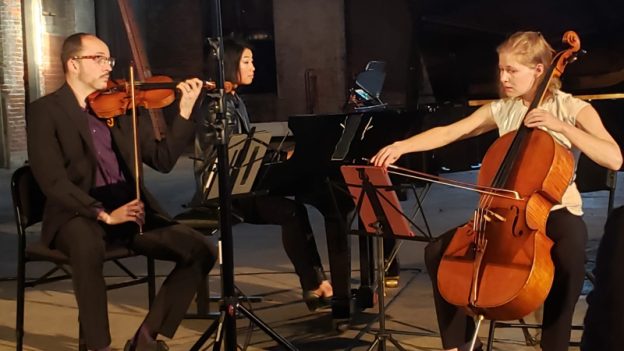
ensemble vim (Bob Anemone, violin; Laura Usiskin, cello; Choo Choo Hu, piano; Emily Koh, bass); collaborative movement artists.
Lauren McCALL: A Spark and a Glimmer (2022)
Leah ASHER: Fiction (2014)
Emily KOH: and still… we breathe (2026)
Alfred SCHNITTKE: Hymn II (1974)
Lera AUERBACH: Triptych: This Mirror Has Three Faces (2011)
Howard Wershil | 11 MAY 2026
As ensemble vim completes its seventh illustrious season, I’m reminded how greatly Atlanta’s cultural scene has grown in the last 50 years, and how fortunate we are to have so many musical entities available, especially an ensemble with vim’s particular talents, perspectives, and initiatives, serving our community. While it may or may not have been the intent of ensemble vim, each of the pieces on the program tonight—even the venue itself—presents, for me, an element of nostalgia, while also serving to paint a future filled with hope and wonders.
The Goat Farm is well known as an excellent venue for a variety of arts and music events, and a number of the spaces available, as the one utilized this evening, are exactly that kind of warehouse space—expansive, high ceilings, exposed brick walls, visible metal supports, warehouse-specific windows—that we so typically associate with artistic endeavors… and that I, as a young artist, may have now and then dreamed of occupying as a personal residence. Entering the space was almost a spiritual experience, amplifying my expectations for the evening; expectations which were surely met, if not exceeded.
And now, on to the musical reality.
Composer Lauren McCall’s A Spark and a Glimmer (2022) was a delightfully refreshing work and a wonderfully appropriate musical introduction to the evening’s program. Joyfully performed by violinist Bob Anemone, cellist Laura Usiskin, and pianist Choo Choo Hu, this selection playfully explores a very listenable and harmonic musical language, one might have thought existed a century or so ago. Yet by fully and effectively utilizing the twists and turns born of 21st-century musical knowledge, the composer imbues the piece with interest, form, and a singular, distinctive identity. At times, I thought I was listening to Aaron Copland… but would he really have done that? At other times, the piece exuded an atmosphere of a late 19th-century salon piece… but, no, that couldn’t have happened there, could it have?
According to McCall, “A Spark and a Glimmer was inspired by visual artist Alison Saar’s sculpture installation titled Feallan and Fallow. Alison Saar created Feallan and Fallow based on the Greek myth of Persephone, and the sculpture on which this composition is particularly based is Summer. Summer is a sculpture of Persephone’s mother, Demeter, who is pregnant with fireflies. This sculpture of Demeter is also a representation of fertility and the coming of fruit during the summer.”
All in all, I was intrigued and amused by the composition, which extended even further my admiration of the penchant of younger composers to open their gates to all kinds of musical styles, and tweak them to make a composition peculiarly their own.
Our next selection, Leah Asher’s Fiction (2014), presented us with a musical style and language almost diametrically opposed to that of our most pleasant introductory experience. Bassist Emily Koh’s fiercely intense and serious performance presented us with dramatic bits of sonically unfriendly, disjointed materials, sparse and few in nature, cynically woven together to tell a vile and heinous story. In addition to the usual bow strokes one expects from a stringed instrument, we’re treated with glissandi, harmonics, bow bounces, and foot stomps, all intermixed by the composer with finesse and proficiency, and soberly, expertly performed by a musician clearly fully engaged in the moment.
Koh’s own composition, and still… we breathe (2026), the third entry on our program, was absolutely stunning, exuding a mastery of form and balance I seldom encounter in a new musical experience. Beautifully performed by Anemone, Usiskin, and Hu, and still… we breathe treated us to opening contrasts between dramatic, dynamic flurries of musical expression from all three performers, sometimes together, sometimes overlapping, sometimes separately; and the entry of a haunting, nostalgic melody that would reappear at various stages of development of the piece. Here again, as with the prior compositions, we find throughout the piece distinctively contemporary performance techniques—musical glissandi, inside-the-piano taps and string plucking, string harmonics, and more—but all utilized so advantageously to the piece that there could never be any question of its use merely for affect or sensationalism; the techniques were inherent to the language of the music, that is all. Without them, the piece could not exist.
One marvelous aspect of the piece, particularly near the end, was the use of non-traditional pitch selections—pitches between what we think of as traditional pitches, if you will—that, rather than detracting from the piece, gave it an unexpected kind of nostalgic feel somehow connected to the lovely, nostalgic recurring melody that captured our hearts. I wonder: was this connection intentional, or simply my own personal perception? Only the composer knows for sure.
This is the first of Emily Koh’s works I’ve heard, and I’m certainly encouraged to seek out more. I would recommend the same for my readers as well.
Following and still… we breathe, Usiskin and Koh offered a reverent performance of Alfred Schnittke’s Hymn II (1974). The soft, solemn opening passages were slightly marred by the passage of a freight train behind our performance venue, but the disturbance was short-lived. Such soft passages were interspersed with louder, more bombastic sections, returning ultimately to expressions exuding more about harmony and compatibility. I found Hymn II to be a satisfying piece in a familiar musical language, primarily redeemed by the sense of devotion it created for the listener.
Yet while I was intently listening to and focusing on the performers, I did find something remarkable happening elsewhere. Out of the corner of my eye, first the left, then the right, I saw stooped, darkly dressed figures on the far edges of the performance area slowly advancing towards the performers. Their body motions seemed most reserved, but their hand motions, their exceptional, expressive hand motions, spoke uncompromisingly of ancient sagas and archaic angst. The juxtaposition of these hand motions against the sacred intentions of the music in performance yielded astonishing and heartwarming results. The brief song of a sparrow outside at the end of the collaborative performance seemed to grant nature’s approval to this particular uniting of the two artistic disciplines, movement and sound.
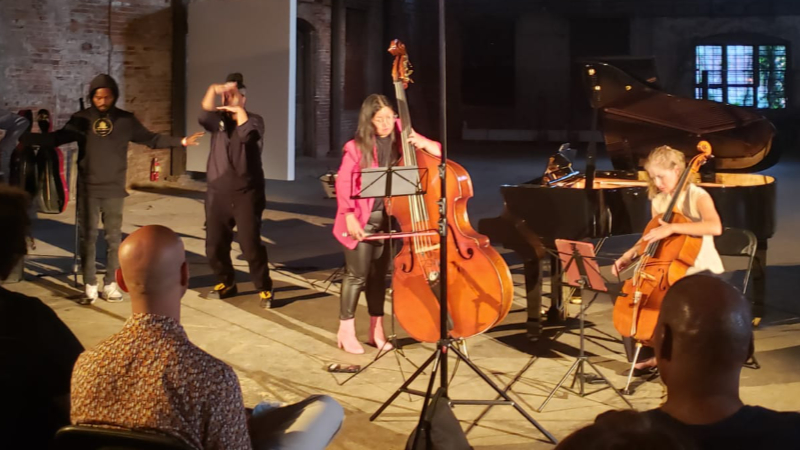
Bassist Emily Koh and cellist Laura Usiskin (right) performance of Afred Schnittke’s ‘Hymn II’ wit movement artists (background left). (credit: Davida Cohen)
Of course, one of the main purposes of tonight’s concert was to announce the winners of ensemble vim’s recent composition competition and the pairing of the three winners with the dance companies chosen to participate in “Spark2.” The “spark!” initiative is described by ensemble vim as “an intersectional music and art festival” pairing musical creativity with creativity in another artistic discipline; with that in mind, we’re offered the initiative’s powerful slogan “ignite the spark / unite the arts.”
The three winning composers for ensemble vim’s most recent composition competition were chosen through a blind adjudication process by ensemble vim, assisted by distinguished composers Badie Khaleghian (Bowdoin College), Liliya Ugay (Florida State University), and Lexi Temple (Arizona State University) from over 100 applications submitted. Each winning composer was then united by ensemble vim with one of three Atlanta-based movement companies, in pairings designed to create challenge and innovation for both. Ensemble vim shared with us that the final selection of winning composers was certainly difficult, with all applicants showing merit, and that final selection discussions among the ensemble were indeed intense. Ultimately, winning composer Ty Bloomfield was paired with dance group gloATL, winning composer Gracie Fagan was paired with dance group FyreNation Crew, and winning composer Joao Pedro Oliveira was paired with dance group Wabi Sabi Terminus.
With the immense success of the initial “spark!,” I can’t wait to hear and see the results of the second. February 2027 can’t come rapidly enough for me.
The final composition of the evening, Lera Auerbach’s Triptych: This Mirror Has Three Faces (2011) for violin, cello, and piano, is a work of valiant dramatic contrasts and unforgiving bombast, but one of tenderness as well. The piece exists in 5 monolithically impactful movements: “Prelude” (Left Exterior Panel) “Moderato libero, First Unfolding” (Left Interior Panel) “Allegro appassionato, Second Unfolding” (Right Interior Panel) “Tempo di valse, Tell’em What You See” (Center Panel) “Allegro assai, and Folding – Postlude” (Right Exterior Panel) “Adagio nostalgico,” each of which melt into each other as if borders were a concept that never existed.
While I found the piece to be masterfully composed, I somehow found myself a bit stuck on what sounded to me like something of a film-score aesthetic, though I wonder if a film creator would seriously consider utilizing such a score as this. In fact, the piece tends to tell its own visual tale, no film required, but in a language seemingly stuck in history. A phenomenon perhaps representing artistic limitations still imposed under Russian government restrictions? Regardless of any limitations, imagined or otherwise, the composer handles her materials with courage and panache, creating a solid work worthy of anyone’s consideration. The composer’s intentions were magnificently conveyed by ensemble vim’s Bob Anemone, Laura Usiskin, and Choo Choo Hu, whose efforts always provide the power to exalt. Indeed, my expectations for the evening were well exceeded, with each piece and each performance offering something of rare and unexpected value.
What will ensemble vim be providing for their upcoming season? We can only guess. So many of us feel that “spark!” in our community, encouraging us to enjoy what our cultural environment has to offer. I hope you encounter that “spark!” as well; the musical pleasure is waiting, and plentiful, for everyone to experience, for all to enjoy. ■
EXTERNAL LINKS:
- ensemble vim: ensemblevim.org

Read more by Howard Wershil.

.png)