

May 8 & 9, 2026
Meymandi Concert Hall
Raleigh, North Carolina — USA
North Carolina Symphony; Carlos Miguel Prieto, conductor
Gabriela ORTIZ: Kauyumari (2022)
Aaron COPLAND: Suite from Appalachian Spring (1944), original 13-instrument version
Silvestre REVUELTAS (arr. José Yves LIMONTOUR): La noche de los mayas (1938/1960)
José Pablo MONCAYO: Huapango (1941)
Christopher Hill | 11 MAY 2026
This weekend, Carlos Miguel Prieto concluded the 2025–26 season of the North Carolina Symphony with a festive program perhaps no other conductor could (or would) have selected: one signature American work (it’s our country’s 250th, after all) and three North American works from south of the border.
The first played was Gabriela Ortiz’s Kauyumari (named for a mythical/shamanic blue deer), commissioned by the Los Angeles Philharmonic to celebrate its first public concerts after the long COVID season of 2020–21. In creating this work, Ortiz went back to a work she wrote for Kronos Quartet and expanded it. In an NCS podcast, maestro Prieto shares his knowledge that this expanded work is intended to manifest musically just how virtual (or blurred) political boundaries can actually become when they impose themselves on shared cultures, cultures such as that of the southwestern U.S. (where L.A. is, geographically, located) and that of northwestern Mexico (where the blue deer myth still lives). The result may be considered music for a world in which the rich want more, and the rest want to dance in peace. Prieto half-joked that Kauyumari has been played recently by the Berlin Philharmonic, the Vienna Philharmonic, and the Boston Symphony, and with those out-of-town trials under its belt, it’s now ready for the North Carolina Symphony.
What kind of music is Kauyumari? Rhythmic music overlaid with melodic folk riffs. It begins with a solemn prelude that wanders close to Copland’s famous Fanfare without ever quite loitering. After a minute or so, Kauyumari transitions into a dance on a tonic chord, and it dances on that chord for about six minutes before moving to an adjacent tonic chord for its last ninety seconds. An accelerando during the last 15 seconds brings the piece to a rousing close. It’s all great fun, and the audience responded as if they were attending a rock concert. In a very real sense, they were — and it worked, more or less the same way it’s been working since Christopher Rouse’s The Infernal Machine made orchestral rock cool in 1981.
The Suite from Appalachian Spring is perhaps Aaron Copland’s most beloved ballet score. Written in the midst of World War II, it still impresses by its utter disregard for nationalistic musical rhetoric. It says, instead, here is how communities really live together. Besides the original ballet, there are two versions of the Appalachian Spring suite: the original is scored for thirteen instruments; the subsequent orchestral version is, as expected, greatly enlarged and comes closer in sound to the stentorian Third Symphony, which the North Carolina Symphony performed last fall.

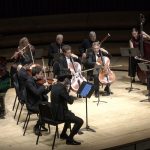
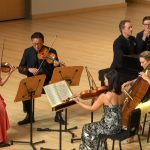
Carlos Miguel Prieto leads members of the North Carolina Symphony in the chamber orchestra version of Aaron Copland’s ‘Appalachian Spring’ at Meymandi Hall on Friday May 8, 2026. (courtesy of NCS)
Your reviewer first met the thirteen-instrument version of Copland’s Appalachian Spring suite in 1960, when an assistant conductor of the New York Philharmonic shared his score and said he thought it the better of the two versions. Copland happened to agree; maestro Prieto also agrees, and in concert, this soft-spoken version of Appalachian Spring is the one he conducted.
It took a while to change the stage from full orchestra to chamber group. So the second item on the first half of the program started after some 10 or more minutes of audience chit-chat. When the musicians came out again, it almost felt as if we were about to hear the program’s opening work. Whatever. It was clear from the opening moments of the chamber performance that this was going to be one infused with great heart and commitment, realized by thirteen superb musicians. As a former orchestral keyboard player, I could not help but be especially impressed by Inara Zandmane, who played her wickedly difficult part in this difficult score as if it were a mere finger exercise.
The suite alternates between slow, inward lyricism and outward expression of social relations so complexly experienced that they require constant asymmetrical and unpredictable quick rhythms. The thirteen-player version is unforgiving in making every performer heard not only in their solo lines but in their doublings of those quick, asymmetrical lines. Any goof spoils the party. In the performance by the select North Carolina Symphony musicians, there were no goofs. Instead, one sensed a deep understanding of Copland’s voice that rose to its fullest expression in the meditative sections, which were played (not performed) with great innigkeit and empathy. Fast tempos were brisk but not antic. Slow tempos were taken at a genuinely introspective rather than a self-consciously rhetorical pace. This was part of Prieto’s essential contribution to the performance.
At the conclusion of this chamber work, the audience rose, remarkably quickly, to their feet. This was no longer a rock concert in which people revel in social solidarity, but a classical concert, in which people are touched on an intimate, personal level. A well-dressed thirty-something gentleman near me, who perhaps had never heard this work before, said to the lady he came with, “Gee, that was beautiful.” In your reviewer’s opinion, he was right.
Besides Ms. Zandmane, the musicians whose dedication and insight made this exceptional performance possible were concertmaster Justin Bruns and Anna Black on first violins; Jackie Wolborsky and Chris Jusell on second violins; Samuel Gold and Kurt Tseng on violas; Elizabeth Beilman and Peng Li on cellos; Leonid Finkelshteyn on contrabass; Megan Torti on flute; Melanie Witsden on oboe; Samuel Almaguer on clarinets (he played two); and Aaron Apaza on bassoon. All are listed because this was, after all, a chamber music performance and because, without exception, each musician played as a winning soloist as well as a sensitive collaborator.
After the interval, the full orchestra returned for a performance of a symphonic suite from the movie La noche de los mayas. The film’s score was written by Silvestre Revueltas. Your reviewer’s first experience of Revueltas came in the mid-1970s, when the Tucson Symphony Orchestra performed his Sensemayá. I was in the orchestra, not the audience, and one of the immediate impressions I got sitting in the middle of everything was that Revueltas does LOUD AND WILD really well, like Stravinsky. But he also does warm and sweet really well, like Gershwin. On the other hand, he doesn’t sound like Stravinsky, Gershwin, or any other composer your reviewer knows. He’s his own wild, warm, mysterious guy.
Sensemayá had its premiere in December 1938. The movie La noche de los mayas premiered in January 1939. In other words, the two scores were written around the same time, a time when Revueltas was at the height of his powers. It was also a time when great Mexican muralists — among whom Diego Rivera is probably the best known in the U.S. — were creating visual environments unlike any ever seen before, mixtures of cultural celebration, gritty realism, emotional expressionism, and flights of fancy. (A wonderful example can be experienced in a room at the Detroit Art Museum.)
La noche de los mayas can be thought of as a parallel to such murals, a parallel in the form of a four-movement symphonic suite along the lines of Rimsky-Korsakov’s Scheherezade or Chadwick’s Symphonic Sketches or Sibelius’s Lemminkäinen Suite. Like them, it is a masterpiece, even though not one concocted by Revueltas himself (who lived only a year beyond the movie’s premiere). Unfortunately, the high-concept film La noche de los mayas did not make as strong an impression in theaters as Revueltas’s score for it, perhaps partly because (as Prieto claimed in his pre-concert talk) the film is, despite its release year, essentially a scored silent film (akin to, say, Lang’s Metropolis). Revueltas’s stunning music thus went unheard, except on rare occasions when film buffs screened the film.
Enter conductor José Yves Limontour. In the late 1950s, he took Revueltas’s film score and reordered its music to make the four-movement suite played this weekend. Limontour’s score has four movements: “Noche de los Mayos” (Night of the Mayas); “Noche de jaranas” (Night of revelry); “Noche de Yucatán” (Yucatán Night); and “Noche de encantimiento” (Night of enchantment). In making this arrangement, Limontour created the most sustained orchestral work written “by” Revueltas, a work about five times longer than Sensemayá. Prieto played the four movements without breaks, thus emphasizing the hybrid nature of Limontour’s arrangement: it’s part tone poem, part symphony.
A number of conductors have championed this score, but no one so much as maestro Prieto. As is his wont, Prieto brings his historic collection of Mexican percussion instruments into play when he performs Revueltas’s symphonic suite. And indeed, percussion plays a huge role in this work, which requires no fewer than fourteen percussionists. Imagine Rivera, say, painting with a palette that includes a particular ocher, an unusual ocher that uses ingredients of Toltec ochres (as analyzed by modern chemistry). That’s the sort of subtlety Prieto brings to the sound world of La noche de los mayas. Right here in Raleigh, North Carolina.
But Prieto goes further than just providing authentic instruments. In a section of “Noche de encantimiento” where Limontour allows for percussion only, Prieto and his fourteen players worked out a lengthy 1939/2026 toccata for percussion (NB: a reference, and bow, to Chavez), a toccata in which players duel with each other at some length, rather like timpanis do in Nielsen’s unforgettable Symphony no. 4. During this perhaps three-minute episode, Prieto simply lowered his baton and danced along, tastefully, to his percussionists’ hot licks.
What of the suite overall? It mixes several styles. The first movement (6:30) evokes the majestic Mayan pyramids with big, loud “stuffed” chords supporting a simple and memorable musical motive. The second movement (5:40) uses native fife tunes for a scherzo that builds progressively in complexity and bitonality until, after four-and-one-half minutes, it suddenly evaporates, leaving a sustained fife-and-drum solo that transitions back to a brief recapitulation of the opening tune. The third movement (6:40), almost from the beginning, mixes chromatic lyricism with popular song, eventually reaching a level of sensitive refinement that almost (but not quite) matches Copland’s Appalachian Spring suite. In the fourth and final movement (10:20), Revueltas composes chromatically from the very opening. It’s not tonal, but it’s also not atonal — sort of like some post-bop jazz you may have heard. Only different.
This is the movement that requires fourteen percussion players — and not only them, but also a conch expert who knows how to blow this common seashell deafeningly, and in a two-octave range. I suspect minds as well as shells were being blown this weekend while he played. What a mix of world musics, from atonal chromaticism to ancient conch calls, is contained in this fourth movement from 1938! One word suffices for it: wild. Mind you, not stupidly or boringly wild; excitingly wild, like Sensemayá. Yet that does not really do the music justice. As with a Rivera mural, the overall effect is as much metaphysical as physical, as much spiritual as lyrical. In 1938, rock was still in the future, of course, but the ultra-loud, ultra-chromatic last movement of La noche de los mayas impacted the Raleigh audience as if it were in fact classic rock. Numerous bows were taken as the audience stood and cheered.
The last work on the program was José Pablo Garcia Moncoyo’s iconic pop-concert favorite, Huapango. In a comment to the audience before performing the work, which he described as “bitter-sweet,” Prieto dedicated the performance (which he was conducting “from the bottom of my heart”) to people leaving the North Carolina Symphony. One hopes it doesn’t include himself.
The Moncoyo piece is instantly recognizable to Mexicans, and as it began, authentically Mexican recognition and approval sounds issued from various corners of the auditorium. Huapango lasts several minutes longer than Gabriela Ortiz’s Kauyumari. They make good bookends. Like Ms. Ortiz’s work, Huapango makes a large orchestra work for its pay; unlike her piece, and in keeping with its era, Huapango employs all three of the “magic chords” (tonic, subdominant, and dominant). The piece’s effect on your reviewer was, truth to tell, more social than personal, rather like encountering an oft-heard Sousa march peppered with potent polyrhythms. But Prieto, on the podium, was smiling radiantly throughout the piece, clearly creating for himself and many others a highly positive memory of this North Carolina Symphony season. The Raleigh audience responded with similar enthusiasm, and for a third time, the packed house rose to its feet. It was a fine and festive way to end a season of increasingly impressive performances. ■
EXTERNAL LINKS:
- North Carolina Symphony: ncsymphony.org
- Carlos Miguel Prieto: carlosmiguelprieto.com

Read more by Christopher Hill.
.png)