

Emory Chamber Music Society of Atlanta w/ Concerts at First
Bach’s Lunch Series
September 10, 2021 @ Noon
First Presbyterian Church, Atlanta, GA
live concert, reviewed via video stream
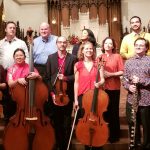
Jessica Shuang Wu, violin; Yinzi Kong, viola; Guang Wang & Khari Joyner, cellos.
DOHNANYI: Serenade for string trio Op. 10
ARENSKY: Quartet for Strings, Op. 35
Giorgio Koukl | 13 SEP 2021
Presenting two semi-unknown composers in a concert involves a certain degree of risk. In the case of Ernö von Dohnanyi (1877-1960) and Anton Arensky (1861-1906), the choice was a winning one for the Emory Chamber Music Society of Atlanta‘s 2021-22 season opener. The noontime Bach’s Lunch concert at First Presbyterian Church of Atlanta on Friday the 10th of September, finally with the presence of the public, was introduced with few but well-chosen words by ECMSA artistic director William Ransom.
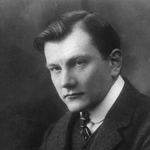
Ernö von Dohnanyi
The first work, Dohnanyi’s Serenade for string trio, Op. 10, was written when the composer was around 27 years old. It has five movements: “Marcia” (Allegro), “Romanza” (Adagio non troppo), “Scherzo” (Vivace), “Tema con variazioni” (Andante con moto) and “Rondo.”
One would assume that this was an immature work of an unknown young composer. Nothing could be more untrue. Gifted with a tremendous personal flair, Dohnanyi managed to keep himself at the center of any group, society, or organization.
At age 18, having chosen to study in his own country, Hungary, and not as usual in Vienna, Dohnanyi started a national movement of students considering the Franz Liszt Academy of Budapest no more a provincial school but something more, de facto influencing the fortune of this institute. He soon became a teacher and director of this academy. He was also the chief conductor of the Philharmonic orchestra, music director of the Hungarian Radio, and a leading force of musical life to the point that his student, Bela Bartok, exclaimed: “Dohnanyi provides the entire musical life.”
However, continuing his activities during the Nazi occupation cost him a significant loss of prestige in post-war Europe. Despite the clearance from charges of collaboration by the American occupation authorities, he never regained his former position. He was forced in 1949 to emigrate to the USA, where he soon became an influential teacher at Florida State University.
This particular work is profoundly rooted in the past. It is well written but lacks entirely in originality.
That made the task of violinist Jessica Shuang Wu, violist Yinzi Kong, and cellist Guang Wang more difficult. Still, the members of the Vega Quartet managed to present this rather unattractive music with such personal enthusiasm and verve that for the most part, nobody seemed to notice the lack of originality of the composition and its relative poverty of melodic invention.
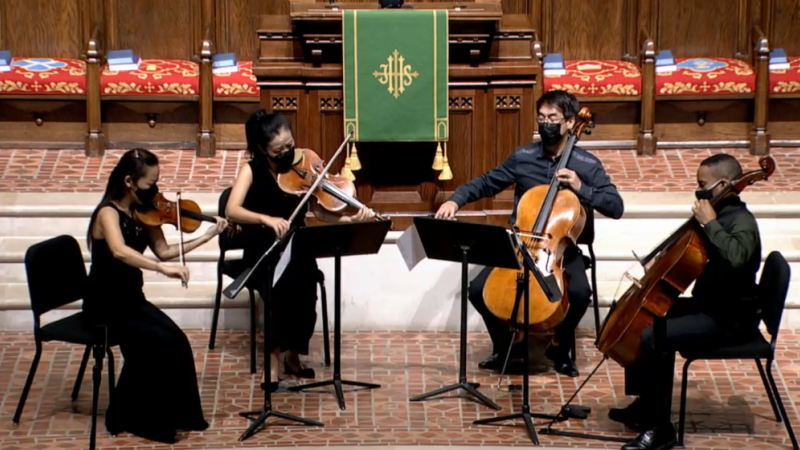
Jessica Shuang Wu, Yinzi Kong, Guang Wang and Khari Joyner (credit: Concerts @ First)
Of entirely different character was the second and final work: Arensky’s Quartet for Strings, Op. 35 (“Moderato,” “Variations sur un theme de P. Tchaikowsky,” and “Finale: Andante sostenuto).”
Anton Arensky was a student of Rimski-Korsakov, who practically destroyed his career with the terrible words: “He will be soon forgotten. “
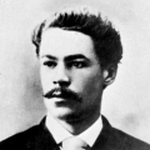
Anton Arensky
This curse, which probably weighed much on the personal life of the composer, proved to be a fatal one. His life ended in a complete chaos of alcohol, gambling, and finally the tuberculosis which killed him at the age of 45. Today his works are practically nonexistent in concert life.
So thumbs up for this courageous choice and discovery of a lovely piece of music.
For this work, guest cellist Khari Joyner joined the Vegas for an unusual quartet formation using two cellos instead of two violins. This choice was a lucky one, giving the quartet sound a gravity otherwise not obtainable.
The technical difficulty of this piece is enormous. To mention one detail: the cello pizzicati have a breathtaking tempo, and the music is full of large pizzicato sections. Not once was there any hesitation or imprecision. Bravo! It was an absolute pleasure seeing the musicians play with all their skillfulness and seeming even to enjoy the music.
Presenting to the public composers who haven’t been so lucky as the already too-well-known ones offers an excellent opportunity to discover musical treasures that need to be better known. As seen from the overwhelming final reaction of the public, such an approach could quickly become a win-win situation for everyone. ■

Giorgio Koukl is a Czech-born pianist/harpsichordist and composer who resides in Lugano, Switzerland. Among his many recordings are the complete solo piano works and complete piano concertos of Bohuslav Martinů on the Naxos label. He has also recorded the piano music of Tansman, Lutosławski, Kapralova, and A. Tcherepnin, amongst others, for the Grand Piano label. Koukl has most recently completed recording the solo piano music of Hungarian composer Tibor Harsányi.
(photo: Chiara Solari)
RECENT POSTS
 Houston Symphony pairs Stravinsky’s austerity with Mozart’s grandeur, Mackey’s inventiveness • 20 Oct 2026
 Raven Chacon’s “Voiceless Mass” anchors an immersive evening with ensemble vim and Bent Frequency • 19 Oct 2026
.png)