

Sergei Kvitko, piano; Madrid Soloists Chamber Orchestra, Tigran Shiganyan, conductor
Wolfgang Amadeus MOZART: Rondo for Piano and Orchestra in D major, K.382
Wolfgang Amadeus MOZART: Rondo for Piano and Orchestra in A major, K.386
Wolfgang Amadeus MOZART: Concerto for Piano and Orchestra in D minor, K.466
Blue Griffin Recordings (BGR 579)
Release date: November 5, 2021
Giorgio Koukl | 14 DEC 2021
Who among us, having seen the film Amadeus by Prague’s most gifted filmmaker Miloš Forman, cannot recall the hilarious scene where our beloved composer Wolfgang Amadeus Mozart complains of not having three heads to be able to buy more wigs?
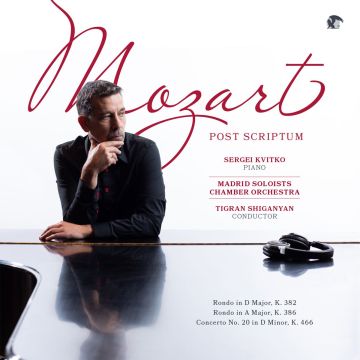
cover art
Well, the pianist, arranger, producer, and sound engineer Sergei Kvitko managed to do exactly this.
While centered on Mozart’s Piano Concerto No. 20 in D minor, the album also contains two Rondos for piano and orchestra. Unfortunately, it is under 60 minutes long, a fact which probably will cause some problems for the buyer.
I have to confess: I was ready to destroy the man with a bazooka right from the beginning. Changing Mozart? How dare he? He is not even Stravinsky playing with Pergolesi.
But after a while, I found myself giggling with my earplugs on, to some discomfort of my wife and my cat.
This man is simply incredible. It is Mozart after Mozart.
Technically perfect, with a seldom heard care of details, Mr. Kvitko already gains his first star as a recording engineer.
The rhythmic precision is astonishing, especially when one realizes all this was recorded in only two days.
But then strange small things begin to happen: a very daring harmonic solution of a cadenza d’inganno, some chromatic ascendant movements, well Mozart was far ahead of his time, wasn’t he?
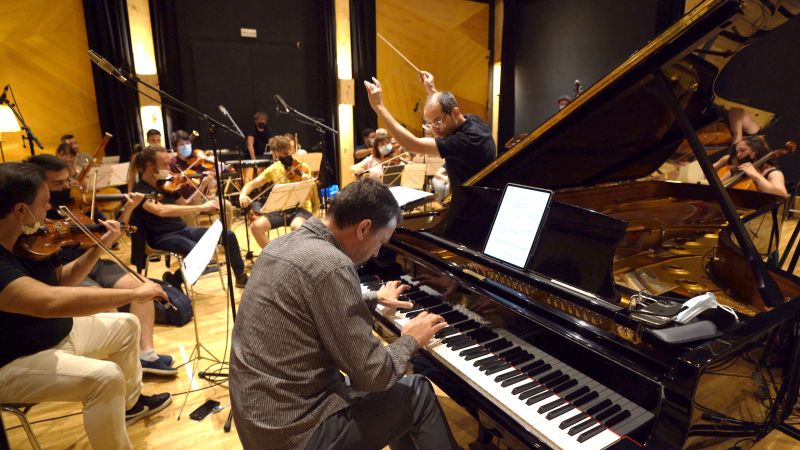
Pianist Sergei Kvitko, conductor Tigran Shiganyan, and the Madrid Soloists Chamber Orchestra in recording session. (credit: Jorge Nunez)
And then, the first of many cadenzas starts, and the listener realizes the subtle play of Mr. Kvitko. He is recomposing many details and doing so in such a perfectly innocent manner that, at least in the beginning, nobody notices. After a while, the romantic chords mixed with citations of a Saint-Säens piano concerto, long trills leading to nowhere, a perfectly Mozart-like solution dissolving in a nearly impossible to identify magmatic cascade … in other words, it is an absolute explosion of creativity for Mr. Kvitko.
Definitely a second star.
Some may find it strange, but let us recall that not so many years ago every pianist was writing their own cadenzas. It was even considered not very appropriate to use the composer’s own. Reviving such a habit is certainly a good thing.
The danger here is overdoing it; to slip into Clayderman, Liberace, or Victor Borge style. But this never happens.
Mr. Kvitko is solid, musically stable, good musician, handling his sound and his rubati with a firm hand, a pianist perfectly able to express what he wants to, clearly at this point a third star.
If such a product will find enough passionate listeners, able to enjoy these subtleties, is another question.
At least let’s hope that his three stars, which in the sense of a famous French restaurant guide means excellence, will help him in the future. ■

Giorgio Koukl is a Czech-born pianist/harpsichordist and composer who resides in Lugano, Switzerland. Among his many recordings are the complete solo piano works and complete piano concertos of Bohuslav Martinů on the Naxos label. He has also recorded the piano music of Tansman, Lutosławski, Kapralova, and A. Tcherepnin, amongst others, for the Grand Piano label. Koukl has most recently completed recording a second volume of the complete solo piano music of Polish composer Alfons Szczerbinski.
(photo: Chiara Solari)
RECENT POSTS



.png)