

(Digital audio album; world premiere recording of the full orchestration.)
The Atlanta Opera
Composer & librettist: Tom Cipullo
(Based on the book by Tom Philpott)
The Atlanta Opera Orchestra
Conductor: Nicole Paiement
Jim Thompson: Michael Mayes
Alyce: Kelly Kaduce
Younger Alyce: Maria Valdes
Young Jim: David Blalock
Format: Digital audio
Duration: 85:01
Release date: November 10, 2021
My Darling Jim
(A short film featuring three arias from Glory Denied)
The Atlanta Opera
Composer & librettist: Tom Cipullo
Co-directors: Tomer Zvulun & Felipe Barral
Creative director: Brian Staufenbiel
Director of photography: Felipe Barral
Jim Thompson: Michael Mayes
Younger Alyce: Maria Valdes
Young Jim: David Blalock
Clinton Smith, piano
Format: Digital video stream
Duration: 20:19
Release date: January 2022
Melinda Bargreen | 10 JAN 2022
The Vietnam War (1955-1975) may seem like ancient history to many of today’s younger music lovers. But to those who watched their former school classmates go off to war in a place few of us could have located on a map, and for those who waited in vain for many to return from Vietnam, that history is still very much with us. That’s why two major new Atlanta Opera projects may have particular relevance for a sizable segment of their audience – although listeners and viewers of any generation are likely to be moved by the heart-wrenching subject matter.
Newly available from The Atlanta Opera are two impressive media presentations. The first is a digital audio album of the two-act Tom Cipullo opera Glory Denied, and the second is a shorter related film, My Darling Jim. The audio album is the work’s first recording with the full orchestration, with members of The Atlanta Opera Orchestra under the able baton of Nicole Paiement. Four singers embody the two characters at different stages in life. Baritone Michael Mayes sings the role of protagonist Colonel Jim Thompson, with tenor David Blalock singing the idealistic and hopeful Younger Jim; soprano Kelly Kaduce is Jim’s wife Alyce, whose younger self is sung by soprano Maria Valdes. All four singers are familiar to Atlanta Opera audiences, a fact that gives the listener an indication of the high quality of this company.
The shorter related film, My Darling Jim, presents three of the opera’s arias with piano accompaniment in an imaginative mini-production that distills the core of the plot.
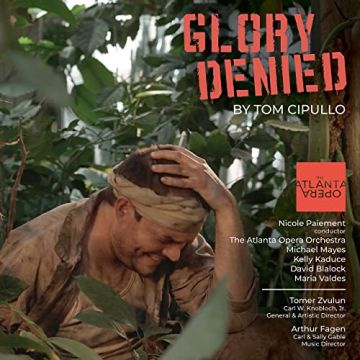
Album art of “Glory Denied”
Glory Denied tells the true story of Army Colonel Floyd James (“Jim”) Thompson (1933-2002), who served in the Vietnam War. He was captured, and he endured almost nine years of interrogation and torture (1964-1973), earning the unenviable distinction as the longest-held U.S. prisoner of war. Meanwhile, his family hoped for his return but imagined him dead; his wife Alyce bore their last child soon after he was captured. After his release from captivity, Thompson returned home to find everything irrevocably changed – most of all himself.
Composer and librettist Tom Cipullo drew material for his chamber opera from Tom Philpott’s 2001 collection of interviews with returning veterans. Jim’s reflections, hopes, and fears have the unmistakable ring of truth, and we see him enduring his captivity while idealizing his far-away wife and their happiness together. He doesn’t know that Alyce, who hasn’t heard from him at all and imagines him dead, is gradually giving up on him – turning to another man, angrily refusing to wear a P.O.W. bracelet, even taking steps to have Jim declared legally dead. Everything has changed during his long captivity: Jim’s family, his home, even the mores of society.
The Glory Denied soundtrack counts on the reader’s imagination to locate the separate milieus of far-off jungle and small-town America, with the husband-and-wife protagonists each cast twice – the younger and older versions of both Jim and his wife Alyce. The double casting is a brilliant decision: the hopeful young couple at the opera’s beginning will change markedly by the final scenes, when they both are worn down by disappointment and tragic circumstance. Alyce’s radiant optimism gives way to a sadder, more realistic worldview of a life that has presented so many obstacles. Jim is torn by disappointment and by rage at the unfamiliar world to which he has returned.
This is why a concert version of this opera makes a great deal of sense: so much of the plot is spent in suspended animation, waiting, confinement, and the emotional imprisonment from memories that press too hard.
Composer Cipullo also wrote the libretto, giving him a total control over the work that can only be envied by composers who set existing libretti. At times, younger Jim (tenor David Blalock) and his older self (baritone Michael Mayes) engage in alternate dialogues, and they recount the endless interrogations: how many ships? How many airfields? The inquisitors learn about Jim from the letters they found in his pockets, using every scrap of information to torment him (“How do you think your wife feels?”). While all this is going on, we hear hopeful and mundane passages from Alyce’s letters: “The children dumped cereal all over the floor,” she reports; the mailman came “with no letter from you.” The poignant letters include lines about one little daughter saving part of her Cracker Jacks for her Daddy.
The younger Alyce (Maria Valdes) sings, “Our fifth week of separation is over,” never imagining that literally hundreds of such weeks await her. Her voice, lyrical and hopeful, deals nimbly with some challenging scoring, and she soars to the top of her compass for a heartfelt “I miss you my dearest, and love you so very much.”
As the older, more hardened Alyce, Kelly Kaduce declares in an equally moving passage, “He went through hell, but so did I.”
The production’s climax is a fiery rap-like rant by the older Jim, who has returned from captivity to a world that is full of startling and upsetting changes: “Kids get high. Men can cry. Wives can lie. … Terrorists at the Munich Games, Athletes now with Muslim names … Music’s vulgar, movies lewd.” It’s a powerful scene and Mayes sings it with a convincing fury.
The score is often bleak, with piercing sorrow at the terrible ordeal that tore apart a family and changed its members forever. The vocal scoring is not always easy – there are some particularly vertiginous high-flying moments that stretch the singers’ compass, and many angular, incisive lines that underscore the torment and pain this couple suffered. There also are moments of shimmering beauty and hope. The characters are fully drawn in just a few sentences and dialogues: their sorrow and anger, their hope and disappointment, and the prevailing sense of unfairness in an ordeal that imprisoned the whole family.
In the production’s final moments, the older Jim finally tells himself, “Forget it … It doesn’t matter … Forget … Forgive …”
Not surprisingly, a work of this power has received more than 20 productions since its premiere in 2007, and also was issued as a recording in 2013 by the Fort Worth Opera Festival.
At a time when the COVID-19 pandemic has forced the cancellation of so many productions, and most future scheduling seems uncertain, it is particularly valuable to have these fresh recordings of thought-provoking works.
After hearing the impact of the “Glory Denied” soundtrack, I found myself wondering about the prospect of a subsequent film that sets three arias from the opera with piano accompaniment. How could the 20-minute film, My Darling Jim, possibly convey the impact of the larger score?
Surprisingly well, as it turns out. Imaginatively filmed in the Atlanta Botanical Garden, full of lush jungle greenery, the film opens with the older Jim (Michael Mayes) – now returned home – gazing in despair at a television, as his younger self (David Blalock) falls wounded to the jungle floor, rising to recite a passage from his wife’s letter.
The aria unfolds: “She said, ‘It’s a little lopsided, but that’s okay…” And the radiant Young Alyce (Maria Valdes) joins in, telling how daughter Pam has declared “I want Daddy to have it” [a star daughter Pam has made in school]. Disheveled, tormented, with the liquor bottle close at hand, Older Jim watches in despair, bitterly exchanging musical phrases with his captive self. The scene then shifts, so that present-day Jim and his TV are sitting outside in the jungle; they share musical phrases from the armchair and from the television, as the despairing Jim watches his own ordeal over again. Then glimpses of his beautiful wife appear, hauntingly declaring “I miss you.”
Jim’s fury at his captivity and all that has changed in the world erupts in his rage aria, listing all the unfathomable changes in the world to which he has returned – but the film ends on a more hopeful note of reconciliation, as Alyce returns to sing “My darling Jim, today was gorgeous outside.” The two of them stroll forward into the jungle, together at last in peace.
The piano accompaniment (rather than an orchestral one) somehow adds to the intimacy of the video; it feels more directly conversational, rather than a “big production.”
Kudos to the My Darling Jim co-directors: Emmy-winner Felipe Barral, and Tomer Zvulun, The Atlanta Opera’s General and Artistic Director, who is himself a military veteran. This short film has the unmistakable punch and impact of a live event, and it offers the hope of peace for its tormented protagonists. ■
• More information about The Atlanta Opera: atlantaopera.org

Melinda Bargreen is a Seattle-based composer and music journalist who has been writing for the Seattle Times and other publications for four decades. Her 2015 book, Classical Seattle is published by University of Washington Press. Her 50 Years of Seattle Opera was published by Marquand Books in 2014.
RECENT POSTS


.png)