
January 15, 2023
Spivey Hall
Morrow, GA – USA
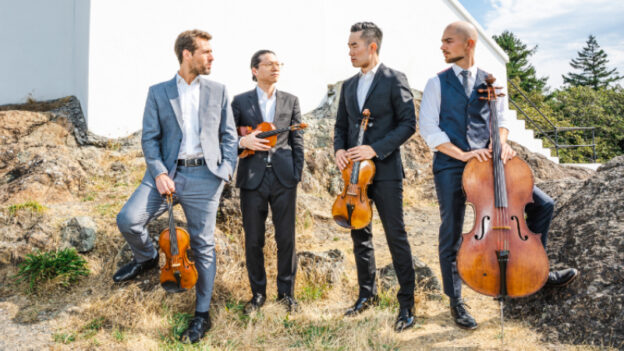
Joel Link, violin; Bryan Lee, violin; Hezekiah Leung, viola; Camden Shaw; cello
Joseph HAYDN: Quartet in C major, Op. 76 No. 3, “Emperor”
Amy BEACH: Quartet for Strings (In One Movement), Op. 89
Antonín DVOŘÁK Quartet No. 10 in E-flat major, Op. 51
Mark Gresham | 17 JAN 2023
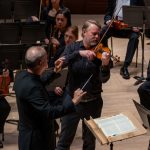
The Dover Quartet performed a gratifying concert of favorite string quartets by Josef Haydn and Antonín Dvořák, plus an admirable one-movement quartet by early 20th-century American composer Amy Beach, on Sunday afternoon at Spivey Hall. They had come to the south suburban Atlanta venue after performing a Friday evening concert at the Amelia Island Chamber Music Festival in Fernandina Beach, Florida.
This concert was the third time Dover Quartet has appeared at Spivey Hall. The significant change since this time is that violist Milena Pajaro-van de Stadt, a member of the Quartet since its inception in 2008, is gone. Her replacement is violist Hezekiah Leung, a founding member of Canada’s Rolston String Quartet, who joined the group in September. The other three are all founding members of Dover Quartet: violinists Joel Link and Bryan Lee and cellist Camden Shaw.
Dover Quartet opened the program with Franz Joseph Haydn’s Quartet in C major, Op. 76 No. 3, Hob. III:77.
Its nickname, “Emperor” (or “Kaiser”), comes from its second movement, a set of variations on “Gott erhalte Franz den Kaiser” (“God save Emperor Francis”), an anthem Haydn wrote for Emperor Francis II of the Austria-Hungarian Empire. In 1922 the tune was adopted for the Deutschlandlied, the German national anthem. Most Americans know it best as the hymn-tune “Austria,” familiarly a setting for the Christian hymn “Glorious Things of Thee Are Spoken.”
In the context of Haydn’s Quartet, which borrows it, it is not at all the congregational hymn that thumps along in a march-like manner. Instead, the second movement, marked “Poco adagio, cantabile,” is a remarkably intimate theme with four variations that grow in their contrapuntal and surprisingly adventurous harmonic complexity. In a musically egalitarian gesture, each instrument gets a turn at the melody.

Theme of the 2nd movement, opening phrase (Violin I).
The opening motif of the “Allegro” first movement is related to that famous theme as a musical acronym corresponding to the first letters of “Gott erhalte Franz den Kaiser” (with “C” for “Caesar”substituting for “K”) from which all the movement’s principal theme springs forth:
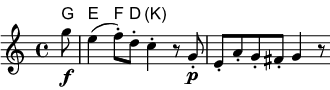
The opening five notes of the first movement are a musical acronym for “Gott erhalte Franz den Kaiser.“
The third movement is a good-natured minuet and trio, and the finale an optimistic “Presto.“
This auspicious start to the concert was followed by the String Quartet in One Movement, Op. 89 by American composer Amy Beach.
Beach’s Quartet is a very original work that is lean yet lyrical and incorporates Alaskan Inuit melodies as thematic material. It also deviates from her larger body of works in its more dissonant and chromatic harmonic language, with extended passages that refuse to settle into any specific tonality. First sketched out in 1921 at the MacDowell Colony in New Hampshire, she completed the quartet in 1929 in Rome, Italy, where a local quartet played it for her. There were many subsequent performances during her lifetime to favorable review, beginning with a January 1931 concert by the Society of American Women Composers in New York.
This kind of integration of indigenous and folk melodies into American art music had been encouraged several decades before by Czech composer Antonín Dvořák, whose Quartet No. 10 in E-flat major, Op. 51 (“Slavonic”) was the final work on the concert.
The piece’s Slavonic character comes from the “dumka” that serves as the scherzo second movement and from the Czech “skočna” stylization found in the “Allegro assai” final movement. Although none of Dvorák’s previous quartets had yet received public performance at the time, No. 10 quickly achieved international renown and has remained popular ever since.
It was a fitting conclusion to this engaging, expertly executed program by the Dover Quartet. ■
EXTERNAL LINKS:
- Dover Quartet: doverquartet.com
- Spivey Hall: spiveyhall.org

Read more by Mark Gresham.

.png)