

February 20, 21 & 22, 2025
Boston Symphony Hall
Boston, Massachusetts – USA
Boston Symphony Orchestra, Alan Gilbert, conductor; Isabelle Faust, violin.
Franz Joseph HAYDN: Symphony No. 48 in C major (“Maria Theresia”)
Igor STRAVINSKY: Violin Concerto
Franz Joseph HAYDN: Symphony No. 99 in E♭ major
Karl Henning | 24 FEB 2025
I’ll lay my cards on the table at the outset by praising this as pitch-perfect programming. Perhaps I should even preemptively exculpate the Boston Symphony Orchestra by assuring the reader that I was not, in fact, consulted, although the program could scarcely suit me better if I had been.
In an online forum dedicated to classical music, I am one of a not large sub-community of Haydn enthusiasts (informally: “Haydnistas”), and a program with not one but two Haydn symphonies is both rara avis Bostoniæ and the envy of our Haydn set. Atop that add the fact that these concerts represent the very first Boston Symphony performances of the Symphony No. 48, “Maria Theresia” (the program notes that we don’t know when the first US performance of the symphony may have been—a condition which cannot be unique to this Haydn symphony) and you have what is (in a small way) an undeniably historic occasion.
Speaking whereof, the nickname attached to the 48th Symphony apparently misleads us with its promise of occasion. It was believed that Haydn composed this symphony for a 1773 visit by the Holy Roman Empress, Maria Theresa of Austria. A manuscript of the symphony was later discovered, dated 1769. Scholars now believe that the symphony actually composed for the Imperial visit was No. 50, but such nicknames do not really become unstuck, let alone reassigned.
The Symphony No. 48 opens with a horn fanfare (Haydn had a pair of fine hornists at Eszterháza and gave them ample employment). It will be taken as read that the orchestra played the piece well, and guest conductor Alan Gilbert led them more than capably. The performance had all the sensitivity and lissomeness of chamber music. The music sang with ease and vibrancy, which delighted the ear.
The opening gesture of Stravinsky’s Violin Concerto, a triple-stop which Samuel Dushkin—the violinist who served both as the composer’s close consultant as he worked on the piece and as soloist creating the concerto’s première (the US première was here in Boston under Koussevitzky’s direction)—immediately but mistakenly told the composer was impossible to play, is as far removed from the Romantic type of violin concerto as are the angels from us mere mortals. Heinrich Strobel wrote that Stravinsky studied all the important concerti in the repertory before beginning his concerto, so his musical choices were deliberate and informed.
What made this such an apt programming choice (beyond the felicity that soloist Isabelle Faust recently recorded the work) is the fact that Stravinsky did not write an archetypal soaringly lyrical solo part with a lush Tchaikovskyan orchestral cushion but a kind of chamber concerto which is no great distance from Hindemith’s Kammermusiken, with comparatively spare textures in which the soloist is first among equals.
This sense of the ensemble, especially the fact that Stravinsky cast the concerto in four movements (rather than the typical three) and the concerto being on a time scale comparable to the Haydn C Major Symphony, made this a superbly apt pairing. The respective designations of the four movements (“Toccata,” “Arias I & II,” and “Capriccio”) hearken back to the Baroque.
Ms. Faust’s performance was incisive and athletic where warranted (the outer movements in particular, which at times recalled the fiddle-playing soldier in Stravinsky’s earlier L’histoire du soldat). She shone, naturally, in the “Arias,” which, quite typically for the composer, present a tenderness at times mixed with some dryness and even acerbity. Befitting the character, Stravinsky reserved some of his most playful rhythmic games for the closing “Capriccio” (no one is going to tell me the trombonists didn’t have fun playing this), towards the end of which is a passage in which the tuba atypically plays the “pahs” of some “oom-pahs.”
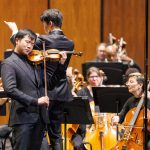
Less ironically, we earlier heard a dazzlingly witty duet between Ms. Faust and First Associate Concertmaster Alexander Velinzon. You could see the joy in their faces as they played together. Ladies and gentlemen, this is why we sing and play music. The audience was enormously appreciative, and their applause brought Ms. Faust back onto the stage twice. She acknowledged the tribute by playing an exquisite little-known Fantasia from Ayres for the Violin, Book 2 by Nicola Matteis the Elder (1672-1699).
After the intermission, Maestro Alan Gilbert and the orchestra reassembled for more Haydn.
Twenty-four years separate Haydn’s 48th Symphony from his 99th–the first of his second tranche of “London” symphonies. This Symphony in E♭ was composed in 1793 and is his first symphony to include clarinets. Haydn directed the première in London on 10 Feb 1794. Wilhelm Gericke conducted the BSO in its first performance of the piece on 30 January 1886.
The second theme of the first movement (“Vivace”) has a charmingly ingratiating character, which we Haydnistas found suggestive of a cat rubbing itself against one’s trouser leg, and so we have dubbed the symphony “The Cat.” If there’s ever a mechanism for attaching a new nickname to a Haydn symphony, let us know.
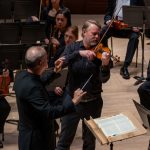
Haydn was in top form in this piece, as likewise were both the Boston Symhpony Orchestra and Alan Gilbert, who collaborated superbly throughout. If the BSO brings Maestro Gilbert back, and especially if “Papa” is on the program, count me in. ■
EXTERNAL LINKS:
- Boston Symphony Orchestra: bso.org
- Alan Glbert: alangilbert.com
- Isabelle Faust: bso.org/profiles/isabelle-faust

Read more by Karl Henning.
.png)