

Yulianna Avdeeva piano.
Dmitri SHOSTAKOVICH: 24 Preludes and Fugues, Op. 87
Dmitri SHOSTAKOVICH/Krzysztof MEYER: Prelude and Fugue in C-sharp Minor
Pentatone PTC:5187480
Formats: CD, digital
Release Date: July 4, 2025
Total Duration: 2 hr 27 min
Giorgio Koukl | 15 AUG 2025
In contrast to his far better-known Op. 34 Preludes, Dmitri Shostakovich’s 24 Preludes and Fugues, Op. 87, were written between 1950 and 1951.
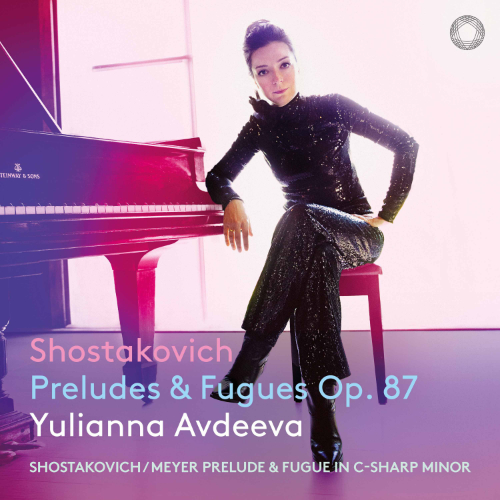
PTC 5187480 cover art
(click to enlarge)
The set is an obvious homage to Bach’s Well-Tempered Clavier, covering all the major and minor keys, though arranged according to the circle of fifths. Written for Tatiana Nikolayeva, who premiered the Op. 87 in Leningrad in December 1952, it has since drawn considerable attention from pianists and inspired numerous recordings.
These preludes and fugues are remarkable for their variety of style and mood, showing Shostakovich’s versatility and depth as a composer: from lyrical and introspective to vigorous and playful, sometimes colored with folk music, jazz, or classical tradition. The cycle is rich in harmonic invention and rhythmic complexity, with each piece offering its own character and technical challenge.
Pianist Yulianna Avdeeva now adds her own version, featuring a small but intriguing addition: a newly discovered fragment of a Prelude in C-sharp minor. Found in 2005, it is probably an early predecessor of the prelude in the same key from Op. 87, but its structure is entirely different. It is unclear how much of the original fragment could be used, but the short work—less than two minutes long—was completed by Shostakovich scholar Krzysztof Meyer. He also composed a corresponding fugue of about ninety seconds to complete the pair.
Listening to the result, one can say this was a worthwhile intervention: the music flows naturally and feels entirely at home in the set. These two world-premiere recordings appear at the end of this release. Avdeeva plays them with solid technique and a discreet palette of dynamic colors. She is no newcomer to the recording market, having made acclaimed recordings of Chopin, Prokofiev, and other composers. This Pentatone release offers a valuable new perspective on the existing repertoire.
From the booklet, we learn that Avdeeva enjoyed the luxury of a generous recording schedule—a detail that can surely be heard in the solidity of her technical solutions and the consistent quality of the entire program. Unfortunately, the same cannot be said for the stability of the sonic image, which is generally quite dry and, at times, varies noticeably from track to track.
But let us now turn to the musical choices Avdeeva makes. Lightness and agility, along with a sempre legato touch, combined with clear articulation, are certainly strong points in her overall approach. This is particularly evident in Prelude No. 2 in A minor. Unfortunately, such an exquisite touch is not always matched by dynamic precision: she too often overlooks dynamic markings, remaining in a comfortable mezzoforte zone without the necessary shading.
While some reviewers have lauded this kind of interpretative refinement and understatement—and indeed Yulianna Avdeeva offers a fresh, intimate perspective, as in Prelude No. 7 in A major or Prelude No. 16 in B-flat minor—the emotional weight can seem more fragile than in Tatiana Nikolayeva’s interpretations, even allowing for the fact that Nikolayeva’s readings are famously commanding and rich.
There certainly is also Igor Levit’s version on the DSCH label to consider. With his introspective yet powerful voice, rich sonority, rhythmic focus, and far wider dynamic range, he offers a certain nervous tension that Avdeeva generally does not employ—a rather different approach, and in many ways a superior one. Yet there are some delicate pieces, such as the Fugue in F-sharp major, No. 13, where no one can quite match Ms. Avdeeva.
What can be said generally about this album: While Yulianna Avdeeva’s superior technical ability, well-proportioned dynamic plan, and subtle use of pedal are undeniably her strong points, she also has much to say interpretatively. Even so, the Hyperion recording by Tatiana Nikolayeva should still be regarded as the benchmark—despite having been made in 1962 with the more limited technical resources of the time. It likely benefited from Nikolayeva’s direct consultation with the composer, which adds significantly to the authenticity of her often tricky tempo choices in this music. ■
EXTERNAL LINKS:
- Yulianna Avdeeva: avdeevapiano.com

Read more by Giorgio Koukl.


.png)