
Mark Gresham | 10 SEP 2025
In the first half of the 19th century, America was a nation on the move. The Treaty of Paris (1783), which concluded the Revolutionary War, granted the United States the Northwest Territory, comprising lands that would become states such as Ohio, Indiana, Illinois, Michigan, Wisconsin, and parts of Minnesota, extending the new nation’s lands to the Mississippi River. The Louisiana Purchase of 1803 then doubled the young nation’s territory and ignited a wave of westward migration.
The period was marked further by aggressive expansion, driven by the ideology of Manifest Destiny, which held that the United States was destined to expand across North America “from sea to shining sea.” Additions included the acquisition of Florida (1819) and the Oregon Territory (1846), annexation of Texas (1845), and cession of vast Southwestern lands from Mexico through the Treaty of Guadalupe Hidalgo (1848) and the Gadsden Purchase (1853)
By 1860, 40% of the nation’s 31.4 million people lived west of the Appalachians, drawn by the Midwest’s farmlands, California’s gold, and visions of opportunity. Steamboats plied the Mississippi and Ohio rivers, 9,000 miles of railroads connected growing towns, and trails like the Oregon and Santa Fe carried settlers across the continent to the Pacific.
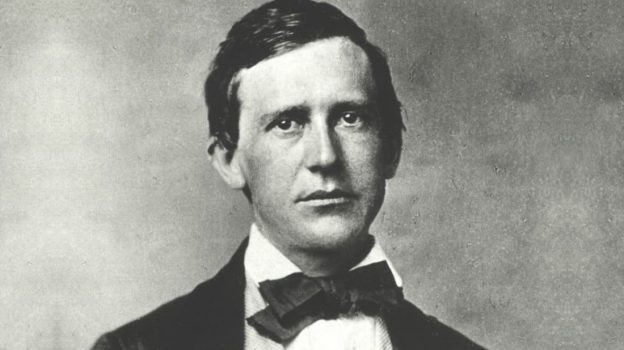
Music traveled with them. In parlors, saloons, and theaters from Pittsburgh to San Francisco, the songs of Stephen Foster, America’s first great songwriter, became the voice of a restless nation in melodies that rang out from Pittsburgh parlors to California saloons. Louis Moreau Gottschalk’s virtuosic Creole piano works dazzled urban elites, but Foster’s parlor songs captured the aspirations of a rising middle class. Yet, his ties to blackface minstrelsy, which had become a wildly popular but racially charged genre, mirrored the nation’s deep tensions over slavery, reflecting a society as divided as it was dynamic.
Born in 1826 in Pittsburgh, a vibrant hub on the Ohio River, Stephen Foster was steeped in the energy of a nation pushing west. His songs—“Oh! Susanna” (1848), “Camptown Races” (1850), “My Old Kentucky Home” (1853), and “Jeanie with the Light Brown Hair” (1854)—blended Irish and English ballad traditions with American themes of frontier adventure, plantation nostalgia, and domestic longing. Ironically, despite the Southern settings of many of his most famous songs, Foster is believed to have visited the American South only once in his life, spending a brief period in New Orleans in 1852.
The Mississippi and Ohio rivers were lifelines for the musical spread of Foster’s songs. Steamboats, ferrying settlers and goods to St. Louis (with 160,000 residents by 1860) and New Orleans (with 168,000), also carried sheet music and performers. “Oh! Susanna” became a gold rush anthem, sung by the 300,000 migrants who flooded California after 1848, transforming San Francisco into a cultural outpost (with 56,000 residents). Railroads linked the Midwest—home to 10 million by 1860—to eastern publishers, flooding homes with sheet music. From Cincinnati to Oregon, Foster’s songs knit together a nation claiming land from Texas (1845) to the Mexican Cession (1848), embodying the era’s Manifest Destiny fervor.
It was a genre in which Foster led the way, but composers like John Hill Hewitt (“The Minstrel’s Return’d from the War,” 1825) and George Frederick Root (“The Hazel Dell,” 1853) also penned hits. Sheet music, a booming industry, drove this musical boom. Publishers in New York and Cincinnati churned out thousands of copies of popular songs, distributed via steamboats and railroads to Midwest towns and beyond. The Gold Rush carried parlor songs to California, where miners sang Foster’s tunes in saloons.
But Foster’s early success was also tied to blackface minstrelsy, the 1850s’ most popular entertainment, which both shaped and reflected America’s social tensions over slavery. Minstrel shows, featuring white performers in blackface caricaturing African-American life, thrived in theaters from Chicago to San Francisco, their troupes traveling along river routes and western trails. Songs like Foster’s “Oh! Susanna” and “Camptown Races” were minstrel staples, performed by groups like the Christy Minstrels. “Dixie” (1859), written by Daniel Decatur Emmett (1815-1904), one of the pioneers of blackface minstrelsy, became a Southern anthem.
Minstrelsy’s popularity—amplified by the same steamboats and railroads that spread parlor songs—clashed with the growing national divide over slavery. By the 1850s, the Kansas-Nebraska Act (1854) had ignited “Bleeding Kansas,” where pro- and anti-slavery settlers clashed, reflecting the nation’s moral and political schism. Minstrelsy’s caricatures, which mocked Black speech and culture, reinforced stereotypes used to justify slavery in the South, where some 3 to 4 million enslaved people lived. Yet, in the North, where abolitionist sentiment grew, these performances were increasingly criticized, even as audiences flocked to them.
Foster navigated this tension uneasily: his early songs leaned into the minstrel dialect, but later works, such as “My Old Kentucky Home” and “Jeanie,” sought emotional depth, aiming to transcend the genre’s racism. His move away from minstrelsy toward parlor songs was a gradual yet deliberate shift, driven by artistic, social, and commercial motivations, with notable changes in his style and output between 1853 and 1855. This shift mirrored the nation’s struggle to reconcile its cultural expressions with its moral failings, as slavery’s expansion into new territories fueled debates that, in 1861, would erupt into war.
Foster would not live to see the end of that war. He died in 1864 at the age of 37, some 15 months before the American Civil War’s conclusion. ■


Read more by Mark Gresham.





.png)