
September 8, 2025
Bailey Performance Center, Morgan Hall
Kennesaw State University
Kennesaw, GA – USA
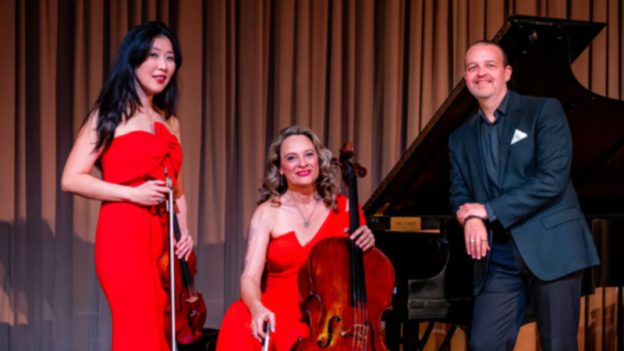
Helen Hwaya, violin; Charae Krueger, cello; Robert Henry, piano.
Joaquín TURINA: Circulo, Op. 91 (1942)
Anton ARENSKY: Piano Trio No. 1 in D minor, Op. 32 (1894)
Felix MENDELSSOHN: Piano Trio No. 2 in C minor, Op. 66 (1845)
Mark Gresham | 13 SEP 2025
The Summit Piano Trio—Kennesaw State University faculty members Helen Hwaya Kim (violin), Charae Krueger (cello), and Robert Henry (piano)—presented a compelling recital on Monday at the Bailey Performance Center’s Morgan Hall, showcasing not only their exceptional artistry but also their vital role as the university’s ensemble-in-residence. The evening’s program featured three distinct works, each offering a unique emotional and technical challenge.
A Spanish composer shaped by both the Andalusian musical traditions of his native Seville and the French modernist currents he encountered during nine formative years at the Schola Cantorum in Paris, Joaquín Turina created a distinctive blend of Spanish folk color and sophisticated harmonic language. His Círculo: Fantasía para piano, violín y violoncelo, Op. 91 (1942), which opened Monday night’s program, exemplifies this synthesis.
Written in three contiguous sections—“Amanecer” (“Dawn”), “Mediodía” (“Midday”), and “Crepúsculo” (“Dusk”)—the 12-minute piece evokes the passage of the sun, combining lyrical melodies, rhythmic vitality, and carefully crafted formal design. Its expressive range and modern harmonic palette showcase Turina’s skill at translating evocative landscapes and Spanish sentiment into chamber music, making Círculo a vivid testament to his mature artistry.
The Summit Trio’s performance captured the rhythmic vitality and lyrical beauty characteristic of Turina’s style. The interplay between Kim’s violin and Krueger’s cello, underpinned by Henry’s dynamic piano, brought the work’s evocative textures to life.
The trio then stepped back in time a half century, to Anton Arensky’s Piano Trio No. 1 in D minor, Op. 32 (1894), one of his most celebrated works and a cornerstone of his chamber music. Written when Arensky (1861–1906) was at the height of his powers, the composer dedicated the work to the memory of the influential cellist Karl Davydov, which lends the work an elegiac tone, especially in its heartfelt slow movement.
Stylistically, Arensky’s trio reflects the Russian Romantic tradition influenced by Tchaikovsky, and remains a favorite among chamber musicians for its emotional immediacy and effective writing for all three instruments.
The work unfolds over four movements that together form a rich emotional arc. The opening “Allegro moderato” was dramatic and sweeping, alternating between stormy intensity and warm lyricism. The “Scherzo: Allegro molto” followed, featuring a lively, dance-like character with playful rhythms and quick exchanges highlighting the ensemble’s interplay. At the heart of the work lies “Elegia: Adagio,” a deeply reflective movement in which the cello sings a plaintive, almost vocal line, lending the music an intimate and mournful quality. The “Finale: Allegro non troppo” tied the piece together, recalling earlier themes, driving toward a vigorous, resolute conclusion.
It is a work of profound emotional depth and technical complexity. The trio navigated its rich harmonies and intricate counterpoint with sensitivity and precision, highlighting the group’s cohesive sound and its ability to convey the work’s emotional nuances.
Stepping back yet another half century, the trio concluded the concert with Felix Mendelssohn’s Piano Trio No. 2 in C minor, Op. 66 (1845), a mature and dramatic work, written just two years before the composer’s death. This four-movement trio balances classical clarity with Romantic intensity, opening with a stormy “Allegro energico e con fuoco” whose urgent rhythmic drive gives way to sweeping lyricism. The second movement, “Andante espressivo,” presents a songlike melody of serene beauty, and the fleet and gossamer “Scherzo” provided a moment of levity. The “Allegro appassionato” finale wove in the chorale “Vor deinen Thron tret’ ich hiermit” (“Before Thy Throne I Now Appear”), creating a powerful, almost spiritual conclusion to the concert, leaving listeners with an uplifting sense of resolution.
Celebrating its 15th season as the ensemble-in-residence at Kennesaw State University, the Summit Piano Trio continues to make a significant contribution to the cultural fabric of the Atlanta region and beyond. In mid-October, they go on tour to North Carolina, playing concerts in in Raleigh, Durham, Chapel Hill, and Pittsboro, then on December 13, Summit Piano Trio will make its Carnegie Hall debut in Weill Recital Hall, marking a significant milestone in their artistic journey. ■
EXTERNAL LINKS:
- Summit Piano Trio: parkerartists.com/Summit-Piano-Trio.html
- Bailey Performance Center, KSU: calendar.kennesaw.edu/bailey_performance_center

Read more by Mark Gresham.
.png)