
September 6, 2025
Emerson Hall, Schwartz Center for Performing Arts
Atlanta, GA – USA
“The 4 Bs – Boccherini, Beethoven, Brahms & Bailey”
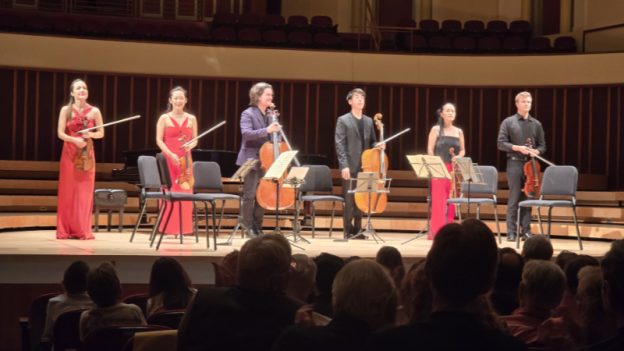
Vega Quartet (Emily Daggett Smith & Jessica Shuang Wu, violins; Joseph Skerik, viola; and Guang Wang, cello); Yinzi Kong, viola; Zuill Bailey, cello; William Ransom, piano.
BOCCHERINI: String Quintet in C major, Op. 11, No. 6
BEETHOVEN: Sonata for Piano and Cello in A major, Op. 69
BRAHMS: Sextet No. 1 in B-flat major, Op. 18
William Ford | 8 SEP 2025
The Emory Chamber Music Society of Atlanta (ECMSA) opened its 33rd season Saturday night at the Schwartz Center for Performing Arts. Admission was free, and the house was full.
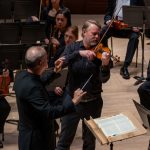
The performers were the Vega Quartet (Emily Daggett Smith, first violin; Jessica Shuang Wu, second violin; Joseph Skerik, viola; and Guang Wang, cello), joined by guest artists Zuill Bailey, cello, and Yinzi Kong, viola. The Vega Quartet, Emory University’s resident string quartet, is celebrated internationally for its vibrant performances and commitment to both classical and contemporary repertoire. Zuill Bailey is a Grammy Award–winning cellist with more than 20 acclaimed albums, including the 2017 Grammy-winning recording of Michael Daugherty’s Tales of Hemingway. He also serves as Artistic Director of El Paso Pro-Musica and is a passionate advocate for music education.
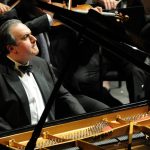
The evening opened with a short welcome from pianist William Ransom, ECMSA’s artistic director, who later performed as well. The three-work program carried the audience from Boccherini’s elegance to Beethoven’s drama and Brahms’ richness, tracing how chamber music grew from graceful conversation into symphonic-scale expression.
The Vega players and Bailey began with Boccherini’s String Quintet in C major, Op. 11, No. 6. Boccherini is not exactly a household name, but the “Minuet” from his String Quintet in E, Op. 11, remains a classical favorite. Born in 1743 and living until 1805, he was well known in his day for his graceful, gallant style, with Spanish influences from his years in Madrid. He is also remembered for pioneering cello-rich string quintets. Yet after his death, his music quickly fell out of fashion.
The quintet began with an “Andante con moto,” graceful and flowing, followed by a courtly “Menuet and Trio” with a playful trio section. The third movement, “Grave,” was dark and dramatic, while the concluding “Rondo: Allegro con moto” sparkled with buoyant rhythms and lively interplay. The audience responded enthusiastically, especially to the spirited finale. Still, despite the richness of two cellos, the work itself felt more refined than memorable, too elegant and too polite to linger in the ear. One might say it would serve well as background music for a champagne brunch, pleasant enough not to interfere with conversation.
By contrast, the opening bars of Beethoven’s Sonata for Piano and Cello in A major, Op. 69, jolted the audience awake from Boccherini’s torpor. This is a dramatic, storm-tossed piece embodying the Sturm und Drang for which Beethoven is famous. Often considered his greatest cello sonata, it was a turning point for the instrument. Earlier sonatas tended to be piano-dominated, but this work presents cello and piano as near-equal partners—though the piano still seizes moments to show off its versatility.
The sonata’s three movements highlight Beethoven’s breadth. The opening “Allegro, ma non tanto” is expansive and driving, symphonic in scale. The “Scherzo: Allegro molto – Trio” offers rustic humor and rhythmic invention. The finale begins with an “Adagio cantabile” of lyrical beauty that transforms into an “Allegro vivace” of dance-like exuberance. Ransom and Bailey played with ferocity and precision, achieving the balance Beethoven sought. Their polished collaboration made this performance a highlight of the evening.
In his introduction, Mr. Ransom said the Beethoven sonata would be one of his desert-island choices. For me, however, that honor goes to the final work—Brahms’ Sextet No. 1 in B-flat major, Op. 18. Overflowing with melody, thick textures, and lush scoring, this work exemplifies the qualities some critics once faulted in Brahms but which I find among his greatest strengths. And really—who can argue with Mr. Spock, who shed a tear at the second movement in the classic Star Trek episode “Amok Time”?
The first movement, “Allegro ma non troppo,” introduces two glowing themes of radiant beauty. The second, “Andante ma moderato,” is contemplative and brooding—no wonder it touched Spock. The Scherzo: “Allegro molto” bursts with energy before yielding to a more relaxed trio. The finale, “Rondo: Poco allegretto e grazioso,” brings a genial, light-hearted close.
Here, the Vega players were joined by Bailey and Kong, pouring every bit of their energy and skill into a glorious performance. Emily Daggett Smith deserves special praise for her lyrical, accurate playing, and Joseph Skerik projected authority, especially in the finale.
The program as a whole traced a journey through chamber music’s evolution: Boccherini’s Classical elegance, Beethoven’s dramatic dialogue, and Brahms’ Romantic richness. Each work illuminated a different stage in that journey, and together they demonstrated how chamber music grew into a vehicle for symphonic breadth. Played with flawless execution, this concert was a thrilling start to ECMSA’s new season. ■
EXTERNAL LINKS:
- Emory Chamber Music Society of Atlanta: calendar.kennesaw.edu/bailey_performance_center
- Vega Quartet: vegaquartet.com
- Zuill Bailey: colbertartists.com/artists/zuill-bailey

Read more by William Ford.
.png)