

February 8, 2026
First Presbyterian Church
Atlanta, Georgia – USA
Atlanta Chamber Players: Helen Hwaya Kim, violin; Catherine Lynn, viola; Julie Albers, cello; Isabel Kwon, cello; Jesse McCandless, clarinet; Ryan Little, horn; Elizabeth Pridgen, piano.
Ludwig van BEETHOVEN: Piano Trio in C minor, Op. 1 No. 3
Andrea CASARRUBIOS: Sextet for clarinet, horn, violin, viola, cello, and piano (world premiere)
Sergei RACHMANINOFF: Sonata in G minor for Cello and Piano, Op. 19
Mark Gresham | 11 FEB 2025
The Atlanta Chamber Players’ winter public concert offered a thoughtfully proportioned program that balanced classical foundations, contemporary creation, and late-Romantic expressivity, presented in the resonant acoustics of First Presbyterian Church of Atlanta.
Opening the afternoon was Beethoven’s Piano Trio in C minor, Op. 1 No. 3, performed by violinist Helen Hwaya Kim, cellist Julie Albers, and pianist Elizabeth Pridgen. The work, the most dramatic of Beethoven’s Op. 1 set, emerged with a sense of urgency in the outer movements, while the set of variations in the “Andante cantabile” unfolded with careful attention to phrasing and color. Kim and Albers shaped the “Minuetto” with a restrained elegance that contrasted effectively with the sharply etched “Prestissimo” finale, where ensemble precision was key.
The centerpiece of the program was the world premiere of Sextet by Andrea Casarrubios, written in celebration of the ensemble’s 50th anniversary. Scored for clarinet, horn, violin, viola, cello, and piano, the work draws on a wide range of instrumental colors and emphasizes contrasts of texture and momentum across its three movements.
Cast as a meditation on time, collective effort, and artistic continuity, the Sextet unfolds in a broad expressive arc. The opening movement introduces the work with bold, declarative gestures that gradually expand into more searching and lyrical passages, suggesting a sense of departure and purpose. A central movement built around gently oscillating figures and overlapping rhythmic layers creates the impression of multiple temporal currents unfolding simultaneously, with sustained melodic lines set against more grounded pulses. The final movement turns toward brighter, more animated writing, its rhythmic energy and surging textures conveying a feeling of culmination and renewal.
The premiere was performed by clarinetist Jesse McCandless, hornist Ryan Little, violinist Kim, violist Catherine Lynn, cellist Isabel Kwon, and pianist Pridgen, continuing the Atlanta Chamber Players’ long-standing practice of pairing new commissions with established repertoire.
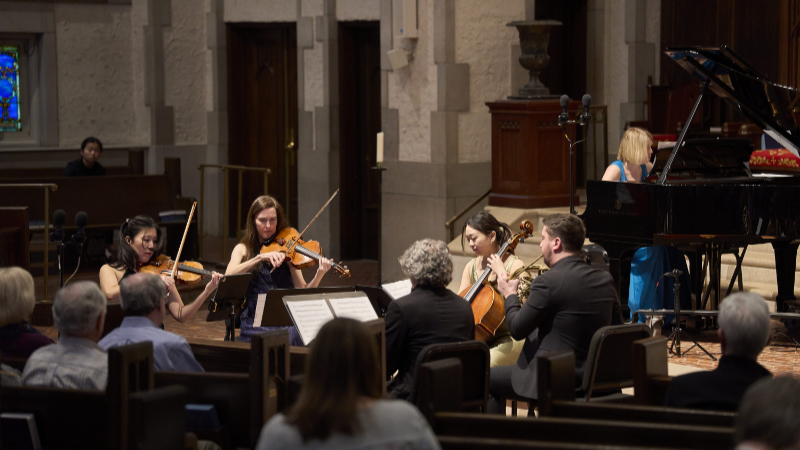
Clockwise from left (foreground): violinist Helen Hwaya Kim, violist Catherine Lynn, cellist Isabel Kwon, hornist Ryan Little, and carinetist Jesse McCandless, with pianist Elizabeth Pridgen (backgtound), performing the world premiere of Andrea Casarrubios’ ‘Sextet.’ (credit: Chris Helton)
The concert concluded with Rachmaninoff’s Sonata in G minor for Cello and Piano, Op. 19, performed by Albers and Pridgen. The expansive first movement unfolded with a broad, singing cello tone, matched by a piano part that alternated between sweeping lyricism and muscular accompaniment. The “Scherzando” movement brought a welcome sense of playfulness, articulated with rhythmic vitality, while the slow movement offered a moment of sustained introspection, leading into the energetic finale that carried the work to a confident close.
Throughout the afternoon, the Atlanta Chamber Players demonstrated the hallmarks that have sustained the organization over five decades: polished ensemble work, carefully considered programming, and a willingness to place new music alongside established repertoire. The result was a concert that felt cohesive, unified by performers who approached each work with equal conviction. ■
EXTERNAL LINKS:
- Atlanta Chamber Players: atlantachamberplayers.com
- Andrea Casarrubios: andreacasarrubios.com

Read more by Mark Gresham.

.png)