
February 1, 2026
Florence Kopleff Recital Hall, Georgia State University
Atlanta, Georgia – USA
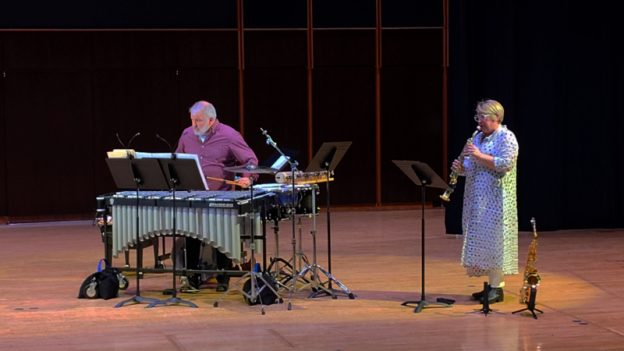
Jan Berry Baker, saxophones; Stuart Gerber, percussion; Kyle Rivera, speaker/performer.
Ahmad DUNCAN: Realizations
Elaijah STACHELRODT: Greyscale
Matt VU: gusts
Micah MONDT: Djungleskog: Hero of the Furnishing Wilds
Kyle RIVERA: Grimoire II: Mauravi
All five works were world premieres.
Jon Ciliberto | 10 FEB 2026
They say the children are our future, a claim springing from hope and resignation. These days, both sources are red-lining in our minds. An evening of five world premieres performed by Bent Frequency during the year’s Atlanta SoundNOW Festival gave the audience something to look forward to by offering a taste of what musical ideas are developing in the next generation’s minds.
(Not that any of the composers are “children,” strictly speaking.)
The four works in the program’s first half germinated from Georgia State University’s composition program. Over the course of a semester, students worked with both members of Bent Frequency (saxophonist Jan Berry Baker and percussionist Stuart Gerber), receiving specific instruction about writing for the instruments, writing works for the duo, and getting “real-world feedback from two people who have commissioned and premiered over 100 works” (Gerber). It sounds like a thoughtfully practical course of work and is further evidence of how valuable the ensemble is to our local musical culture.
The weight of the program leaned toward its second half: young, acclaimed composer Kyle Rivera’s Grimoire II: Mauravi. Rivera joined Bent Frequency on stage as a performer, reading a recitative, walking in slow-motion choreography, moving lights here and there, and otherwise adding theatrical, if obscure, aspects to the work.
All of the GSU Student works had quite direct lyrical statements written for saxophone, and generally featured the two performers working in tandem on a single idea.
Several of the works draw from jazz. The score notes make this plain (“taking clear inspiration from the jazz idiom” (Stachelrodt); “[d]rawing influences from jazz and popular music” (Vu)). This influence mostly showed in harmonic choices, less so in rhythmic ones: or rather, the predominant jazz-inflected rhythmic aspect was spaciousiousness, or even a spacy aesthetic, particularly in,, for example, Ahmad Duncan’s Realizations, whose program notes describe the “‘electric’ or ‘flowy’ feeling when you finally understand something”, and the score indicates that the piece be performed “Floating, rubato.”
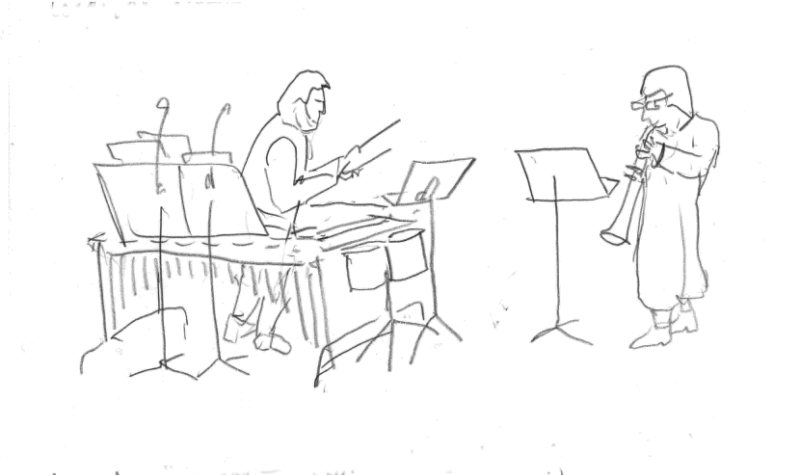
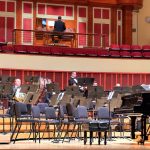
Bent Frequency in concert sketch #1, by Jon Ciliberto.
Grayscale by Elaijah Stachelrodt began with a more forcefully rhythmic approach with a range of mixed time signatures (measures of 7/16 and 9/16 alternating, for example), and then slid into a slow, lyrical section, before concluding with a reprisal of the first. Extensive use of pedal on the vibraphone (a technique that appeared across several of the works) added to the creation of this dreamy, peaceful space.
Further to the “these are not children” point, all of the GSU Composers have histories of performing and writing.
Matt Vu, for instance, has a long resume of performance and writing, and is pursuing graduate studies in music composition at Georgia State University. I found his work, gusts, particularly successful, with some quite unexpected and thoughtful harmonic passages, and a greater distinction in the writing between the two instruments.
Perilous as it is to draw any inferences from four works by young composers, I could not help but wonder at the common aspects: jazz, space, naïveté, and even wonder. Given the times, how much inwardness (or escapism) is entering the contemporary compositional landscape?
All of these considerations are in contrast to Rivera’s Grimoire II: Mauravi, a work that brings in spoken voice, improvisational compositional direction, theatrical aspects, staging (sinuous lines of candles on an otherwise dark stage), props (small lights, a bottle filled with sand (?)), and choreography. All of the elements created a charged, tense space, in part based on the material, but also by the functional and expressive questions that these non-musical elements raised.
While in residence at MacDowell, Rivera began composing this work, then described as “for ensemble and generative video [with i]n addition to the music […] poetry, visuals, and a stage design that will be integrated into the performance of the work.” As presented on Sunday, the work took a slightly different form than described then, but one that, regardless, shows the composer’s “interests in linguistics, spirituality, and media.”
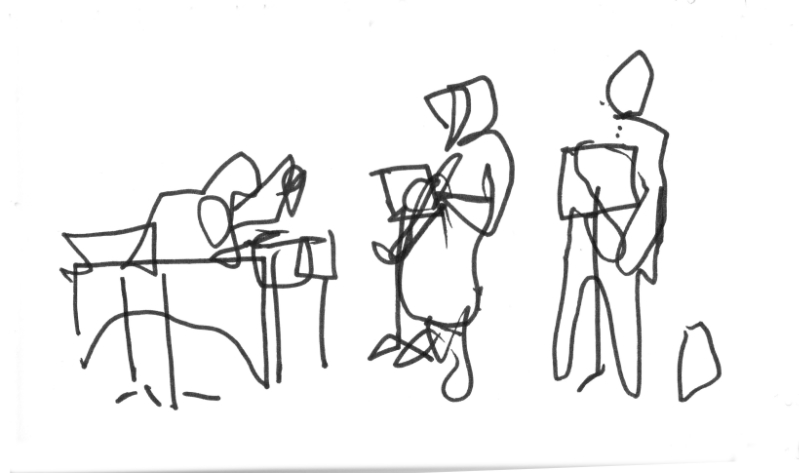
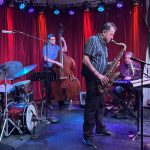
Bent Frequency in concert sketch #2, by Jon Ciliberto.
Program notes say of the composer that “[s]ome of his music has focused on topics relating to social justice, equality, and racialized matters. Alongside that, his music explores the conceptual limits of psychology, spirituality, and consciousness in sound.” Mauravi itself, the composer explains, proceeds from “the Mahabharata, the great Sanskrit epic poem” and explores “the implications of marriage in Mauravi’s story.” However, the spoken portions of the work don’t tell the story, and so it is hard to say exactly what, for Rivera, these implications are. But they seem painful and tragic. Certainly, the performance’s text is fraught and troubled.
I thought about all of these “extra-musical” aspects and decided that one should not conclude that composers progress from writing notes on page music (as with the GSU student works) to writing music from a theoretical (or literary) base. That is, like listeners, composers work in all sorts of ways.
Structurally, Mauravi moved between the composer’s recitation and the musician’s performance, with interleaving (Baker and Gerber also read out passages which they’d been asked to write pre-performance). The opening two-thirds of Mauravi had quite a bit of silence in it: bursts of percussion followed by gaps of quiet. This brought to mind Theodor Adorno’s writings on Webern, a composer whose compositions became increasingly spare through his life:“[t]he fear that the act of composition might damage the notes.” Listening becomes a tense act when small bits of sound are fragmentarily separate from one another. Here, a long, purely musical section toward the end delivered intense satisfaction, probably precisely because of the far more fragmentary musical passages of the first three quarters of the work — the former set a place for the latter, as it were. The composer showed in this section a strong command of writing for the duo, with a pleasing density of musical ideas.
Works like Mauravi certainly illustrate the “cup of tea” approach to art: some people find that theoretical underpinning enriches the experiences, while others prefer the art alone. (I was also reminded of Tom Wolfe’s arch comment on the state of Late Modernist painting in The Painted Word: “without a theory to go with it, I can’t see a painting”). As a listener, without specific knowledge of the work’s reference to the Mahabharata (and not having read some of the poem prior to the performance), and the culturally distant ideas regarding marriage (of gods) that are embedded in that work, one might easily misinterpret the meaning of the spoken portions of Rivera’s work when encountered as part of a performance. I did.
As a listener, thus, I largely ignored the subtext and found the music itself very skillfully composed, particularly in the lengthy musical section toward the work’s conclusion.
Bent Frequency — as they always do — went all in on the work, exerting their substantial musical and interpretive skill to present the composer’s quite ambitious and wide-ranging ideas to maximum effect. ■
EXTERNAL LINKS:
- Bent Frequency: bentfrequency.com
- Atlanta SoundNOW Festival: atlantasoundnowfestival.com
- Kyle Rivera: macdowell.org/artists/kyle-rivera

Read more by Jon Ciliberto.


.png)