
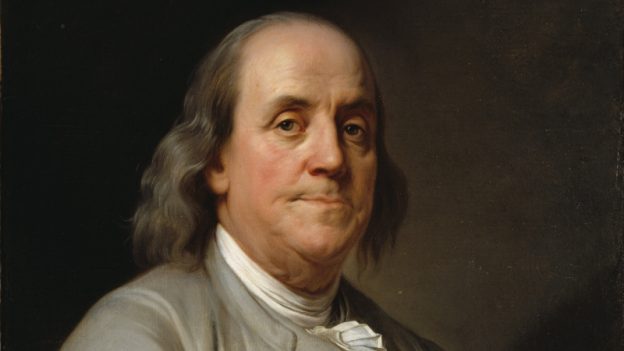
Mark Gresham | 20 AUG 2025
Renowned as a statesman, scientist, and inventor, Benjamin Franklin was also a pivotal figure in early American music, blending his inventive genius with a deep appreciation for the art. His creation of the glass armonica, alongside his engagement with the musical culture of his time, reflects the vibrant and evolving soundscape of colonial America and the new nation. As a signer of the Declaration of Independence, Franklin’s musical endeavors connect to the broader cultural pursuits of his fellow Founders, several of whom, like Thomas Jefferson, were also amateur musicians.
Franklin’s musical legacy is inseparable from his inventive spirit. A skilled amateur musician, he played several instruments, including the harp, guitar, and violin, and was an avid music enthusiast. His home in Philadelphia was a hub for musical gatherings, where he and his family, including his daughter Sally, who played the harpsichord, entertained guests with performances. Franklin’s love for music extended beyond performance to innovation, most notably through his invention of the glass armonica, a groundbreaking instrument that captivated audiences in America and Europe.
In 1761, while in London as a colonial agent, Franklin encountered the ethereal sounds of tuned water glasses, a technique known as the “musical glasses.” Inspired, he set out to improve the concept, creating the glass armonica—a mechanized instrument consisting of a series of glass bowls of varying sizes mounted on a spindle, rotated by a foot pedal. By touching the rims with moistened fingers, players produced hauntingly beautiful tones, likened by Franklin to the sound of an angelic choir.

The glass armonica (or simply, the armonica) was a triumph of Franklin’s inventive ingenuity, blending scientific precision with musical artistry. He debuted the instrument in 1762, and it quickly gained popularity in Europe and America. Composers like Wolfgang Amadeus Mozart, Ludwig van Beethoven, and Christoph Willibald Gluck wrote pieces for it, and it was featured in concert halls and private salons.
In America, the armonica found a place in the parlors of the elite, including at George Washington’s Mount Vernon, where his step-granddaughter Nelly Custis played one. Franklin’s invention not only expanded the tonal palette of the era but also reflected the Enlightenment ideal of merging science and art, cementing his reputation as an inventor who could transform musical expression.
The String Quartet Attributed to Benjamin Franklin
Around 1778, while serving as U.S. Minister to France, Benjamin Franklin is said to have composed a string quartet, discovered in 1945 by Guillaume de Van at the Bibliothèque Nationale in Paris. This quirky piece, scored for three violins and cello instead of the standard two violins, viola, and cello, uses scordatura tuning, allowing it to be played entirely on open strings without fingering. Structured as a suite with movements like “Introduction,” “Minuet, “Capriccio,” and “Siciliano,” it reflects Franklin’s inventive spirit, prioritizing accessibility for amateur musicians. Its simplicity and unconventional design led some to call it a “musical farce,” yet it aligns with Franklin’s scientific approach to music.
However, Franklin’s authorship is debated. The manuscript, not in his hand and misspelling his name as “Francklin,” lacks direct references in his writings. Conversely, scholar M.E. Grenander argues Franklin’s mathematical mindset and Parisian salon connections, including with composer Madame Brillon, support his authorship. While no definitive proof exists, Franklin’s documented musical interests and innovative tendencies make his composition plausible, though not certain. Nevertheless, the quartet’s historical value endures.
Other Musical Contributions
Beyond the glass armonica and the attributed string quartet, Franklin engaged with music in ways that complemented his inventive pursuits:
- String Quartet Advocacy: Franklin was an early proponent of the string quartet, a new chamber music form emerging in Europe during the mid-18th century. In a 1780 letter from Paris, he praised the quartet’s conversational quality, likening it to a “polite conversation among gentlemen.” While not a composer (with the possible exception of the one string quartet), Franklin’s appreciation for the works of Haydn and other quartet pioneers suggests he promoted this genre among his American peers, influencing the classical music scene in Philadelphia and beyond.
- Musical Experiments and Writings: Franklin’s scientific curiosity extended to acoustics. He studied the physics of sound, corresponding with European musicians and scientists about pitch and resonance. His writings on music, including letters advocating for Scottish folk tunes over complex operatic arias, reveal his preference for accessible, emotive music, aligning with the democratic ethos of the American Revolution.
- Music Publishing: As a printer, Franklin published music books and broadsides, including psalm settings and secular songs like The Downfall of Piracy (1731), which circulated patriotic and popular tunes. His printing press helped disseminate music in colonial America, supporting both sacred and secular traditions.
Franklin’s contributions to American music stand out as a unique fusion of his inventive and cultural roles. The glass armonica in particular, with its otherworldly tones, symbolized the innovative spirit of the era, much like the American Revolution itself, captivating enlightened audiences on both sides of the Atlantic. ■


Read more by Mark Gresham.





.png)