
September 28, 2025
Spivey Hall
Morrow, Georgia – USA
Alan Morrison, organ.
Louis MARCHAND: Grand Dialogue in C
Johann Sebastian BACH: Pastorella
John IRELAND: Elegy
Aaron David MILLER: Fireflies
Florence PRICE: Variations on a Folksong (Peter, Go Ring Dem Bells)
Charles-Marie WIDOR: Symphony No. 6 in G minor, Op. 42, No. 2
william Foird | 30 SEP 2025
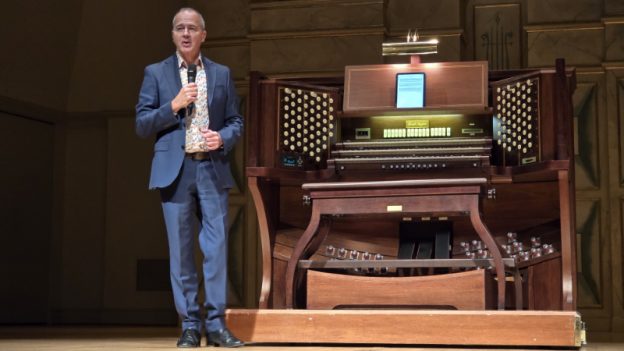
On Sunday, Spivey Hall presented the second concert of its 35th season with an organ recital by the distinguished Alan Morrison. The occasion was marked by favorable weather, which made the trip to Clayton State’s campus unusually pleasant. Within the recently refurbished hall, an audience of roughly fifty patrons gathered to hear the celebrated organist inaugurate the anniversary season.
Morrison, head of the Organ Department at the Curtis Institute of Music, is widely recognized as one of America’s leading concert organists. Known for his dynamic performances and commitment to expanding the instrument’s reach, he balances an active recital career with teaching and service as College Organist at Ursinus College.
Morrison offered a panoramic portrait of the organ as storyteller—by turns conversational, pastoral, elegiac, playful, folk-inspired, and symphonic. From Marchand’s Grand Dialogue in C and Bach’s rustic Pastorella to Ireland’s hushed Elegy and Aaron David Miller’s sparkling Fireflies, the program traced how composers across centuries have used the instrument to speak in different voices. Florence Price’s variations on the spiritual Peter, Go Ring Dem Bells rooted the recital in American tradition, while Widor’s grand Symphony No. 6 crowned the evening with orchestral sweep. Together, the works revealed the organ’s astonishing chameleon power—shifting from intimacy to monumentality, and from Old World refinement to New World vitality. Morrison also praised the Albert Schweitzer Memorial Organ, built by Fratelli Ruffatti of Padua, Italy, noting that organists the world over admire it and hope for the chance to perform on it.
Since there were no program notes, Morrison himself provided background to the pieces, including the colorful tale of Johann Sebastian Bach’s near encounter with French virtuoso Louis Marchand. Legend has it that Marchand, slated for a contest against Bach, abruptly fled Dresden rather than risk being outplayed—a story that cemented Bach’s reputation as the supreme master of the keyboard.
Marchand’s Grand Dialogue in C proved a fitting opener, its celebratory exchanges dramatizing the contrasts between the organ’s manuals. The piece epitomizes the splendor of the French Baroque tradition, though Spivey’s Ruffatti instrument, while versatile, inevitably sacrifices some historical grit in favor of modern clarity. Bach’s Pastorella, likely written for the Christmas season, benefited from that transparency: Morrison’s precision illuminated its four contrasting movements, masking the absence of the earthy edge one expects from a period organ.
Ireland’s Elegy, originally for viola and piano, took on added melancholy in its organ arrangement. Written during World War II, it unfolds at a slow, contemplative pace, its lines drifting with an almost amorphous quality. On the organ, the music gained depth but also a layered fuzziness that blurred its outlines. Miller’s Fireflies (2009) offered a striking contrast, mimicking the rapid vibration of insect wings with flashes of lyricism to suggest luminescence—the organ’s answer to Rimsky-Korsakov’s Flight of the Bumblebee.
Price’s Variations on a Folksong (Peter, Go Ring Dem Bells) followed. While the work treats its theme with dignity, the variations remain close to the source, offering restatement rather than transformation. The result feels formally static compared to the inventive folk treatments of her European contemporaries. Still, the piece carries historical weight as an assertion of African American identity in a concert tradition that long resisted it. Morrison’s performance bridged the gap between Price’s formal conservatism and the spiritual fervor of her source material.
The program closed with Widor’s Symphony No. 6 in G minor, Op. 42, No. 2. Written for the great Cavaillé-Coll organ at Saint-Sulpice in Paris, it represents the full flowering of the French symphonic organ tradition. Morrison brought thunderous energy to the opening “Allegro,” shaped the “Adagio” with lyrical warmth, and animated the scherzo-like “Intermezzo” with rhythmic bite. The concluding fugue built inexorably to a triumphant G-major climax, showcasing both the performer’s mastery and the instrument’s vast resources.
Hearing the organ at Spivey Hall proved a two-edged experience. The instrument speaks with striking clarity, every stop and color laid bare, especially for those in the front rows. Yet what is gained in detail comes at the cost of grandeur: the enveloping warmth and resonance of a vast cathedral space. Widor, conceived for Saint-Sulpice, suffered most; Bach thrived in the transparency; Ireland’s Elegy gained definition but lost serenity. The recital itself leaned toward showcase—dazzling in execution, rich in color, but not always cohesive. At times, organ music’s tendency toward a unified sonic profile left contrasts more superficial than structural. What lingered was admiration for Morrison’s prodigious technique more than a sense of musical journey.
Still, as the first organ recital of Spivey Hall’s 35th season, the recital made an eloquent case for the organ’s power to astonish, and for Alan Morrison as a master of its possibilities. The evening left its listeners reminded of why this instrument—in all its brilliance, subtlety, and sheer force—continues to command both respect and wonder. ■
EXTERNAL LINKS:
- Alan Morrison: alanmorrison.com
- Spivey Hall: spiveyhall.org

Read more by William Ford.

.png)