
April 17, 2026
Glenn Memorial Church, Emory University
Atlanta, Georgia – USA
Atlanta Baroque Orchestra; Julie Andrijeski, music director; Thomas Cooley, tenor; Doug Dodson, countertenor; Carrie Anne Wilson, soprano; Michael Dauterman, baritone/conductor; Ellen Sauer Tanyeri, flauto traverso; Glenn Memorial UMC Chancel Choir.
Georg Philipp TELEMANN: Concerto for 3 Trumpets and Timpani, TWV 54:D3
Christoph GRAUPNER: Cantata Ihr Lieben, glaubet nicht einem jeglichen Geist, GWV 1140/45 (possible U.S. premiere)
Johann Sebastian BACH: Orchestral Suite No. 2 in B minor, BWV 1067
Johann Sebastian BACH: Ascension Oratorio, BWV 11
Encore: George Frideric HANDEL: Hallelujah Chorus (Baroque-style arrangement)
William Ford | 21 APR 2026
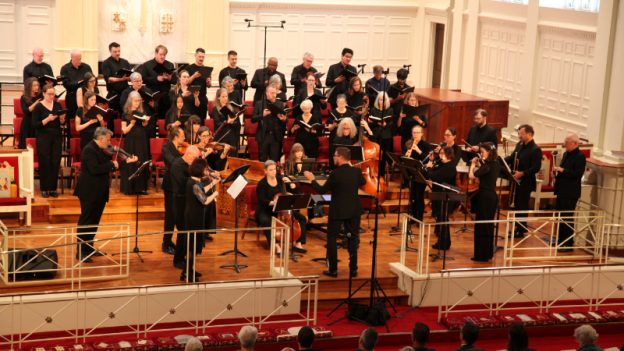
The Atlanta Baroque Orchestra’s (ABO) final concerts for this season began at the 1931-era Glenn Memorial Church on the Emory University Campus. This building is notable for its great columns, excellent lighting, and agreeable acoustics.
The ABO presented a program that, at first blush, seemed like a survey of the repertoire, but on closer inspection, it demonstrated the progression of how Baroque music functioned—from public display to private reflection, from instrumental elegance to sacred proclamation. Presented in the order of Telemann, Graupner, Bach’s B minor Suite, and finally Bach’s Ascension Oratorio, the evening unfolded as a kind of map: what music did in civic life, in personal devotion, in courtly culture, and in the church.
Telemann: Concerto for 3 Trumpets and Timpani, TWV 54:D3
The concert opened in the most outward-facing way possible. Telemann’s concerto belongs to the world of ceremony and announcement—music designed to project authority and festivity into large spaces.
The use of natural (valveless) trumpets immediately situates the sound in its historical context: bright, direct, and harmonically grounded rather than fluidly chromatic. The writing favors clear block sonorities and rhythmic propulsion, with the three trumpets often moving together to create a unified brilliance rather than contrapuntal interplay.
There were a few moments early on where ensemble alignment felt slightly unsettled, likely the kind of brief adjustment that can occur at the start of a program. That said, the trumpets themselves were impressively secure and stylistically assured. Their placement—off to the side of the ensemble with bells facing inward—produced a more blended effect, though it may have slightly reduced the sense of projection that gives this music its ceremonial impact.
Graupner: Cantata “Ihr Lieben, glaubet nicht einem jeglichen Geist,” GWV 1140/45
If Telemann speaks outward, Graupner turns inward. This cantata represents the function of music as private spiritual discernment—less proclamation than reflection.
Graupner, a near-contemporary of Bach, spent most of his career in Darmstadt and composed an enormous number of cantatas, many of which remained unpublished and largely unknown for centuries. He was, notably, a leading candidate for the Thomaskantor position in Leipzig before Bach was ultimately appointed. Because his music stayed in manuscript form, it never entered the mainstream repertoire in the way Bach’s did. Performances today remain relatively rare; as ABO music director Julie Andrijeski noted, this work may even have been receiving its U.S. premiere, making its inclusion here particularly significant.
The music itself reflects that inward function directly. Textures are lean, gestures more rhetorical than decorative. Rather than projecting, the lines probe and question, aligning with the text’s warning to “test the spirits.” Harmonic turns carry expressive weight, and the pacing allows the listener to follow the argument rather than simply respond to it.
Tenor Thomas Cooley carried the work with a voice that combines warmth, presence, and notably clear diction. His sound projected easily over the ensemble without forcing, giving shape and clarity to the text. A brief technical interruption—his tablet momentarily going blank—was handled with ease and humor and did little to disrupt the overall flow.
J. S. Bach: Orchestral Suite No. 2 in B minor, BWV 1067
From introspection, the program moved into the realm of courtly refinement. Bach’s suite reflects the influence of the French dance tradition, where music functions as cultivated social art—elegant, stylized, and balanced.
The opening overture establishes a formal frame with its stately dotted rhythms and fugal continuation, after which the sequence of dances unfolds. Each movement—Rondeau, Sarabande, Bourrée, Polonaise, Minuet—transforms physical dance into musical character, defined by rhythm and gesture rather than literal movement.
With flutist Ellen Sauer Tanyeri featured, the suite took on a particularly graceful profile. The traverso’s softer, more veiled sound, especially in a historically informed performance, creates a different balance than modern interpretations. Rather than dominating, the flute weaves through the texture, at times emerging, at times blending.
Tanyeri’s playing emphasized line and articulation over projection, resulting in a sound world that was intimate and finely detailed. The Badinerie, often treated as a virtuosic showpiece, retained its lightness and buoyancy without becoming exaggerated—very much in keeping with the suite’s function as refined entertainment rather than display for its own sake.
J. S. Bach: Ascension Oratorio, BWV 11
The program concluded with Bach’s Ascension Oratorio, returning to the sacred sphere—but now at its most public and celebratory level. This is music designed for a major feast day, where theology is not only reflected upon but proclaimed.
The Atlanta Baroque Orchestra was joined by tenor Thomas Cooley, countertenor Doug Dodson, soprano Carrie Anne Wilson, and baritone/conductor Michael Dauterman, along with the Glenn Memorial UMC Chancel Choir. Musically, the work alternates between narration, reflection, and communal affirmation. The opening chorus, with its bright orchestration and upward momentum, sets a tone of controlled exaltation—less theatrical than inevitable, as if the ascent were built into the structure itself. Arias provide moments of individual response, while chorales anchor the work in shared understanding.
Given the space limitations of the church, soloists entered from the sides near the altar area, which introduced a degree of visual distraction, though it was an understandable logistical necessity. Balance between orchestra and choir was well maintained, allowing the choral writing to register clearly.
Cooley again stood out for the consistency of his vocal presence and textual clarity. Dauterman contributed a solid, well-grounded baritone while also guiding the ensemble effectively. Dodson’s countertenor was particularly compelling in the upper register; in lower passages, there were moments where pitch felt less settled. Wilson’s soprano blended effectively within the ensemble, though its lighter, more head-focused production made it less prominent in fuller textures.
A brief curiosity—a broken string for violinist Even Few—required his quick exit and return, adding a touch of unintended percussive punctuation to the music.
Encore and Atmosphere
The encore—a Baroque-style Hallelujah Chorus by George Frideric Handel—was a reminder of how effective this music can be when performed at an appropriate scale. The clarity and rhythmic lift stood in contrast to the heavier, more Romanticized approach often heard in concert halls.
Not all contributions were confined to the stage. An audience member nearby joined in audibly, and not always in tune—a moment where enthusiasm overtook discretion. Combined with the noticeably cool temperature in the church, these extraneous factors subtly shaped the overall experience.
Closing Perspective
If there were moments that invited small reservations, they were outweighed by the broader achievement. The Atlanta Baroque Orchestra continues to present thoughtful, historically informed programs that illuminate not just the music, but the purposes it once served.
Heard this way, the evening traced a clear arc: ceremony → reflection → refinement → proclamation.
Even with the occasional imperfection—musical or otherwise—the performance offered a compelling reminder that Baroque music is not a single style, but a set of functions, each brought to life with care and conviction by the Atlanta Baroque Orchestra. ■
EXTERNAL LINKS:
- Atlanta Baroque Orchestra: atlantabaroque.org
- Music at Glenn Memorial UMC: glennumc.org/music

Read more by William Ford.


.png)