
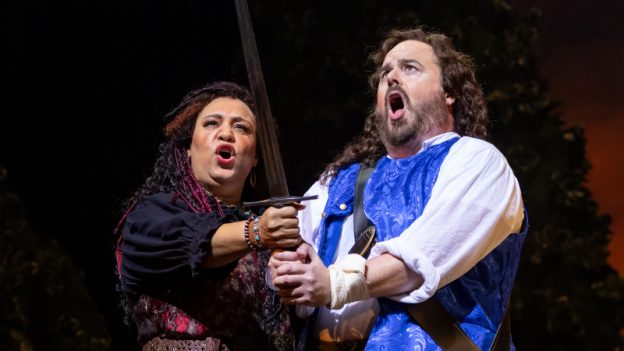
April 17 & 19, 2026
Raleigh Memorial Auditorium
Raleigh, North Carolina – USA
Giuseppe VERDI: Il trovatore
James Meena, conductor; Chuck Hudson, stage director; Giuseppe Verdi, composer; Salvatore Cammarano and Leone Bardare, librettists. Cast: Andrew Manea (Count di Luna); Jonathan Burton (Manrico); Deborah Nansteel (Azucena); Rebecca Krynski Cox (Leonora); Ricardo Lugo (Ferrando); Francis Bushman (Inez); Jacob Cortes (Ruiz); Thomas M. Keefe (Old Roma).
Christopher Hill | 23 APR 2026
Il trovatore is a staple of nineteenth-century Italian opera and therefore of opera houses everywhere. An ambitious Sarasota, Florida, production of it was reviewed on this site just last month. The North Carolina Opera production extends the life of scenery created for that recent Sarasota one. It turns out to be scenery both sensually attractive and economically practical, scenery that locates the action in some kind of past Verdi imagined rather than on a spaceship, in an automobile plant, on an iceberg, or during the Roaring Twenties, as so many recent productions do. It would be interesting to compare scenery in the productions of Il trovatore being mounted in Munich this month and in Madrid during the entire month of July. (Why not? This is, after all, a story set in Spain.)
Dramatically, Il trovatore does not extend the breakthrough seen in Verdi’s previous opera, Rigoletto. Instead, it is, as it were, the swansong of Verdi’s extension of bel canto opera, a genre epitomized by Rossini, Donizetti, and Bellini. And, indeed, again and again in this opera, Verdi matches Bellini in effusions of lyric genius and Rossini in rhythmic propulsion. At the same time, Il trovatore is the first of Verdi’s mature operas to make a female role absolutely central. (Aïda may be thought of as the culmination of such Verdi works.) Here, the central female is Azucena, whose arias provide the axis that motivates the rest of the plot. In fact, Verdi originally planned to name the opera Azucena. Thus, the opera looks backward (towards Bellini and Rossini) and forwards (towards Aïda) literally at the same time.
Plot is paramount in Il trovatore. Like the Spanish source play, it has more twists and turns than the Monaco Grand Prix. Verdi wanted a chance to depict extreme behaviors, and he did his best to ensure the plot would provide opportunities for music to depict infanticide, jealousy, outrage, suicidal thoughts, revenge, and numerous other dysfunctions of the limbic system typical of Italian opera. Verdi’s first librettist was not quite on board with this plan, but when that first librettist died, Verdi hired a newbie from Naples to revise the plot in accordance with the composer’s own dramatic instincts. Guess what? A hit happened! Verdi’s biggest ever (in his lifetime). Il trovatore was performed hundreds of times all over the world within the first few years of its premiere.
Enrico Caruso, perhaps still the most famous tenor of all time, once opined that all you need for a good performance of Il trovatore is the four greatest singers in the world. Ah, rhetoric! Still, you can see that a hundred-plus years ago, it was well understood that any real-world performance of this opera is likely to rise not quite as far as the opera’s potential. Following Caruso, the most it is reasonable to be hoped for, then, in any regional production, in any country, is a committed performance by singers who, if not one of the “four best in the world,” have voices that communicate the beauty of Verdi’s bel canto vocal writing as well as a pit orchestra that understands how to convey the dynamism of Verdi’s instrumental writing without overwhelming the singers.
Speaking of whom, the North Carolina Opera has in recent seasons recruited slates of operatic stars on the verge of becoming unaffordable (or just becoming affordable again) and mixed these with the best of (typically young) singers from the mid-Atlantic region. In your reviewer’s memory, past results have been impressive. The same casting policy has prevailed in this production, except that one of the four major roles has been given to a “regional” singer (who has also sung in Iowa). Among the singers in this weekend’s performance of Il trovatore:
- Andrew Manea, baritone, as Conte di Luna. Manea this season has previously sung George Benton in Dead Man Walking at the English National Opera, Ford in Verdi’s Falstaff at the Opéra Orchestre National Montpelier Occitaine, and Germont in La traviata (Verdi’s next work after Il trovatore) with the Sacramento Philharmonic & Opera.
- Jonathan Burton, tenor, as Manrico. Burton has been busy the past few years singing many of the major Puccini and Verdi roles at major U.S. regional operas. He will play Pinkerton in Madama Butterfly at the Santa Fe Opera this summer.
- Deborah Nansteel, mezzo-soprano, as Azucena. Nansteel has appeared in multiple roles at the New York Metropolitan Opera and Chicago Lyric Opera. She has previously sung Azucena with Opera Santa Barbara.
- Rebecca Krynski Cox, soprano, as Leonora. Cox is a regional standout who has recently been heard both across the U.S. and at European opera houses in roles ranging from Mozart to Strauss. In September 2024, Cox sang with the North Carolina Opera at its Opera in the Park event. In Il trovatore, the company has entrusted a major role to a regional rising star.
- Ricardo Luco, bass, as Ferrando. Seasoned Puerto Rican Luco has performed well over a dozen roles at the Metropolitan Opera as well as concert engagements with many of the most prominent orchestras.
- Francis Bushman, soprano, as Inez. Bushman is an Afro-Cuban soprano based in Apex, North Carolina. In 2024, she sang a supporting role in Verdi’s Ernani with the North Carolina Opera.
- Jacob Cortes, tenor, as Ruiz. Cortes sang Il marchese d’Obigny, a bass role, in La traviata with the NC Opera in 2023. Cortes is currently transitioning from bass parts to tenor parts.
In performance, it was the men who evoked the most impassioned responses from the packed audience, responses that teased the bravo threshold without quite crossing it. The first was Andrew Manea with his Act 2 aria “Il balen del suo sorriso.” Manea made an excellent Conte di Luna. Handsome and noble on stage, Manea brought substantial dramatic weight to his singing. Consider these major pluses in any performance of Il trovatore. Manea was particularly effective in the opera’s last two acts, during which his character cultivates, more or less constantly, a state of narcissistic outrage. Your reviewer confesses to preferring a slightly narrower baritone vibrato, one more like Sherrill Milnes’ in his prime. But in truth, Manea’s attractive voice sounds as focused as that of virtually any other dramatic baritone I know of these days. And he looks great on stage.
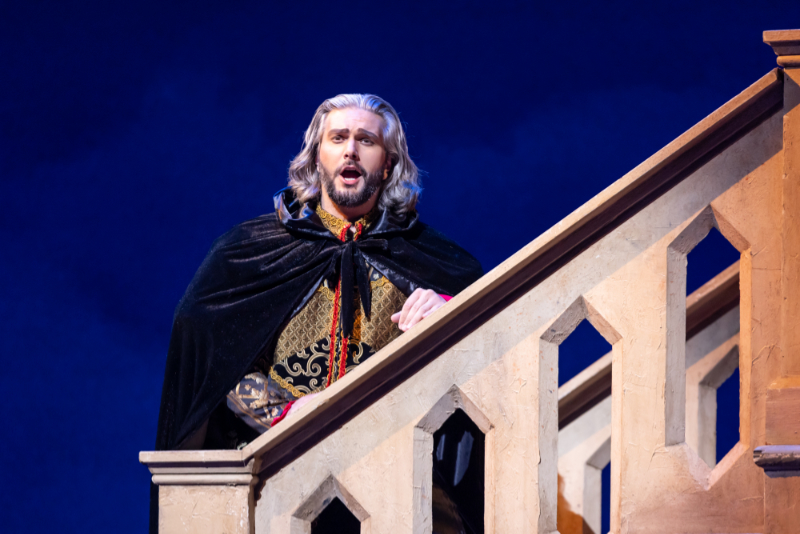
Andrew Manea (Count di Luna) in North Carolina Opera’s ‘Il trovatore.’ (credit: Eric Waters)
The very biggest ovation was for Jonathan Burton after his Act 3 aria “Di quella pira.” And it was deserved; he nailed that cabaletta. Burton’s robust tenor has the testosterone-infused authority and projection necessary for major nineteenth-century Italian roles. He made a convincing Manrico. At this performance, Burton’s soaring lines almost always began quite musically. His high notes were often stirring. There was, however, a tendency to end lines just a bit carelessly, as if he couldn’t see the prompter, or abruptly, as if he were out of breath. Not in his big arias, though. There, the ends of phrases were as carefully shaped as the beginnings. During curtain calls, it was clear that Burton was the audience favorite.
In your reviewer’s (humble, of course) opinion, though, it was the ladies who did the better singing. Once those pesky anvils are out of the way, Act 2, Scene 1, belongs to Azucena. And mezzo Deborah Nansteel proved a superb Azucena, with a lower register that packed a uniquely gutsy punch while remaining delicious to the ear. Her upper register carried easily over the chorus and pit and was dramatically strong. Further, her singing seemed warmed by genuine emotions, including maternal feelings, PTSD, and lust for revenge. No character in the opera was more fully inhabited or artistically rendered. Nansteel’s Act 4 aria was just as finely sung, though there she couldn’t dominate since Verdi puts her character to sleep through much of the climactic action — that is, until the final minute, when Azucena loses everything and simultaneously achieves the revenge she’s been seeking. Your reviewer admits to now being a fan of Deborah Nansteel. Happily, director Chuck Hudson and costume coordinator Denise Shumaker allowed Azucena the dignity of appearing as a traumatized mother rather than a freakish, wild-haired crone, as seen in some productions.
As mentioned, the soprano role of Leonora, vocally the most demanding in the opera, was sung by a local artist, Rebecca Krynski Cox. Quite the challenge, and one that she rose to as the performance progressed. Hers cannot yet be called a dramatic soprano, the type some might consider essential for establishing the role of Leonora in the Act 1 aria “Tacea la notte placida.” But it was a lovely lyric soprano. Like Manea and Burton, she seemed to be warming up at the beginning of this matinee performance. That said, in the ensuing scenes, Cox proved herself capable of the sort of vocal agility bel canto requires, both in its lyrical and coloratura aspects. And in the last two acts, she was undoubtedly a most affecting vocal dramatist as well as effective “coloraturist” — with one exception: her high notes, when sung fortissimo over a chorus, vocal ensemble, and orchestra — those high notes, though pitch perfect, were certainly not tonally perfect. If Cox could make those high notes as exquisite as the rest of her singing, she could go far, for nerves with experience figure out what to do, and Cox’s other technicals (and emotionals) are much more than promising.
Another local artist, Francis Bushman, was equally effective in her more lyrical soprano part. She sang beautifully and acted effectively every time she was on stage. And Jacob Cortes, in his limited role, contributed a robust, authentic Verdi tenor; one would never guess he had recently sung bass parts.
In works of this period, it’s easy to overlook the orchestra, since scoring is oftentimes sparse. But the whole pacing of a performance depends upon the conductor, and the sort of elastic pacing required for Verdi is not nearly as easy to achieve as it may sound when well done. This weekend it was well done, thanks to conductor James Meena; for their part, the orchestra players showed both great sensitivity in the way they accompanied the singers and great vitality in the many rhythmic unisono passages that characterize this score. I would be remiss not to mention the subtle way lighting designer Ross Kolman shifted colors on stage to enhance changes of mood. So often one sees bold contrasts rather than subtle changes; Kolman showed how both are helpful in different ways. In sum, then, this was a superior production of Il trovatore, another gem from one of Southeast’s best and most successful opera companies. ■
EXTERNAL LINKS:
- North Carolina Opera: ncopera.org

Read more by Christopher Hill.



.png)