
May 3, 2026
Kopleff Hall, Georgia State University
Atlanta, Georgia – USA
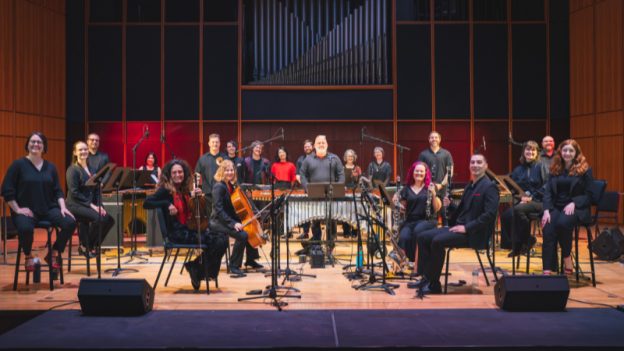
Bent Frequency (Jan Berry Baker, saxophone/metronome; Stuart Gerber, percussion; Jeremy Muller, percussion; Erika Tazawa, piano; Tim Fitzgerald, clarinet; Serena Scibelli, violin; Avery Britt, voice; Amy Petrongelli, soprano/voice; Audrey Vazquesz, voice; Abigail Weller, voice); Chamber Cartel (Laura Gordy, piano; Caleb Herron, percussion; Ariana Warren, clarinet); ensemble vim (Choo Choo Hu, piano; Laura Usiskin, cello); smol ensemble (Amy O’Dell, piano; Justin Greene, percussion; Victor Pons, percussion; Paul Stevens, percussion); Atlanta Contemporary Music Collective (Dominic Ryder, percussion; Bryan Wysocki, percussion); Cole Hankins, sound engineer.
Ella KAALE: perfect lovers (2021)
Ilana WANIUK: arcana minor (2021)
João Pedro OLIVEIRA: Improvisation on a Poem by Augusto de Campos (2012)
Steve REICH: Music for 18 Musicians (1976)
Jon Ciliberto | 19 MAY 2026
Significant events in the cultural life of a city generate from the meeting of artists, community, and artwork. Excitement simmered at Koploff Hall, downtown at Georgia State University as a large crowd filled it, for a rare performance of Steve Reich’s Music for 18 Musicians.
Its importance in American music is well-established. John Adams wrote, “When I first heard Music for 18 Musicians I felt that the experience of pure aural pleasure, so long absent in contemporary classical music, had re-emerged from a long, dark night of the soul.”
Stuart Gerber, Bent Frequency’s co-artistic director (with Jan Baker), explained that assembling an ensemble of this size, and matching the composer’s instrument instructions (especially the four grand pianos) was one challenge, as was finding the 18 or so musicians to rehearse and perform the physically challenging piece, all with scarce (and midstream disappearing) funding. It is difficult to overstate the amount of Gerber’s oversight, planning, and direction that must have been brought to bear.
Fortunately, Atlanta has a rich and energetic group of contemporary classical ensembles (as well as a small but mightily interested audience for such music). Caleb Herron (percussion) expressed to me that the “New Music scene in Atlanta is at an all-time high with no less than six thriving contemporary music ensembles” currently working. This deep well of performers from which to draw was essential to Gerber pulling together this performance. Their willingness to devote time and energy to a challenging work, with no promise of payment, in most cases, is further testament to the golden times in which Atlantans who love contemporary music live.
This year, the 50th anniversary of its premiere, 18 Musicians is being performed across the country. The performance at Georgia State University’s Kopleff Hall brought together musicians from five separate groups, all deeply experienced players and, perhaps more important, agile and up to the challenges.
All of these groups survive by donation. Here are links to their websites, where contributions are welcome:
- Atlanta Contemporary Music Collective: atlcmc.net
- Bent Frequency: bentfrequency.com
- Chamber Cartel: chambercartel.org
- ensemble vim: ensemblevim.org
- smol ensemble: smolensemble.com
Anticipation simmered through the first half of the program, performances of the three winners of Bent Frequency’s annual, and generous opportunity: an open call for scores.
Since 2021, the call has received over 2,500 submissions. This year’s winners were Ella Kaale’s perfect lovers (2021), Ilana Waniuk’s arcana minor (2021), and João Pedro Oliveria’s Improvisation on a Poem by Augusto de Campos (2012). The three works were performed by Bent Frequency, fewer than in previous years, and this due to the programming of the Underscore performances with Reich’s 18 Musicians. I’ve enjoyed previous iterations of Underscore, in part for the variety of ideas and styles.
An interactive program includes bios of composers and ensembles, as well as notes on the works.
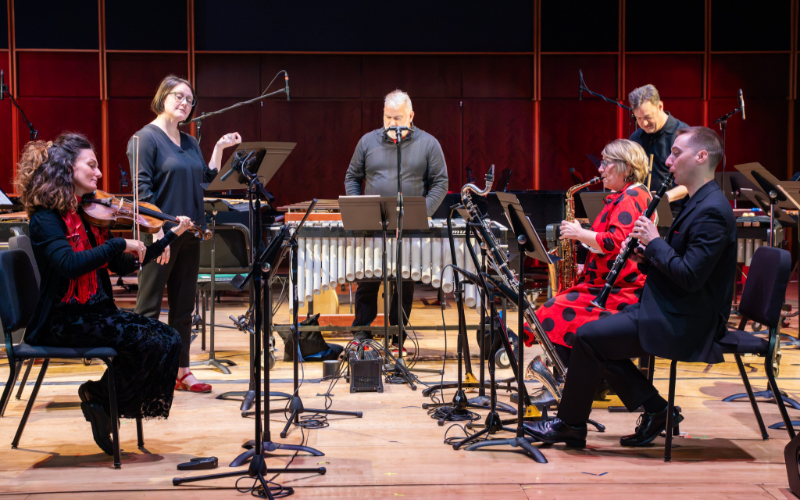
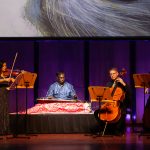
If composing means writing out a plan that puts together ideas and performers through a score to produce a musical result, among the Underscore winners, I found the most successful and compelling was de Campos’ piece. I was somewhat surprised to learn, from Gerber and the program notes, of the extent of improvisation involved. What was performed was a seamless integration of voice and instrument timbre. The notes indicate that the “sounds of the poem mutate in the sounds of the instrumental part.” As an improvisational instruction, it is slight, but if the performers find in it, or create from it, it is enough. How well the performers achieved it! While the work’s text can be (and I think, usually is) recited, Amy Petrongelli (soprano) sang and utilized a range of techniques, lending the whole a kind of “art song” feel.
Concert photo by Ben Garden.
“arcana minor” which Waniuk says “developed from my interest in modular graphic notation, improvisation, and performer agency,” also worked in an improvisational space. Kaale’s “perfect lovers” required one of the performers to improvise by virtue of a hidden conductor, who controlled the metronome, guiding her on stage, “slowly fluctuating it over time so player 2 falls out of sync with player 1.” Following this, the hidden metronome stops, and the score calls for player 2 “to improvise using extended techniques,” an “improvisation that should lack any structure, be completely spontaneous, and have a somewhat macabre tone.”
“perfect lovers” is based on a 1991 artwork of the same name by Félix González-Torres, which consists of two battery-powered clocks that gradually fall out of time with one another.
Initially, I admit that I questioned the work’s total reliance on the ideas (and significant aesthetic pedigree) of another work of art. However, upon deeper consideration, I saw that, first, González-Torres idea was simply a jumping off point and that in a musical setting, the disorientation of mysterious disconnection finds wholly different expression there, and second, as with de Campos’ work, that Bent Frequency’s sensitive and perceptive performers were able to translate this idea from its art historical placement to a present, musical one.
Regarding the improvisation present in all three works, I wondered at the composers’ choice to abdicate to a small or large degree the resulting musical performance to the performers.
The sparseness and overly looseness of the Underscore pieces kept the audience’s ears fresh for 18 Musicians, a work that is both highly composed and lacking empty space, just about completely. This year is both Steve Reich’s 90th birth year and the 50th anniversary of Music for 18 Musicians first performance.
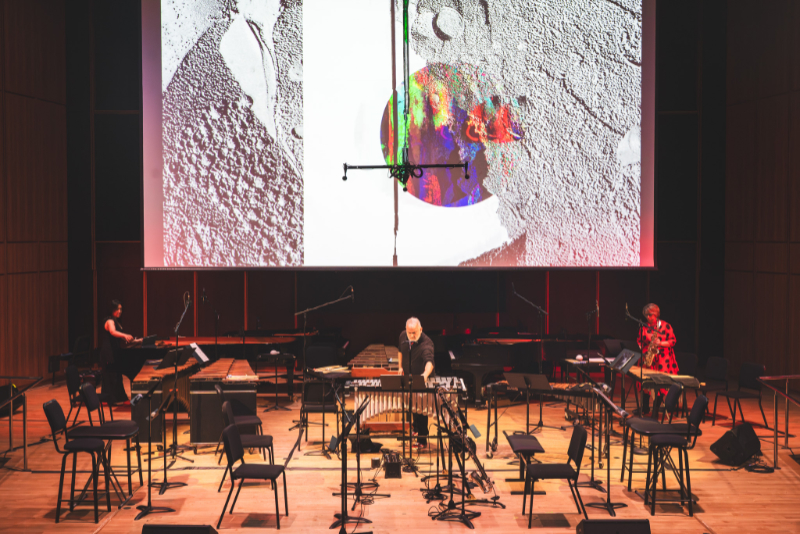
The base of 18 Musicians is the shared pulse, which is played on marimbas and pianos. This helps to unpack Reich’s gnomic comment, “The pulse is the perfect state containing all patterns.” Combined with the pulse are short motifs and breath-length phrases. This “combination of pulsing, ambiguous harmonic rhythm, and subtle variation of rhythmic patterns, all against a background of breath-length phrases, gives me a sense of well-being while I am playing the piece,” wrote Russell Hartenberger, who met Steve Reich in the spring of 1971 and performed the debut in 1976, in Performance Practice in the Music of Steve Reich (2016) [PP].
That the work has a highly emotional, even spiritual (if one is willing) aspect is not obvious from its dry musical-historical place. Minimalism (a term Reich bridled against) is considered austere, experimental, cool, and mathematical — but only to those who approach it from a theoretical point of view. The performers with whom I spoke were all keenly aware of the emotional power of the piece, especially to those playing it. The force of this is in the music itself, in how it requires players to lock into the pulse and become a part of it — to be it rather than to make it, as well as in its structure.
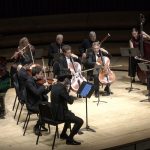
Audry Wright, original violinist for 18 Musicians, stated that “the chordal progression of this series is subtle yet profound, and by the time it circles around and comes to a close, we feel as if we’ve experienced a life-cycle. […] By the time we reach the closing section, we feel that we have gained this deep understanding about life and our existence, but the closing section, again a series of waves as in the beginning, can remind us that all experiences are truly cyclical rather than finite.”
Concert photo by Ben Garden.
Comments from smol ensemble’s Amy O’Dell echoed this, noting how personally meaningful it was to her to perform this piece at this moment in her life, that “the weekend of the Reich performance will be one of the most memorable weekends of my life.” Paul Stevens (percussion) said that he “was sincerely moved by the experience” of performing it.
Shem Guibbory, violinist for the 1976 debut, commented that: “you had to do something with yourself, with your spirit, and with your body, something that was way, way beyond the notes. […] Divine Spirit has to move through your form.” (PP) Stevens told me that “one of the pianists backstage joked that the piece is a cult.”
All of the performers I spoke with expressed how important the community of musicians was to making the performance happen. O’Dell called it “the best representation of this community.”
The performers described (and it was obvious to the observer) how they relied on one another onstage for cueing, and I loved seeing the musicians grooving with one another in 2s and 3s throughout the performance. Everyone I spoke with described how much work was required to stay in sync through the piece’s many sections, and all expressed the importance of Cole Hankins, who managed the sound. This included balancing the acoustic and amplified sounds and providing in-ear monitoring for the performers.
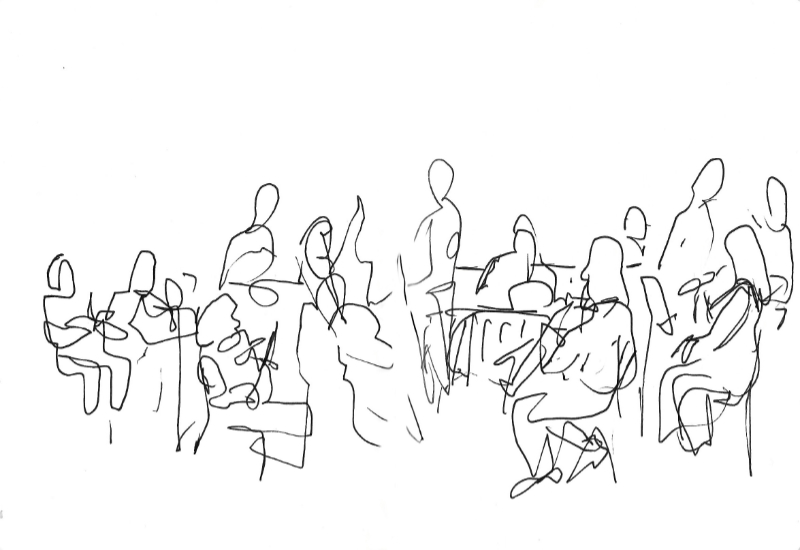
Amy O’Dell, pianist, noted the challenges of performing a work involving so many players without a conductor, and simply of hearing one another across the entire stage in order to hit cues accurately. Stevens mentioned to me that “finding balance within the group became much easier once microphones and monitors were in place.” Earlier performances of the piece lacked sophisticated audio technology, but even with it, visual cues amongst the players are crucial. From the audience, it was easy to see the myriad “conversations” by head nods, eye contact, and so forth. O’Dell noted how she “often would look around, listen to, and lock in with different players.”
During the rare instances when I wasn’t absorbed utterly in listening, I noted other evidence of the deep commitment of the performers to the work. As a crucial maraca entry neared, I saw Stevens gently lift his two maracas, cradling them like delicate eggs, and then hitting perfectly their transition into the next section of the cycle. The effect of seeing the concentration and then — like that — hearing the entire ensemble shift smoothly was very powerful. Stevens described this moment to me, embracing the spiritual quality needed to get there: “…and most IMPORTANTLY find the drishti to relax into the first note. I shed hot tears while listening to the chords change in that section. I was thinking about nothing until I thought about something. Not to get too woo-woo about the whole thing, but it’s sort of yogic. Finding ease instead of tension.”
Following that, I enjoyed seeing how the maraca part was transferred effortlessly across the stage to Justin Greene, and his handling of the maracas cupped, and then, later, seeing Victor Pons holding them differently — cross-wristed. (Gary Schall, who “developed the sound that Reich wanted for [the maracas] with a clear articulation of the beads inside the maraca gourd,” called the maraca part “one of the best ever written for maracas.”)
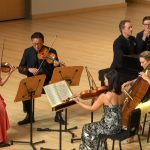
Clarinetist Tim Fitzgerald played the key role in cuing the piece through its 11 sections. He deserves immense praise for his work.
Concert sketch by Jon Ciliberto.
Reich moved from conceptual, abstract works toward the pulse-based works of which 18 Musicians is his most effective and satisfying. This move was somewhat born from his study of Ghanaian drumming.
The music of 18 Musicians and its performance in Atlanta made it astonishingly easy to fall into an intense, present, listening mind for the entirety of the work. Conversations with others in the audience confirmed this, with full credit to the performers.
O’Dell wrote, “To ‘lock-in’ and be in the moment for so long is highly addicting. You never want it to end!” It is fascinating to read the nearly identical words of Audrey Wright, violinist in the 1976 performance: “The trance-like state and the feeling of groove to which Wright refers can produce an “overwhelming sense of comfort,” especially if the performers are all feeling the groove in the same way.” (PP)
I also heap praise on the four vocalists (considered “musicians” per Reich, after some initial complaint with the piece’s earlier title Music for 18 Musicians and Singers) whose parts integrated perfectly with the instruments’ voices.
The form of 18 Musicians is a cycle of 11 chords, with an introduction and a closing that run through these chords more briefly. The “return” of the closing has, after the nearly hour-long, non-stop cycle, brought the spiritual uplift noted by performers and listeners. I was reminded, then, of Plato’s description in the Phaedrus of those lucky few who, attuned to the Forms (or, to music) have glimpsed Beauty once, and later, upon seeing some hint of it, feeling a powerful urge toward it — the “return” of the form in some earthly thing. At the end of Music for 18 Musicians, I felt precisely this sense of incredible uplift and longing, both that the music had ended where it began and wishing that it would continue forever. ■
EXTERNAL LINKS:
- Atlanta Contemporary Music Collective: atlcmc.net
- Bent Frequency: bentfrequency.com
- Chamber Cartel: chambercartel.org
- ensemble vim: ensemblevim.org
- smol ensemble: smolensemble.com

Read more by Jon Ciliberto.


.png)