
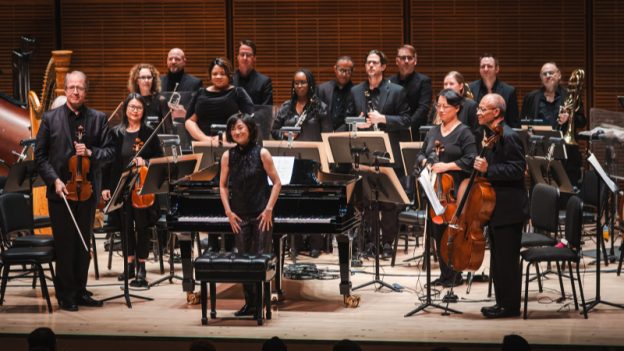
American Composers Orchestra; Rei Hotoda, conductor and piano; Chrystal E. Williams, mezzo-soprano; Felipe Hostins, accordion.
George ANTHEIL: A Jazz Symphony (1955 version)
Duke ELLINGTON: Sophisticated Lady (arr. Morton Gould)
Kurt WEILL & Bertolt BRECHT: Pirate Jenny from The Threepenny Opera (trans. Marc Blitzstein; arr. Felipe Hostins)
John GLOVER & Kelley ROURKE: Right Now
Duke ELLINGTON: Solitude (arr. Morton Gould)
Tonia KO: Her Land, Expanded
Jerod Impichchaachaaha’ TATE: Clans from Lowak Shoppala’
Platoon Classical
Formats: Digital
Release Date: July 24, 2026
Total Duration: 70:12
Giorgio Koukl | 14 JUL 2026
This new release, America in Weimar: On the Margins, by the American Composers Orchestra and its wonderful conductor, Rei Hotoda, with intriguing works by George Antheil, Duke Ellington, Kurt Weill, John Glover and Kelley Rourke, Tonia Ko, and Jerod Impichchaachaaha’ Tate, is a real treasury of partly known and partly new works, rich in color and rhythm.
Album cover art
Out of the seven tracks, the beginning is well chosen; the “bad boy” George Antheil (1900-1959), with his Jazz Symphony here played in the late 1955 version, is a real explosion of energy and surprising mood changes, all this well captured by the orchestra and the astonishing pianist Rei Hotoda. This score is only some eight minutes long, yet it captures so many ideas and literally bursts with energy and joy. It is also a real nightmare for every pianist, brilliantly mastered by this pianist.
Antheil, despite his rather impressive production of film music, beginning with the experimental Ballet mécanique by the legendary French filmmaker Ferdinand Léger made in 1924 until his last score from 1957, The Young Don’t Cry, is still extremely neglected in the current programming; certainly a gap which must be filled soon.
The next track is an arrangement of Duke Ellington’s (1899-1974) “Sophisticated Lady,” a well-polished but somehow sterile version by Morton Gould. This offers the string section of the orchestra a welcome opportunity to demonstrate their rich sound and exemplary bowing technique. The other Duke Ellington piece is the famous “Solitude,” presented, as before, in Morton Gould’s arrangement.
The Threepenny Opera (“Die Dreigroschenoper”) was written and composed in 1928 by Kurt Weill (1900-1950) on the text of Bertold Brecht. The legendary “play with music” premiered on August 31, 1928, at Berlin’s Theater am Schiffbauerdamm, becoming the definitive musical-theater triumph of the Weimar Republic era. The show is a modernized adaptation of John Gay’s 1728 British ballad work, The Beggar’s Opera. The two most famous songs are: “Mack the Knife” (“Die Moritat von Mackie Messer”) and “Pirate Jenny,” featured on this installment.
Despite the difficulties of the first performance, including a plagiarism scandal (Brecht directly lifted entire verses from the medieval French poet François Villon without giving any credit) and last-minute changes, this work has found a solid place in the world of music.
Now the version in this release is in the capable hands of the mezzo-soprano Chrystal E. Williams, with a gorgeous voice and a real peak of this installment, and her husband, the Brazilian accordionist Felipe Hostins, who has written this arrangement. They are a marvelous duo, fully in tune with this music, immensely uplifting the artistic content.
Three first world premiere works follow.
No wonder that the score of Right Now, written by John Glover and Kelley Rourke, in the same lucky constellation of interpreters like Williams and Hostins, immediately can grow in interest for the listener. The whole work, which, at 19 minutes, is the longest score of this release despite its weaker moments, features some lucky points and is skillfully orchestrated. Generally speaking, all four parts called grasshopper, cotyledon, petrichor, and mycorrhyza are well built and marvelously played.
The work of Tonya Ko, titled Her Land, Expanded, is probably the least interesting contribution in this all-American collection. This form of composing, while popular some 40 years ago, today bears the dusty patina of deja-vu.
The final piece by the composer Jerod Impichchaachaaha’ Tate, called Clans, brings fresh winds of a very impressive use of Chickasaw cultural voices, which are supposedly largely unknown here in Europe. Just another interesting contribution of a mixture of cultural influences in a real sense.
What can be generally said of this production?
The artistic quality as well as the technical realization is of very high level. The musical qualities of pianist and conductor Rei Hotoda, accordionist Felipe Hostins, and mezzo-soprano Chrystal E. Williams are a sure guarantee of an outstanding result. ■
EXTERNAL LINKS:
- American Composers Orchestra: americancomposers.org
- Rei Hotoda: reihotoda.com
- Chrystal E. Williams: chrystalewilliams.com
- Felipe Hostins: felipehostins.com

Read more by Giorgio Koukl.



.png)