October 26, 2026
Bailey Performance Center, Morgan Concert Hall
Kennesaw State University
Kennesaw, Georgia – USA
Robert Henry, piano.Franz Joseph HAYDN: Sonata in F major, Hob. XVI:23
John IRELAND: The Island Spell (1912), from Decorations
Robert HELPS: Portrait (1960)
Johann Sebastian BACH: Chaconne in D minor, from Partita No. 2 in D minor for Solo Violin, BWV 1004 (transcribed by Ferruccio Busoni)
Claude DEBUSSY: Suite bergamasque
Claude DEBUSSY: L’isle joyeuse
WMark Gresham | 2 NOV 2026
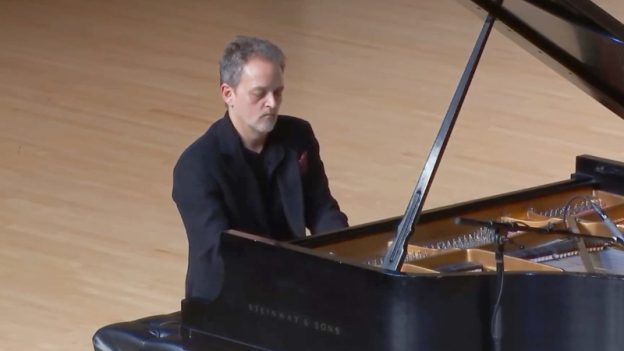
Pianist Robert Henry brought together three centuries of keyboard music in a recital at Kennesaw State University’s Bailey Performance Center on Oct. 26, moving from the Classical-era craftsmanship of Joseph Haydn through the atmospheric writing of early 20th-century British composers to the expansive piano transcriptions of Ferruccio Busoni and the impressionistic sound world of Claude Debussy.
The program offered a study in contrasts, placing works of markedly different character and scale side by side.
The recital opened with Haydn’s Sonata in F major, Hob. XVI:23, a 1773 work that reflects the composer’s gift for combining formal balance with musical surprise. Its three movements (“Allegro moderato,” “Adagio,” and “Finale: Presto”) offer contrasting opportunities for rhythmic vitality, lyrical expression, and keyboard dexterity. The sonata’s outer movements frame a more introspective central section, creating a compact but satisfying dramatic arc.
Henry’s approach was clear and conversational, with particular attention to articulation and the voicing of individual musical lines. The outer movements had a pleasing rhythmic buoyancy, while the central slow movement provided a more measured contrast.
The program then turned to two works from the British piano repertoire: John Ireland’s The Island Spell, composed in 1912 as part of his collection Decorations, and Robert Helps’ Portrait (1960).
Ireland’s music frequently draws on landscape, atmosphere and an introspective strain of English musical expression. The Island Spell, whose score carries an epigraph by poet Arthur Symons, suggests an imagined retreat from the ordinary world. Its subtle textures and fluid, shifting harmonic language contrasted sharply with Haydn’s clearly articulated musical architecture.
Helps, an American composer and pianist, belonged to a considerably different musical generation. His Portrait (1960) offered another shift in perspective. Where Ireland’s music relies on atmospheric suggestion, delicate sonorities, and flowing harmonies, Helps brings a more contemporary harmonic language and a less traditional sense of musical direction; yet the piece remains accessible, expressing its modern character through changes in mood and texture rather than abstract musical complexity.
The first half concluded with one of the most imposing works in the piano repertoire: Johann Sebastian Bach’s Chaconne in D minor, from Partita No. 2 in D minor for Solo Violin, BWV 1004, in Ferruccio Busoni’s transcription.
Bach’s original is a monumental set of variations built around a recurring harmonic pattern. Written for unaccompanied violin, it explores an extraordinary range of musical expression within a single instrument’s limitations. Busoni’s transcription, first performed in 1893, transforms that conception for the piano, expanding the original’s implied polyphony and giving its musical architecture an almost orchestral breadth.
This ambitious arrangement is more than a straightforward transfer from one instrument to another. Busoni uses the piano’s wider range, sustained sonority, and capacity for simultaneous layers of sound to bring out dimensions that remain implicit in the original for solo violin. The result is a sweeping, almost orchestral sonority, with broad chordal passages and expansive keyboard writing that make full use of the piano’s expressive and dynamic range, while retaining the contrapuntal foundation of Bach’s music.
Henry brought considerable energy to Busoni’s expansive conception of the Chaconne, moving between its massive chordal statements and passages in which individual melodic lines emerge from the dense texture. These contrasts gave the performance much of its dramatic character. Rather than allowing the work’s formidable sonorities to become an undifferentiated display of pianistic power, Henry shaped the variations through changing weight, texture, and intensity, building toward the imposing return of the opening theme.
After intermission, Henry turned to Debussy’s Suite bergamasque, a four-movement work that blends the forms and dances of an earlier musical era with the more fluid harmonies and subtle colors of impressionism. Composed in the 1890s and revised before its 1905 publication, the suite looks back to Baroque traditions while reflecting Debussy’s emerging musical language, in which shifting harmonies and nuanced changes of texture expand the expressive possibilities of traditional forms.
The four movements formed a sequence of contrasting characters, and Henry gave each its own place within the larger design. The opening “Prélude” set the music in motion, while the “Menuet” brought a more measured, courtly character. In the familiar “Clair de lune,” Henry brought out the layered voicing with care, allowing the melody to sing above the shifting accompaniment. His pacing gave the movement room to unfold without losing its underlying sense of motion. The concluding “Passepied” restored a lighter, more animated character, its buoyant rhythm and nimble passagework bringing the suite to an energetic close.
Debussy’s L’isle joyeuse brought the program’s principal works to a conclusion. Composed in 1904, the work is among the composer’s most exuberant piano compositions. Its shifting harmonies, brilliant passagework, and surging rhythmic energy evoke an imagined landscape of movement and celebration. The music demanded both considerable virtuosity from Henry and the ability to maintain continuity through its rapidly changing textures.
As an encore, Henry offered Frédéric Chopin’s Étude in A-flat major, Op. 25, No. 1, often called the “Aeolian Harp.” Its flowing, arpeggiated accompaniment and singing melodic line offered a striking change of scale after the brilliant demands of Debussy’s L’isle joyeuse. The étude’s apparent ease conceals considerable technical control, requiring the pianist to sustain a lyrical line above continuously moving figures. It was a graceful final turn, bringing the evening’s exploration of piano color and texture to a more intimate close.
Rather than following a single historical narrative, the program invited listeners to consider how composers across different periods have approached the keyboard’s expressive resources. It also placed the pianist’s interpretive responsibilities in clear view: the need to move between stylistic conventions, distinct musical personalities, and widely differing demands of touch, color, and scale. ■
EXTERNAL LINKS:
- Robert Henry: roberthenry.org
- Dr. Bobbie Bailey School of Music, Kennesaw State University: campus.kennesaw.edu

Read more by Mark Gresham.