

December 10, 2021
Bach’s Lunch Series
“Eternal Love Triangle: Music of Clara & Robert Schumann and Johannes Brahms”
First Presbyterian Church of Atlanta
Presented by Emory Chamber Music Society of Atlanta & Concerts @ First
Jessica Wu & David Coucheron, violins; Yinzi Kong, viola; Julie Coucheron & William Ransom, pianos
Clara SCHUMANN: Three Romances, Op. 22
Robert SCHUMANN: Violin Sonata in A minor, Op. 105
Johannes BRAHMS: Sonata in F minor, Op. 120 No. 1
Giorgio Koukl | 13 DEC 2021
On Friday at noon, yet another fascinating chamber music concert by Emory Chamber Music Society of Atlanta took place at First Presbyterian Church of Atlanta.
This time, the engaging premise was the juxtaposition of two heavy-weight romantic composers, Robert Schumann and Johannes Brahms, versus Clara Schumann, until recently rather neglected and surely less present on the world musical stage. It might be due to the unhappy words of Clara Schumann: “women should not compose”; it may be caused by the general negative attitude towards “woman composers” which is, fortunately, changing over recent decades. But, to name only a few, extremely interesting music by, let’s say, Kaprálová, Boulanger, or Bacewicz, only now gets its deserved place in history.
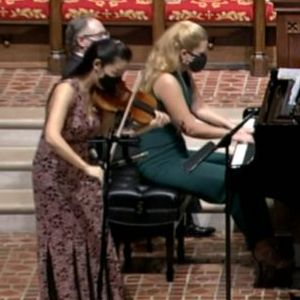
Jessica Shuang Wu and Julie Coucheron (FPCA)
“You can be rightfully pleased with what is coming!” announced Clara Schumann self-confidently in late 1855 to the 24-year-old violinist Joseph Joachim upon sending him a copy of the Three Romances, Op. 22. In fact, they continued to perform these three romantic gems for many years. The single Romances are very different in nature, one from another. With the tengle parts named Andante molto, Allegretto: Mit zartem Vortrage, Leidenschaftlich schnell, this music is touching, elegant and very inventive.
Violinist Jessica Schuang Wu and pianist Julie Coucheron delivered an elegant, robust, and quite energetic rendering. They are visibly used to playing a lot together, so there is no such a thing as imprecision. Their dynamic range was well chosen, too.
Robert Schumann (1810-1856) was far less enthusiastic about his late Violin Sonata in A minor, Op. 105 to the point that he preferred writing just a new one from scratch. Today this is quite an incomprehensible evaluation from the composer, even considering that a three movements sonata (“Mit leidenschaftlichem Ausdruck,” “Allegretto,” “Lebhaft”) was for that historical period already a “small” sonata.
The Sonata in A minor was written in Düsseldorf in autumn 1851 when the composer struggled to fulfill the duties of a musical director and was not very happy with his health situation. He was already suffering heavy periods of depression. Nevertheless, it is a perfect example of romantic beauty and well-balanced interplay between the piano and violin. It is actually designed as a sonata for piano and violin, sharing this indication with many other works like “Kreutzer” Sonata by Beethoven.
Violinist David Coucheron and pianist Julie Coucheron were perfectly at ease with this music. Their choice of non-violent sound and a quite classical bow technique together with restraint in fortissimo passages was a winning one.
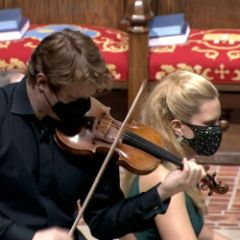
David & Julie Coucheron (FPCA)
Johannes Brahms (1833-1897) already said and announced his farewell from composition only to discover the artful clarinet playing of Mr. Richard von Mühlefeld. He decided to contribute to the relatively small repertoire of this instrument by writing different chamber works and two Sonatas, Op. 120. The version for viola was planned in parallel with the clarinet version, keeping in mind only slight adjustments necessary for the viola, such as a different choice of sharps versus flats and leaving the piano part completely unchanged.
The Sonata in F minor, Op. 120 No. 1 with its four movements (“Allegro appassionto,” “Andante un poco adagio,” “Allegretto grazioso,” “Vivace”) is a perfect example of the melancholy of late Brahms. Written in Bad Ischl only two years before the composer’s death, it is a perfect example of the autumnal, melancholic mood which the composer was probably feeling at the end of his life.
Violist Yinzi Kong and pianist William Ransom, piano, preferred a quite muscular approach, underlining the dramatic side of this music. This was working extraordinarily well in the first and last movement with the help of the lovely viola sound Ms. Kong produced. Accustomed as I am to the clarinet version, I appreciated the melodic expressiveness that a good violist can produce. Both versions, clarinet or viola, have their interesting timbral effectivity, but the viola sound is definitely superior to a clarinet with this dramatic approach.
Needless to underline Mr. Ransom’s perfect piano technique and seemingly effortless touch. They were as perfect as any time I could listen to his performances.
This was ECMSA’s final concert of 2021. Under the guidance of artistic director William Ransom, undoubtedly, many more beautiful performances and exciting music await in the new year. ■

Giorgio Koukl is a Czech-born pianist/harpsichordist and composer who resides in Lugano, Switzerland. Among his many recordings are the complete solo piano works and complete piano concertos of Bohuslav Martinů on the Naxos label. He has also recorded the piano music of Tansman, Lutosławski, Kapralova, and A. Tcherepnin, amongst others, for the Grand Piano label. Koukl has most recently completed recording the solo piano music of Hungarian composer Tibor Harsányi.
(photo: Chiara Solari)
RECENT POSTS



.png)