

December 2 & 4, 2021
Atlanta Symphony Hall, Woodruff Arts Center, Atlanta, GA
Donald Runnicles, conductor; Jacquelyn Stucker, soprano.
Melody EÖTVÖS: The Deciding Machine
Richard STRAUSS: Vier Letzte Lieder
Johannes BRAHMS: Symphony No. 1
Mark Gresham | 3 DEC 2021
Thursday night’s concert marked the return of principal guest conductor Sir Donald Runnicles to the podium of the Atlanta Symphony Orchestra for two sets of programs in one week. Thursday’s program, which repeats Saturday night, features the music of Melody Eötvös, Richard Strauss, and Johannes Brahms.

Australian-American composer Melody Eötvös (credit: Answer Photography)
The concert opened with The Deciding Machine by Australian-American composer Melody Eötvös. Written in 2020, the Grand Teton Music Festival, for which Runnicles is music director, commissioned The Deciding Machine to mark the 250th anniversary of Beethoven’s birth and the centennial of the 19th Amendment of the U.S. Constitution, which guarantees American women the right to vote.
Furthermore, the Festival is located in Jackson Hole, Wyoming. Wyoming’s official nickname is “The Equality State” and the official state motto is “Equal Rights.” In 1869 Wyoming was the first US territory and later state (admitted 1890) to grant suffrage to women. Women first served on juries in Wyoming in 1870. In the same year, Wyoming got its first female court bailiff and the first female justice of the peace in the country. It was the first to elect a female governor in 1924, Nellie Tayloe Ross, who took office in January 1925. Jackson Hole itself, in 1920, became the first town in the nation to be governed by an all-female town council. So it seemed only natural that the Festival’s commission should honor a historically significant woman.
Eötvös drew her inspiration for The Deciding Machine from English mathematician and writer Augusta Ada King, Countess of Lovelace (née Byron; 1815–1852), the sole legitimate child of English poet and peer Lord Byron (George Gordon Byron, the 6th Baron Byron). Ada married William King in 1835. King was made Earl of Lovelace in 1838, whereby she became Countess of Lovelace.
Ada Lovelace was principally known for her work surrounding Charles Babbage’s Analytical Engine, a proposed mechanical general-purpose computer, and was first to recognize its possible applications beyond pure calculation. She was the first to publish an algorithm (computer program) intended for such a hypothetical machine, so many historians often regard her first computer programmer. But other computer scientists and historians reject this, as Babbage’s notes from 1836/1837 contain the first programs for the Analytical Engine.

Painting of Ada Byron Lovelace at the piano, by Henry Phillips.
In her own notes, Lovelace wrote:
This was a significant development beyond previous ideas about the capabilities of computing devices, anticipating implications of modern computing a century before their practical implementation. Babbage himself had focused only on computational capabilities. Lovelace took it to a different level. She described her approach as “poetical science” and herself as an “Analyst (& Metaphysician).”
But then we come to Eötvös’ music itself, which seemed a bit less intriguing than the woman who inspired it. The listener’s reception of The Deciding Machine as pure music mostly depends upon the level at which they focus. On the level of overall gesture, the piece seems rather ordinary. On the level of phrases and their irregularities, more interesting, especially when it comes to punctuation, whether by sharp, percussive chord or by momentary breath (or gasp) in the otherwise relentless stream of semiquavers, a torrent of bits and bytes of serial data, but with some rather colorful and occasionally sparkling moments at times.
But about six minutes in, there was a longing for more material contrast. Some short motifs with a few repeated pitches occasionally offered some relief, shiny little objects that drew attention. But again, on the larger scale, it seemed a single-themed essay that abruptly concluded with what impressed as a half-finished phrase. It felt like it just ran out of sound at the end — or ran out of time.
If I may make a food analogy: My impression is that it is a piece that comes across best if you are more interested in the details of how the dish is made than what it tastes like.

Soprano Jacquelyn Stucker sings the “Four Last Songs” of Richard Strauss. (credit: Raftermen)
The last time the ASO performed the Vier Letzte Lieder (“Four Last Songs”) of Richard Strauss was on March 30 and April 1, 2006. Runnicles was also the conductor then, and the soprano was Christine Brewer. That instance became immortalized on a Telarc disc (CD-80661). Fifteen years later, Runnicles has brought it back to the ASO stage, this time with the fluidly swooping soprano voice of Jacquelyn Stucker.
Stucker possesses an impressive spectrum of color across her vocal range. She has the glistening, fluid top-end necessary for these Strauss songs without feeling overbearing; simultaneously, she has a remarkably substantive lower range that does not disappear beneath the orchestral texture. And what appears an all-important smooth timbral transition between them.
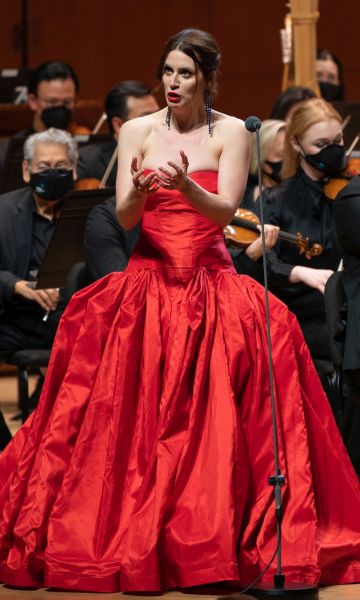
Soprano Jacquelyn Stucker (credit: Raftermen)
In this concert’s Vier Letzte Lieder, Runnicles kept the orchestra well in balance with Stucker without losing expressiveness.
These songs proved the highlight of the evening.
If there was one downside, the imagery projected to the pull-down screen and back wall of the acoustic shell was more distracting from the performance than enhancing; likewise true of the vague imagery projected during The Deciding Machine, which alluded to the movie The Matrix.
What should have been projected on the screen but was not were English supertitles for Vier Letzte Lieder. Nor were there translations in the program booklet — a practice the ASO abandoned some years ago in favor of supertitles when the program booklet publisher demanded more ad space.
This Sunday and Wednesday (Dec. 5 & 8) Stucker returns to the ASO stage to portray Gretel in the ASO’s concert performance of Engelbert Humperdink’s opera, Hänsel und Gretel, again with Runnicles conducting.*
*This paragraph corrects the original post, which erroneously stated that Stucker would portray Hansel. ~ed.]
The program’s second half was one of my own favorites, the Symphony No. 1 in C minor, Op. 68, of Johannes Brahms.
Unlike the more deliberate, paced tempo typically heard, Runnicles took a rather fast and aggressive approach to the first movement’s “Un poco sostenuto” introduction. Much of the symphony came across as more muscular exercise. The third movement (“Un poco allegretto e grazioso”) felt more impetuous than graceful; the fourth, more expressing the moment’s passion than the deliberate deployment of an overarching formal emotional drama. Brahms may be a Romantic-era composer, but played at its best, his music is that of a formally classical mind with a Romantic temperament. So this performance was a little uncomfortably out of scope for my tastes concerning how to approach Brahms, for whose music I have great affinity. Your tastes may differ. ■

Mark Gresham is publisher and principal writer of EarRelevant. he began writing as a music journalist over 30 years ago, but has been a composer of music much longer than that. He was the winner of an ASCAP/Deems Taylor Award for music journalism in 2003.

.png)