

January 12 & 15, 2023
Atlanta Symphony Hall, Woodruff Arts Center
Atlanta, Georgia – USA
January 13, 2023
The Kravis Center for the Performing Arts
West Palm Beach, Florida – USA
Kazem Abdullah, conductor; Tom Borrow, piano.
Louise Farrenc: Overture No. 2, Op. 24
Ludwig van BEETHOVEN: Piano Concerto No. 4 in G major, Op. 58
Jean SIBELIUS: Finlandia, Op. 26, No. 7
Jean SIBELIUS: “Valse Triste” from Kuolema (“Death”), Op. 44, No. 1
Jean SIBELIUS: Symphony No. 7 in C major, Op. 105, “In One Movement”
Mark Gresham | 13 JAN 2022
Thunderstorms and the threat of tornados advanced through Atlanta ahead of Thursday night’s concert by the Atlanta Symphony Orchestra. Fortunately, the turbulent weather exited the city over an hour before the performance began.
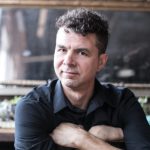
On tap was American conductor Kazem Abdullah, in his first appearance on the ASO podium, and the young Israeli pianist Tom Borrow in his Atlanta debut, teaming up for Beethoven’s Piano Concerto No. 4.
But much like the volatile weather that passed through, there had in recent weeks been a shakeup with the rest of the program.
The ASO had originally planned to play Charles Ives’ Symphony No. 2 in this program. That did not happen. Sibelius and Farrenc replaced Ives.
That was disappointing, to say the least. To say the most would be unprintable.
I was looking forward to hearing this particular symphony by Ives, especially since ASO audiences rarely get opportunity to hear any of his music. The most recent instance was in 2005 when Roberto Abbado conducted Thanksgiving Day. No record of other Ives performed on ASO classical series concerts in the 21st century has come to light as of this writing.
Older audience members will remember that Robert Shaw championed the music of Ives, most notably in a performance by the ASO and its Chorus at the Kennedy Center in Washington, DC, for the inauguration of President Jimmy Carter. Atlanta has been long overdue for a chance to revisit and celebrate that remarkable American iconoclast.
Instead, Abdullah and the ASO opened with the Overture No. 2 of French composer and pianist Louise Farrenc (1804-1875). It’s one of only two overtures in her orchestral oeuvre, which also includes three symphonies and two sets of variations for piano and orchestra. The majority of her compositions are solo piano pieces, chamber works, and some vocal and choral works.
Farrenc is only one of many composers of the 19th century who were successful during their lifetime but whose works were set aside by later generations of performers and mostly forgotten, female and male alike. There are shoals of such compositions out there, ready to be ignored.
The Overture No. 2 itself is that kind of good-but-not-great piece common to Farrenc’s day: An extrovertedly boisterous bit of a barn-burner, well crafted but without much in the way of distinguishing marks except that is written by a woman, which works by itself if your primary interest is in increasing your organization’s DEI score (diversity, equity, and inclusion) and it certainly checks that box, something that the League of American Orchestras has been adamantly pushing in recent years.
More importantly than that, Farrenc’s Overture was well-played by the ASO under Abdullah, who effectively comes across as an extroverted conductor. The performance was better than any of the handful of recordings I’ve uncovered to date.
Next, 21-year-old Tom Borrow joined Abdullah and the ASO for the program’s centerpiece, Ludwig van Beethoven’s Piano Concerto No. 4 in G major, Op. 58, marking the pianist’s Atlanta debut.
Although still a student in Tel Aviv, Borrow is getting considerable attention in Israel and worldwide. In January 2019, with only 36 hours’ notice, he replaced renowned pianist Khatia Buniatishvili in a series of concerts with the Israel Philharmonic Orchestra, performing Ravel’s Piano Concerto in G to critical acclaim with conductor Yoel Levi.
Composed in 1805 and 1806, Beethoven’s sometimes overlooked Piano Concerto No. 4 in G Major stands poised between the classically-oriented Third (1800) and the heroic Fifth Piano Concerto (1809).

Pianist Tom Borrow (credit: Rand Lines)
Borrow leaned toward the more classical approach for the Fourth, setting an intimate tone for his playing in the serene first five bars for the solo piano alone. He played with a clearness and fluid elegance, an ease that is visible in his hand and arm movements as much as it is heard. Technically astute, Borrow doesn’t make an exhibition of it. It comes across as a kind of “effortless effort,” perhaps too cool in places where more fiery drama, variety, and unpredictability might have been desirable.
Borrow’s encore, Rachmaninoff’s Prelude in G♯ minor, Op. 32, No. 12, with its shimmering semiquaver patterns accompanying a broad lyrical melody, afforded some better insight into his playing, freed from the backdrop of the orchestra.
Together, what we heard here between the Beethoven and the Rachmaninoff left the impression that Borrow is an introvert, meaning he is more inclined to focus on inner thoughts and ideas rather than what’s happening externally as the source of his outward expression. That hypothesized, was the pairing of Borrow and Abdullah a mismatch of sorts?

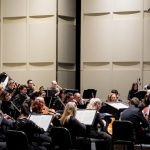
Guest conductor Kazem Abdullah leads the ASO in music of Jean Sibelius. (credit: Rand Lines)
Abdullah does come across as a rather extroverted conductor, as already witnessed in Farrenc’s Overture No. 2. This was also the case even in quieter moments with Beethoven. Abdullah and the orchestra left plenty of room for Borrow’s more thoughtful, inward-gazing expressiveness. Still, there seemed little gradation between the softer dynamics underscoring the solo and some occasions when the orchestra would forcefully burst forth on its own.
This extroverted tendency carried over into the program’s second half, entirely comprised of music by Jean Sibelius, where it worked to somewhat better advantage in Finlandia, though not as well in Valse triste (which could have easily been omitted without harm to tighten the program). The final piece, Sibelius’ one-movement Symphony No. 7, fared well under Abdullah’s baton, achieving some good emotional depth and range in its musical ponderings about life. ■
The Atlanta Symphony Orchestra repeats this program tonight, Friday, January 13, at The Kravis Center for the Performing Arts in West Palm Beach, Florida, and then again on Sunday afternoon, January 15, at Atlanta Symphony Hall.
EXTERNAL LINKS:
- Atlanta Symphony Orchestra: aso.org
- Kazem Abdullah: kazemabdullah.com/biography
- Tom Borrow: tomborrow.com

Mark Gresham is publisher and principal writer of EarRelevant. he began writing as a music journalist over 30 years ago, but has been a composer of music much longer than that. He was the winner of an ASCAP/Deems Taylor Award for music journalism in 2003.

.png)