

May 16 and 17, 2025
Meymandi Concert Hall
Raleigh, North Carolina – USA
North Carolina Symphony; Andrew Grams, conductor; Kirsten MacKinnon, soprano; Leah Wool, mezzo-soprano; Eric Ferring, tenor; Wei Wu, bass; North Carolina Master Chorale, Dr. Alfred E. Sturgis, music director.
Wolfgang Amadeus MOZART/completed by H. C. Robbins Landon: Requiem in D Minor, K. 626
Christopher Hill | 17 MAY 2025
While Mozart was working with his father for the Prince-Archbishop of Salzburg, production of sacred pieces for the chapel was expected, and the young composer produced many such works, including seven masses, nine missa brevae, and more than ten shorter liturgical works. After departing for Vienna, however, he only had occasion to write three more liturgical works. Of these the most famous is his Requiem in D Minor, K. 626. Thanks to a popular stage play and film, the story of its composition is well known in general outline, though much embellished by fictions of varying kinds. The facts, insofar as they can be determined, are these.
In February 1791 28-year-old Franz, Count von Walsegg-Stuppach, an amateur musician, lost his 20-year-old wife. That spring, he commissioned a monument to her, and in the summer, he offered Mozart (through an intermediary) 50-60 ducats (5 to 7 thousand euros in today’s currency) to write her a Requiem Mass. As it happened, Mozart already had a plate full of commissions that summer, including the clarinet concerto, the motet “Ave verum corpus,” and especially the last two operas, La clemenza de Tito for Prague and Die Zauberflöte for Vienna. He accepted the Requiem commission but didn’t really turn his attention to it until October after the operas in particular had been premiered.
During October and November, Mozart’s wife, Constanze, was resident at a spa in Baden. Mozart several times interrupted his work on the Requiem to visit her there. Additionally, in early November Prince Karl Lichnowsky took Mozart to court for non-payment of a debt; Mozart lost. And during those same weeks, Mozart completed yet another commissioned work, the Masonic Cantata, K. 623, duly entering it into his personal catalog on 15 November. Only five days later, on 20 November he took to his bed, quite sick, and remained there until he expired on 5 December. It is not known whether Mozart continued working on the Requiem while bed-ridden.
When Mozart died the Requiem was far from complete. Full payment for the commission depended, of course, on delivery of a completed work. Constanze, with a young mouth to feed and another on the way, desperately needed money, not least because of the recent court judgment against her husband. She therefore got to work quickly on a two-pronged strategy: (a) making sure word got out that her husband had completed the Requiem; and (b) making secret arrangements to have the Requiem completed quickly. Completing the Requiem might have seemed a daunting task, but in fact, it wasn’t. Why? Because liturgical music then, as now, was the most formulaic genre practiced by late eighteenth-century composers, and accordingly the pedagogy of the period placed an emphasis on excellence in the techniques of liturgical music writing.
For the first prong of her strategy, Constanze arranged for the “Introit,” the one completed movement of the Requiem, to be performed at her husband’s Exequiem (an event featuring a Requiem brevis) on 10 December. For the second prong, she engaged an unknown composer (possibly with the 10 December performance in mind) to finish orchestrating the “Kyrie.” She also engaged the composer Joseph Eybler, a young friend of Mozart’s, to complete the rest of the work confidentially.
Mozart had indicated melodies and figured bass for most of the “Sequentia,” the multi-part second movement of the Requiem, and Eybler started turning these indications into a contrapuntal score for orchestra and chorus. This is an AI-level task, and Eybler proved himself to be an excellent student of liturgical counterpoint. When Eybler got as far as the last section of the “Sequentia,” however, the “Lachrimosa,” he saw that Mozart had only indicated a few measures of melody. Writing from scratch a movement that was supposed to be Mozart’s, he felt, was beyond him; he could go no further. Accordingly Eybler returned Mozart’s materials and his own work to Constanze with regrets.
At this point Constanze turned to Franz Xaver Süssmayr, a student of Mozart’s who had helped him with Die Zauberflöte. Süssmayr, unlike Eybler, was willing to take a stab at writing faux Mozart. Even better, Süssmayr’s hand looked (and looks) very much like his teacher’s, which made it possible for Constanze to aver that Süssmayr’s work was that of her dead husband. Eybler’s hand, on the other hand, was noticeably different from Mozart’s, and this may be why Süssmayr copied out Eybler’s earlier work, in the process revising the counterpoint and orchestration to his own taste (or his sense of Mozart’s practices).
Constanze had two copies of the completed Requiem manuscript made. One was sent to the King of Prussia, for the celebration of whose coronation La clemenza de Tito had been written. One may guess she hoped the king would be moved to express his thanks in coin. That done, in February 1792 the Mozart/Süssmayr manuscript was delivered to Count von Walsegg-Stuppach in time for the anniversary of his wife’s death. Unquestionably, Süssmayr had helped Constanze out of a tight spot and, furthermore, had done so nobly, particularly in the quality of his “Lachrimosa,” “Benedictus,” and “Agnus Dei,” which cleverly segues into a recap of Mozart’s own music for the final “Communio.” Perhaps it was out of gratitude that Constanze named her sixth child Franz Xaver when he was born in July 1792.
A bit messy that story, isn’t it? What with all the grubbing around for money, the deception, and the rush to complete a working score. Well before the end of the eighteenth century, Constanze made a deal with Mozart’s first biographer, and in interviews with him she let the cat out of the bag regarding Süssmayr’s contributions to the Requiem. Almost immediately some Mozart lovers started finding fault with the quality of Süssmayr’s work. During the nineteenth and twentieth centuries various alternative versions of the Requiem were penned. None, however, ended up replacing the first published version, the one completed by Süssmayr.
In the late 1990s American musicologist H. C. Robbins Landon produced an edition of the Requiem that used then-up-to-date scholarship to hew as closely to Mozart’s own manuscript as possible. In particular Landon believed Eybler’s work to be closer to Mozart’s intentions than Süssmayr’s revisions of Eybler. Thus the Landon score generally restores Eybler’s completions where they exist and turns to Süssmayr only where both Mozart and Eybler are silent. The Landon edition of the Requiem has been warmly received since its publication in 2000, and it is the edition heard this weekend in Raleigh.
Your reviewer was present when Andrew Grams conducted the North Carolina Symphony in Handel’s Messiah in December 2022. It was a lively, informed performance. In the Mozart/Landon Requiem, Grams’ conducting style was animated and easy to follow (writing as someone who has played in an orchestra). Once or twice he became airborne, but more often he was seen crouching to demonstrate the low dynamic level he wished to hear from his players. His conception of the Mozart/Landon Requiem was a sensitive but dramatic one, and it made a strong case for the work of both Eybler and Süssmayr.
The performance featured four strong soloists. Earlier this year soprano Kirsten MacKinnon sang Also Jess in the Metropolitan Opera’s production of Grounded. This was a vocally demanding role, and your reviewer, who admired and enjoyed the overall production, can testify that MacKinnon’s performance was most impressive. Mozart, as mentioned, postponed focusing on the Requiem while writing his two last operas. While nothing in the Requiem is remotely like the Queen of the Night’s aria in Die Zauberflöte, the overall writing of the soprano part includes operatic elements, and MacKinnon made the most of these, whether they call for soaring, angelic high notes or a heartfelt but restrained mezzo voce.
She was paired on the conductor’s left side with tenor Eric Ferring, who has sung in Donizetti’s Lucia di Lammermoor, Mozart’s Die Zauberflöte, and Puccini’s Turandot at the Met. Ferring has a penetrating tone and excellent projection. Whether a voice like his is the most appropriate option for the Requiem your reviewer cannot say for sure, but he can report that Ferring used his excellent instrument with both modesty and sincerity in the liturgical context of the Requiem.
On the conductor’s right side were paired the alto and bass soloists. Mezzo-soprano Leah Wool previously sang Mozart’s Requiem with the Nashville Symphony. She also joined with Andrew Grams for the 2022 Raleigh Messiah. Based on her Friday performance, Wool’s is an attractive soubrette voice within its alto tessitura. It blended well, sometimes perhaps too well, with the other voices. Her chest tones and stage deportment are most attractive. Through no fault of her own, though, many of the Requiem’s more prominent alto passages fall in its lower register, where projection is more difficult.
Bass Wei Wu sang Gounod and Puccini at Los Angeles Opera earlier this season, and in 2023/24 he created the role of Köbun in Santa Fe Opera’s production of The (R)evolution of Steve Jobs. Previously he sang Mozart’s Requiem with the Kansas City Symphony. Wu has cultivated a comfortable bass with a rich and most attractive tone and unforced projection. He demonstrated a sensitive and seasoned musicality throughout the Requiem, so that when, for instance, the trombone solo in the “Tuba Mirum” stole the spotlight from his extended solo, it was clear that Wu was the better musician and that Grams, the conductor, had likely erred on balances here.
Particular praise should be accorded chorus music director, Alfred E. Sturgis and of course the North Carolina Master Chorale itself, which indeed performed masterfully. Fugues and fugatos are abundant in the Requiem, and choral textures in performance were always clear and balanced, making the counterpoint effective and often powerful. Dynamics were well judged and nuanced, whether in the drama of the “Introit” or the numinous beauties of the “Hostias.” In the “Confutatis” one finds not only drama, but some of the most striking chromatic harmonic progressions in all of Mozart, which the chorus presented with great sensitivity and secure accuracy.
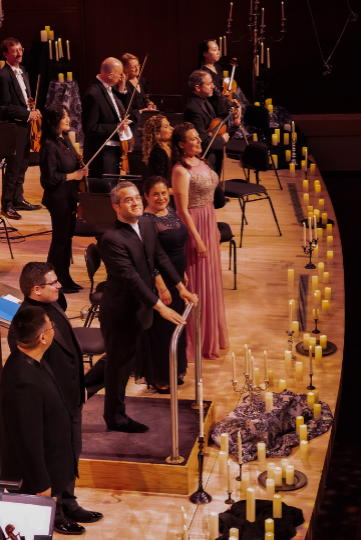
From lower left: Wei Wu, Eric Ferring, Andrew Grams, Leah Wool, and Kirsten MacKinnon. (credit: John Hansen Photography
The evening was advertised as a candlelight Requiem, not unlike a candlelight Christmas service. The place was packed. Even the uppermost boxes seemed fully occupied, something I can’t recall seeing during concerts of music by composers Tom Hulce hasn’t played. The audience for the season finale was remarkably young, with a median age that couldn’t have been over 45. It was really quite touching to be part of this audience, which chose Mozart’s response to death over many other concurrent entertainments in downtown Raleigh and which, during a performance lasting an hour, coughed no more than twice. Several children sat near your reviewer, and they were patient and well behaved—unlike your reviewer, who was constantly scribbling and resetting his stopwatch.
Upon entering the auditorium, one indeed saw candles arrayed across the front of the proscenium. They did not flicker since they were faux candles, but they provided a certain hushed and retro ambience to the theater for a bit, namely until it became time for the music to be played. Then brilliant overhead stage lights came on to help orchestral players and chorus members read their parts. The candles subsequently appeared somewhat silly. But this is of course subjective; your reviewer is surely more of a curmudgeon than the average audience member.
At the end of the “Communio” (the last part of the Requiem) the audience remained silent for maybe ten to fifteen seconds, a surprisingly long time. Perhaps they didn’t know the piece was over. Or perhaps they felt that one is not supposed to applaud performances in a liturgical context, even when it occurs in a concert hall. When a few brave people started clapping, the rest of the auditorium followed suit with enthusiasm. Shared experiences like this bring out the best in a community. ■
EXTERNAL LINKS:
- North Carolina Symphony: ncsymphony.org
- Andrew Grams: andrewgrams.com
- Kirsten MacKinnon: kirstenmackinnon.com
- Leah Wool: fletcherartists.com/leah-wool
- Eric Ferring: ericferring.com
- Wei Wu: weiwubass.com

Read more by Christopher Hill.


.png)