
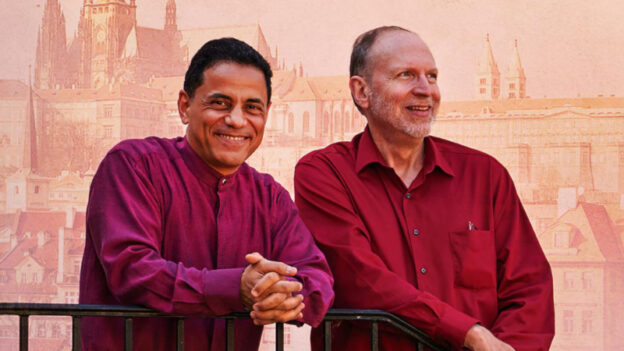
Steven Gross horn; Pascal Salomon piano.
Jaroslav KOFROŇ: Sonatina for Horn and Piano
Klement SLAVICKÝ: Musica per Corno solo
Václav NELHÝBEL: Scherzo Concertante
Francesco Antonio ROSETTI: Concerto for Horn in E flat major C49/K III:36
Bernhard KROL: Laudatio
Franz STRAUSS: Nocturno, Op. 7
Navona NV6733
Formats: Digital
Release Date: May 23, 2025
Total Duration: 56:45
Giorgio Koukl | 13 FEB 2025
Hornist Steven Gross and pianist Pascal Solomon have released a refined, intriguing program on Navona Records entitled Soundscapes for Solo Horn by Czech & German Masters.
It is certainly true that the repertoire for horn is not enormous, not to speak about solo horn pieces. Nonetheless, this limitation allows us to explore composers who would not usually appear easily on a CD.

NV6733 (click to enlarge)
It must be said right from the beginning that both musicians are of top quality, perfectly mastering all the technical difficulties and displaying a rare quality nowadays: elegance.
Let us take the opening piece: the three-movement Sonatina for Horn and Piano by Jaroslav Kofroň (1921–1966) is certainly not as well-known, despite the composer having a prominent place in Prague’s musical life.
He was a composer, music theorist, and educator whose work had a significant influence on mid-20th-century Czech music. His contributions spanned both theoretical instruction and composition, reflecting a deep engagement with the musical traditions.
There are not many recordings of it that precede this CD, and the one generally regarded as the leading one, played by hornist Přemysl Vojta and pianist Tomoko Sawano, is certainly inferior in many aspects.
Especially the last movement, “Allegretto,” with its duration of less than three minutes, is a real firework of precision and perfect phrasing.
A short piece for solo horn follows.
Written by the well-known composer Klement Slavický in 1988, Musica per Corno solo is a quite interesting work that reflects his deep connection to Moravian folk traditions and his commitment to exploring the expressive capabilities of solo instruments. Composed as a gift for his horn-playing grandson, it certainly strives to overcome the limitations of a solo instrument through refined playing techniques.
Despite the very good rendering by Mr. Gross, the music is probably the weakest part of the entire disc.
Some very intriguing scores follow. Written by Václav Nelhýbel (1919–1996) and titled Scherzo Concertante, this horn and piano piece is a miniature, with an approximate duration of three minutes, yet it is very expressive.
The rendering by both artists could not be better. It is a true joy to listen to this refined score. The question is why the composer has not chosen to develop it fully as a sonatina. It could have entered right into the core repertoire of every horn player.
As the excellent booklet explains, the name of Francesco Antonio Rossetti, also known as Franz Anton Rössler or Růžička, is that of a composer originally from Northern Bohemia. Rosetti received his early education from the Jesuits in Prague. He adopted the form “Antonio Rosetti” before 1773, a common practice among composers seeking broader European recognition. In 1773, he joined the Hofkapelle of Prince Kraft Ernst of Oettingen-Wallerstein in southern Germany, where he advanced from a violone player to Hofmusikus and eventually Kapellmeister by 1786. Under his leadership, the Wallerstein court orchestra gained acclaim, particularly for its exceptional wind players. Today, dozens of scores survive, mostly for wind instruments, and the Concerto for Horn in E flat major is certainly one of those.
It has three movements: “Allegro,” “Adagio non tanto,” and “Allegretto non troppo.”
There are no surprises in this music. Including the version with a piano instead of an orchestra is probably not a happy idea, but more than necessary in view of such a lack of intriguing horn music. This could be a nice input for composers of today: provide more scores for this instrument.
Bernhard Krol (1920–2013) was a distinguished German composer and hornist celebrated for his extensive contributions to brass and sacred music. His Laudatio from 1966 is an unaccompanied horn solo that has become an important part of the horn repertoire. The piece draws inspiration from the Gregorian chant “Te Deum Laudamus,” exploring themes of introspection.
The rendering of Mr. Gross is magnificent, surely one of the most interesting among the many existing ones.
The last piece on this CD is Nocturno Op. 7, written by Franz Strauss. Composed in 1904, it was an important work in the Romantic horn repertoire. As a virtuoso hornist and the father of composer Richard Strauss, Franz Strauss conceived this piece to highlight the horn’s lyrical and expressive capabilities. It is surely the best way to give one more opportunity for both musicians to showcase all their capabilities in this remarkable CD. ■
EXTERNAL LINKS:
- Steven Gross: stevengrosshorn.com
- Pascal Salomon: pascalsalomon.com

Read more by Giorgio Koukl.

.png)