
Mark Gresham | 13 AUG 2025
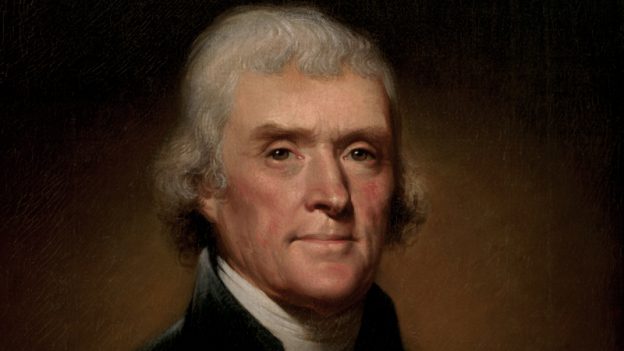
Thomas Jefferson, the primary author of the Declaration of Independence and the third President of the United States (1801–1809), was not only a statesman, architect, and philosopher but also a dedicated violinist whose love for music resonated through his life.
Describing music as the “favorite passion of my soul,” Jefferson’s engagement with the violin offers a window into the rich musical culture of early America, where European classical traditions mingled with local vernacular sounds. From the parlors of Virginia plantations to the concert halls of Paris, Jefferson’s musical world was shaped by the dynamic cultural scene around him, making his story a compelling element in the evolution of American music.
Jefferson’s passion for the violin began in childhood, nurtured by the musically inclined Virginia gentry. He owned at least three violins over his lifetime, each with its own story. In 1768, he purchased a Cremona violin, possibly crafted in the school of Nicolò Amati, a prized instrument nearly lost in the 1770 Shadwell fire but saved by an enslaved individual. In 1771, Jefferson acquired a violin from his cousin John Randolph of Williamsburg, a transaction sealed with a gentleman’s agreement involving books or the instrument’s transfer upon Randolph’s departure for England in 1775. Finally, in 1786, while in Paris, Jefferson bought a portable “dancing master’s violin” or pocket viol, ideal for travel but less resonant than a standard instrument. These violins were more than possessions—they were companions in his American musical journey.
Jefferson’s skill as a violinist is a matter of debate. Some sources suggest he achieved “serious mastery,” while family accounts describe a “gentlemanly proficiency.” His music library, cataloged by 1783, included challenging works by Arcangelo Corelli, Antonio Vivaldi, George Frideric Handel, and Francesco Geminiani. Jefferson’s annotated copy of Geminiani’s The Art of Playing on the Violin reveals his study of vibrato and other elements of performance technique, indicating he was a highly skilled amateur. Even after fracturing his right wrist in 1786, which curtailed his playing, he continued to purchase strings and repair bows into the 1790s, a testament to his enduring commitment.
The music scene in colonial Virginia was a vibrant tapestry that encouraged Jefferson’s violin playing. Among the gentry, music was a mark of refinement, and plantation homes like Shadwell and Monticello were alive with song. Jefferson’s mother, Jane Randolph Jefferson, played the harpsichord, and his courtship of Martha Skelton, a skilled harpsichordist, involved violin-harpsichord duets that charmed their social circle. Williamsburg, Virginia’s colonial capital, was a musical hub where dancing masters like Cuthbert Ogle taught violin and introduced European repertoire. Ogle’s 1755 advertisement in the Virginia Gazette for violin lessons likely reached the young Jefferson, whose guardian had ties to the instructor.
Public concerts in Williamsburg’s taverns and theaters further enriched Jefferson’s musical world. Events like the 1760 Raleigh Tavern concert featured chamber music with the violin at its core, showcasing works by Handel and Geminiani. These performances exposed Jefferson to professional standards, inspiring his daily practice of up to three hours in his youth.
Jefferson’s diplomatic tenure in Paris as Minister to France from 1784 to 1789 immersed him in Europe’s premier classical music scene, deepening his connection to the violin. At venues like the Concert Spirituel, he heard symphonies and chamber works by Haydn, Mozart, and François-Joseph Gossec, where the violin’s expressive power was on full display. His purchase of a pocket violin in 1786 allowed him to stay musically active despite his busy schedule. Jefferson also expanded his music library, acquiring scores by Corelli, Vivaldi, and others, which he shared with his daughters, Martha and Maria, to cultivate a musical household. His interactions with musicians like piano maker John Broadwood and his correspondence about music’s emotional impact reflect how Paris reinforced his worldview.
Upon returning to America, Jefferson continued to foster music at Monticello and in the early republic’s growing urban centers. In Philadelphia, where he served as Secretary of State, he attended concerts featuring European classical music by composers like Bach and Haydn. At Monticello, he hired European tutors like Francis Alberti, an Italian violinist, to teach his daughters harpsichord and guitar, ensuring the family’s engagement with classical traditions. His granddaughters later played the fortepiano, for which Jefferson purchased an instrument, creating a musical legacy that echoed his own violin playing.
The broader American music scene included folk traditions, with fiddlers playing jigs and reels at social gatherings. These vernacular styles contrasted with Jefferson’s classical repertoire but likely influenced his appreciation for the violin’s role in dance music. His continued purchase of strings suggests he may have blended these traditions in private performances, bridging the elite and popular sounds of early America.
Jefferson’s violin playing reflects the intersection of classical and vernacular music in early America, a period when European traditions were taking root alongside local influences. His dedication to the violin, from his rigorous practice in Virginia to his immersion in Paris’s concert halls, mirrors the era’s growing musical sophistication. Unlike William Billings, whose bold compositions gave voice to American identity, or the Moravians, who enriched sacred music with communal devotion, Jefferson’s contribution was personal yet profound, shaping his family’s musical life and reflecting the gentry’s role in cultivating classical music. His story also sets the stage for Lowell Mason’s later efforts to standardize American hymnody and education, as both men valued music’s power to elevate and educate. ■


Read more by Mark Gresham.


.png)