
September 3, 2025
Bailey Performance Center, Morgan Hall
Kennesaw State University
Kennesaw, GA – USA
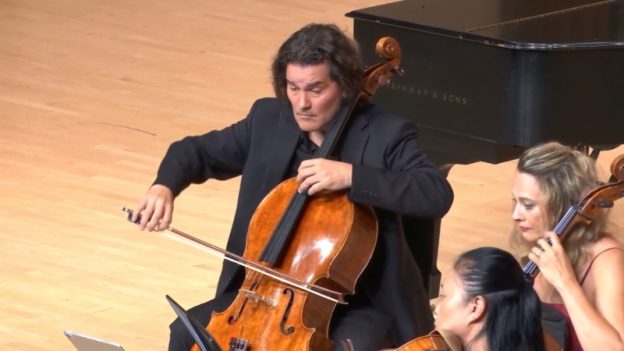
Zuill Bailey, cello (guest artist); Helen Hwaya Kim & Kenn Wagner, violins; Yinzi Kong, viola; Charae Krueger, cello.
Camille SAINT-SAËNS: The Muse and the Poet, Op. 132
Camille SAINT-SAËNS: Cello Concerto No. 1 in A minor, Op. 33
Franz SCHUBERT/arr. Parnas: Arpeggione Sonata in A minor, D.83
Mark Gresham | 9 SEP 2025
Roughly a dozen miles or so northwest of Atlanta’s Perimeter freeway (I-285), Kennesaw State University’s Dr. Bobbie Bailey & Family Performance Center is well within reach for intown metro-area concertgoers. But for locals unwilling to venture into the gridlock of downtown, it’s a rare treat: a suburban jewel of music-making that feels both comfortably intimate and modernly elegant. Part of the Robert S. Geer Family College of the Arts, the Bailey Center’s 624-seat Morgan Hall set an inviting stage Wednesday evening for a recital that combined technical mastery with expressive depth.
While the Bailey Performance Center and the School of Music each bear the name of a longtime benefactor of KSU’s music programs, the spotlight on Wednesday night fell on the guest artist, cellist Zuill Bailey, whose name is coincidentally shared but unrelated. The hall’s intimate acoustics and attentive audience provided the perfect environment for a program that spanned a piano trio by Saint-Saëns, a cello-and-piano version of his First Cello Concerto, and a reimagined Schubert sonata.
Bailey, a Grammy Award-winning soloist known for both virtuosity and expressive nuance, began the evening with Camille Saint-Saëns’ The Muse and the Poet, Op. 132, for violin, cello, and piano (1909), performing alongside violinist Helen Hwaya Kim and pianist Robert Henry.
The trio of musicians navigated the piece’s conversational textures with remarkable ease, balancing the work’s intricate interplay between instruments, with Bailey’s cello resonating warmly alongside Kim’s nimble violin and Henry’s responsive piano, always attuned to the shifting currents of the ensemble. Phrasing and dynamic contrast were highlighted without fanfare, creating a musical dialogue that felt both spontaneous and thoughtfully structured.
Saint-Saëns composed The Muse and the Poet as a piano trio in 1909, then quickly reworked it for violin, cello, and orchestra—the version most often encountered in concert halls. Wednesday’s performance marked what was said to be Bailey’s first time tackling the rarer trio version.
Likewise, the evening’s centerpiece, Saint-Saëns’ Cello Concerto No. 1 in A minor, Op. 33, is most familiar in its orchestral form, though performances with piano reduction have long been a practical solution in settings where a full orchestra was unavailable.
The concerto placed Bailey squarely in the spotlight. From the opening notes, he projected a commanding tone, blending technical precision with expressive sweep. Henry’s responsive accompaniment provided a steady foundation, giving Bailey the freedom to shape phrases with elegance and subtlety.
Rather than following a traditional multi-movement concerto form, Saint-Saëns crafted the work as a single continuous movement, divided into three interconnected sections. The piece’s demanding passages seemed effortless in Bailey’s hands, yet the performance never veered into mere display; careful attention to dynamics and expressive shading made each phrase both thrilling and emotionally compelling. In the lyrical middle section, Bailey’s warm, singing tone was particularly captivating, drawing the listener fully into the music’s expressive arc.
Following intermission, the program turned to Franz Schubert’s Arpeggione Sonata in A minor, D. 821, arranged for solo cello and string quartet by American cellist Cicely Parnas. Joined by Kim and Kenn Wagner on violins, Yinzi Kong on viola, and Charae Krueger on second cello, Bailey, as solo cellist, explored Schubert’s lyrical lines in a new ensemble context.
Composed for piano and arpeggione—a viol-like six-stringed fretted instrument tuned like a guitar but bowed like a cello—this string quintet arrangement preserves the sonata’s inherent melancholy and melodic richness while introducing added warmth, depth, and textural variety. Bailey’s solo passages were expressive without ever feeling indulgent, while the quartet provided attentive, supportive lines that highlighted the sonata’s contrapuntal interplay. From delicate pizzicati to sustained, lyrical passages, details were rendered with clarity, allowing the work’s subtle beauties to shine without eclipsing the cello’s central voice.

Clockwise: Kim, Wagner, Bailey, Kong, and Krueger performing Parnas’ arrangement of Schubert’s Arpeggione Sonata. (uncredited)
Bailey’s performance throughout the evening demonstrated both his versatility and his instinctive musicality. Whether in intimate chamber settings or as a soloist, he demonstrated an ability to inhabit the music fully, balancing technical mastery with interpretive insight. Saint-Saëns’ more formally structured works and Schubert’s lyrical reinterpretation were both served by his careful attention to tone, phrasing, and dynamics. His musical colleagues contributed performances of equal sensitivity, making the evening a cohesive display of artistry.
Morgan Concert Hall itself enhanced the experience. Its acoustics allowed every note to resonate fully, while the hall’s intimate scale fostered a palpable connection between performers and audience.
The concert also underscored the broader role of the Bailey School of Music in bridging professional artistry and academic life. By hosting artists of Bailey’s stature alongside faculty musicians, KSU offered students and the local community direct exposure to high-level performance practices. The evening highlighted the value of such programs in cultivating both an appreciation for classical music and active creative engagement among accomplished musicians. ■
EXTERNAL LINKS:
- Zuill Bailey: colbertartists.com/artists/zuill-bailey
- Bailey Performance Center, KSU: calendar.kennesaw.edu/bailey_performance_center

Read more by Mark Gresham.


.png)